
Non-FictionSelf-HelpRequest Skills
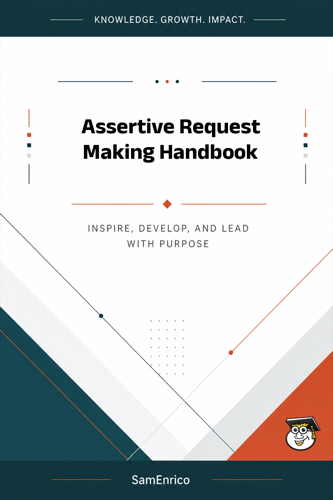
Assertive Request Making Handbook eBook
Teaches asking for what you want clearly and respe
Teaches asking for what you want clearly and respectfully.
Formats
Free sample
Chapter 1: The Silent Epidemic--–- On a Tuesday afternoon in Chicago, a woman named Sarah sat across from her husband at the kitchen table. She had not asked for help with the dishes in 847 days. She had counted. Not obsessively, she told herself. Just accurately.
Every night, she washed, dried, and stacked while he scrolled through his phone. Every night, she swallowed the words “Could you please help me?” because they felt too heavy, too needy, too much. And every night, she went to bed a little more tired and a little more resentful. On paper, their marriage was fine. No screaming.
No infidelity. Just 847 nights of unasked-for help, hardening into a fossil of silent bitterness.This is not a story about dishes. This is a story about the most expensive thing you will never buy: the cost of not asking.You are about to learn that the gap between what you want and what you get is almost always filled by one thing—your willingness to ask. Not your intelligence. Not your charm.
Not your hard work. Your willingness to form a sentence that begins with “Would you be willing to…” and ends with a question mark. That single skill, more than any other, predicts your income, your relationship satisfaction, your career trajectory, and your mental health. And yet, most people would rather endure almost anything than make a direct request.This chapter is called The Silent Epidemic because that is exactly what we are facing. Millions of adults walking around with fully formed sentences stuck in their throats, choking on words they were told as children were rude, selfish, or unnecessary.
The epidemic has no visible symptoms. You cannot spot it on an X-ray or diagnose it with a blood test. But you can see it in the marriages that die by a thousand unasked questions. In the careers that stall because someone never asked for the raise. In the friendships that wither because no one asked for the conversation.
In the parenting relationships where grown children harbor decades of resentment toward parents who “should have just known.”The purpose of this chapter is to convince you, with evidence and stories and uncomfortable self-reflection, that your difficulty with asking is not a character flaw. It is a learned response. And anything learned can be unlearned. By the time you finish these pages, you will understand exactly why asking feels like standing at the edge of a cliff, why your childhood trained you to be silent, and—most importantly—how much you have already paid for every question you never asked. That last part will hurt.
It is meant to. Because the pain of awareness is the fuel for change.The Biology of Silence: Why Your Body Fights You Let us begin with a radical reframe: when you hesitate to ask for what you want, you are not being weak. You are being human. Specifically, you are being a human with a nervous system that has not yet realized we no longer live in caves.Thousands of years ago, human survival depended entirely on social belonging. To be rejected by the tribe meant to be eaten by a predator, to starve in winter, to die alone.
Your brain evolved a simple equation: social rejection equals physical death. That equation was not wrong then. It is wrong now, but your brain did not get the memo. When you consider asking your boss for a raise, your spouse for help, or a friend for a favor, your amygdala—the brain’s smoke alarm—interprets the possibility of “no” as a threat to your very existence. It floods your body with cortisol and adrenaline.
Your heart races. Your palms sweat. Your throat tightens. You feel, genuinely and physically, as if you are in danger.You are not in danger. You are considering a sentence.
But your body does not know the difference.This is the first and most important truth of this book: the fear of asking is not a psychological weakness. It is a biological overreaction. And like all biological responses, it can be regulated. Not eliminated—regulated. You will never stop feeling that flicker of fear before a high-stakes request.
But you can learn to feel it without being controlled by it. The techniques in later chapters (particularly Chapter 12’s Emotional Regulation Toolkit) will give you the physiological tools to calm that alarm. For now, simply recognize that your reluctance is not evidence that you are broken. It is evidence that you are human.The Four Monsters Inside Your Head Before we go any further, you need to meet the four versions of yourself that have been handling requests up until now. I call them monsters not because they are evil, but because they have taken on a life of their own inside your communication habits.
They live in your head, rent-free, running the show while you stand by helplessly.Monster One: The Ghost The Ghost is passive. It does not ask. It hopes. It hints. It sighs dramatically and assumes other people will pick up on the clues.
The Ghost believes that if you have to ask, it does not count. “They should just know,” the Ghost whispers. “If I were in their shoes, I would know. Why don’t they care enough to notice?” The Ghost confuses love with telepathy. It mistakes silence for politeness.
And it lives in a constant state of quiet resentment because the world refuses to read its mind.If you have ever been angry at someone for not doing something you never asked them to do, you have met the Ghost. If you have ever said “It’s fine” when it was very much not fine, the Ghost was speaking. The Ghost’s signature move is the slow burn—weeks, months, or years of accumulated disappointment that the other person never detects because you never gave them a chance to.Monster Two: The Hammer The Hammer is aggressive. It asks by demanding. “Do this.
Now.” “You need to…” “Why haven’t you…?” The Hammer confuses volume with clarity and force with respect. It gets what it wants in the short term but destroys relationships in the long term. People comply with the Hammer out of fear or exhaustion, not generosity. And then the Hammer wonders why everyone seems so distant, so unwilling to go the extra mile.The Hammer’s tragedy is that it often starts as a Ghost. After years of silent hoping, the Ghost finally explodes into a Hammer, swinging wildly at the person who never had any idea anything was wrong.
The Hammer blames others for its own silence. “I shouldn’t have to ask” becomes “You should have known,” which becomes “You never listen,” which becomes a slammed door.Monster Three: The Snake The Snake is passive-aggressive. It does not ask directly. Instead, it coils around the request, squeezing slowly. “Oh, I guess I’ll just do it myself, like always.” “Must be nice to have so much free time.” “No, no, don’t worry about it.” (Said in a tone that means please worry about it very much.) The Snake’s words say one thing; its tone, posture, and facial expression say another.…
This is the end of the free sample. Get the eBook to keep going. Buy now
About this book
Details
- Author
- Morrison Dennis
- Publisher
- SamEnrico
- Language
- English
- Genre
- Non-Fiction, Self-Help, Request Skills
- Released
- 2026-06-10
- Pages (approx.)
- 141
- Available as
- eBook, Audiobook

Read better in the ZLOADR app
Your eBooks on your phone or tablet. Sign in with your SamEnrico account and start reading.
More by Morrison Dennis
 The 7 Breath InductionMorrison Dennis$11.99
 South Korean Seller Amazon USMorrison Dennis$11.99
 Butterfly Transformation VisualizationMorrison Dennis$11.99
 The Loving Kindness for ComparisonMorrison Dennis$11.99
 The Last Broadcast of Radio KryptosMorrison Dennis$11.99
 Understanding Reiter's SyndromeMorrison Dennis$17.99
 Instrumentation EngineerMorrison Dennis$11.99
 Amazon Global vs Jumia GuideMorrison Dennis$12.99
 Concerts Events GuideMorrison Dennis$12.99
 How to Start a Nail Salons BusinessMorrison Dennis$11.99
You may also like
 Hong Kong Handover 1997Dunn Johnnie$11.99
 Zumba For Postnatal Recovery CourseNeal Christian$11.99
 Zumba for BeginnersLadner Nikia$11.99
 YouTube Comment Mining GuideHumes Pandora$12.99
 Worry Box MeditationCarlin Rudy$11.99
 Workplace Stress MeditationNguyen Lynn$11.99
 Workplace Stress and Sleep RepairHawley Ivory$11.99
 Workplace Perfectionism CureDelaney Jeffry$11.99
 Workplace Injustice Anger GuideWallen Isabelle$11.99
 Work Addiction and Burnout LinkGreenwood Ester$11.99
 Women in Yoga and WellnessBeattie Galina$11.99
 Women in Stand Up ComedyChun Evangeline$11.99