
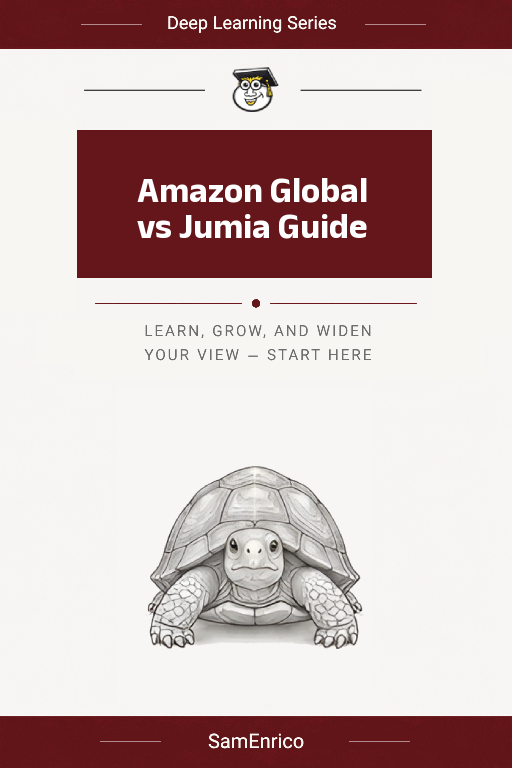
Non-FictionBusiness BriefE-commerce Comparison
Amazon Global vs Jumia Guide
Compare Amazon's global reach against Jumia's Afri
Compare Amazon's global reach against Jumia's African dominance. Market access and customer bases.
Formats
About this book
Free sample
Chapter 1: The Flywheel Paradox...--–- In the annals of business strategy, few diagrams have achieved the cult-like reverence of Amazon’s flywheel. Sketched by Jeff Bezos on a napkin—or so the legend goes—this simple circle of arrows promised a self-perpetuating machine of growth: lower prices attracted more customers, more customers attracted more sellers, more sellers expanded selection, and expanded selection enabled even lower prices. Repeat forever. It is elegant, seductive, and for two decades, it appeared unbeatable.Yet in the bustling markets of Lagos and the dusty roads of rural Kenya, another machine is turning. It does not spin smoothly like Amazon’s flywheel.
It lurches, stutters, and occasionally breaks down. But it turns nonetheless. This is the Adaptive Engine of Jumia, and it operates on a radically different principle: where Amazon asks “How can we make this faster?”, Jumia asks “How can we make this possible at all?”To understand the clash between Amazon Global and Jumia—and more importantly, to decide where to place your bets as a seller, investor, or entrepreneur—you must first understand these two fundamentally different engines of growth. This chapter dissects the architectural DNA of both platforms, revealing why they behave the way they do and why copying one model into the other’s territory would be a catastrophic mistake.The Genesis of Two Giants Amazon launched in 1995 as an online bookstore from Jeff Bezos’s garage in Bellevue, Washington. The United States in the mid-1990s already possessed a robust postal system, widespread credit card adoption, and a legal framework for interstate commerce.
The infrastructure for e-commerce existed; Amazon simply needed to build the software layer on top.Jumia launched in 2012 in Lagos, Nigeria, founded by Jeremy Hodara and Sacha Poignonnec, two former Mc Kinsey consultants. At the time, fewer than 30% of Nigerian adults had bank accounts. Street addresses were inconsistent or nonexistent. The postal system was unreliable. The founders were not building software on top of existing infrastructure—they were building the infrastructure itself, from scratch, while simultaneously trying to sell phones and diapers.This origin story explains everything…
This is the end of the free sample. Get the eBook to keep going. Buy now
Contents
- Chapter 1
- Chapter 2
- Chapter 3
- Chapter 4
- Chapter 5
- Chapter 6
- Chapter 7
- Chapter 8
- Chapter 9
- Chapter 10
- Chapter 11
- Chapter 12
Details
- Author
- Morrison Dennis
- Publisher
- SamEnrico
- Language
- English
- Genre
- Non-Fiction, Business Brief, E-commerce Comparison
- Released
- 2026-06-01
- Pages (approx.)
- 137
- Available as
- eBook, Audiobook

Read better in the ZLOADR app
Your eBooks on your phone or tablet. Sign in with your SamEnrico account and start reading.
More by Morrison Dennis
 The 7 Breath InductionMorrison Dennis$11.99
 Assertive Request Making HandbookMorrison Dennis$11.99
 South Korean Seller Amazon USMorrison Dennis$11.99
 Butterfly Transformation VisualizationMorrison Dennis$11.99
 The Loving Kindness for ComparisonMorrison Dennis$11.99
 The Last Broadcast of Radio KryptosMorrison Dennis$11.99
 Understanding Reiter's SyndromeMorrison Dennis$17.99
 Instrumentation EngineerMorrison Dennis$11.99
 Concerts Events GuideMorrison Dennis$12.99
 How to Start a Nail Salons BusinessMorrison Dennis$11.99
You may also like
 Hong Kong Handover 1997Dunn Johnnie$11.99
 Zumba For Postnatal Recovery CourseNeal Christian$11.99
 Zumba for BeginnersLadner Nikia$11.99
 YouTube Comment Mining GuideHumes Pandora$12.99
 Worry Box MeditationCarlin Rudy$11.99
 Workplace Stress MeditationNguyen Lynn$11.99
 Workplace Stress and Sleep RepairHawley Ivory$11.99
 Workplace Perfectionism CureDelaney Jeffry$11.99
 Workplace Injustice Anger GuideWallen Isabelle$11.99
 Work Addiction and Burnout LinkGreenwood Ester$11.99
 Women in Yoga and WellnessBeattie Galina$11.99
 Women in Stand Up ComedyChun Evangeline$11.99