
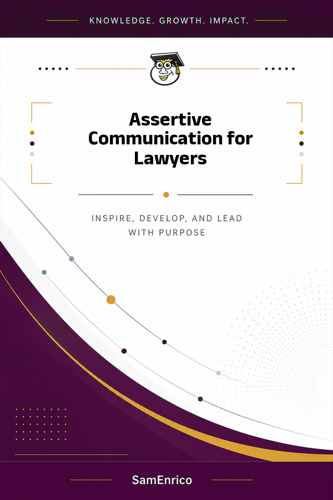
Assertive Communication for Lawyers eBook
Argue cases zealously without alienating judges or
by Riley Greg
Argue cases zealously without alienating judges or juries.
Formats
Free sample
Chapter 1: The Silence That Wins--–- The young prosecutor was winning. At least, that’s what he thought. He had the witness cornered, the contradiction exposed, and the jury’s attention. So why did they look away? Why did the judge sigh?
And why did his own client, seated ten feet behind him, sink lower in her chair with every clever barb he launched?This chapter dismantles the most expensive myth in legal education: the belief that zealous advocacy requires volume, interruption, or personal attack. It reveals the uncomfortable truth that the lawyer who “wins” every verbal skirmish often loses the only battle that matters—the jury’s trust. And it introduces the first and most fundamental tool of the assertive advocate: the strategic use of silence.The Expensive Myth Every lawyer has heard it. From law school mock trial competitions to the whispered advice of senior partners: “Be aggressive. Fight for every inch.
Never let them see you blink.” This advice is not entirely wrong. Zealous advocacy is a sacred duty. But somewhere along the way, “zealous” became synonymous with “loud,” “relentless,” and “combative.”Here is the data point that changed my entire understanding of courtroom communication. Researchers have studied jury decision-making for decades. One consistent finding cuts across every study: jurors do not trust lawyers who interrupt, raise their voices, or launch personal attacks on witnesses or opposing counsel.
When a lawyer behaves aggressively, jurors do not think, “He’s a fierce advocate.” They think, “He’s hiding something,” or “He’s losing control,” or most damaging of all, “He’s mean.”The myth persists because it feels true. When adrenaline floods your system during a heated cross-examination, aggression feels like power. When opposing counsel throws a punch, the instinct to punch back feels like self-defense. But the courtroom is not a boxing ring. It is an operating theater.
The best surgeons do not shout at the patient or swing wildly at the nurse. They are calm, precise, and utterly in control of themselves before they attempt to control the room.Consider the difference between two styles. The traditional aggressive advocate thinks: “I must dominate this witness. I must show the jury I am smarter, faster, and tougher than opposing counsel.” The assertive advocate thinks: “I must reveal the truth. I must be the calmest person in this room.
Every word I speak should make the jury lean in, not lean back.”Which one would you trust with your freedom, your money, or your reputation?The Anatomy of a Courtroom Ambush Let me tell you about a trial I observed early in my career. The case was a civil fraud claim. The plaintiff’s lawyer, a man I will call Mitchell, was known as a “bulldog.” His opening statement was loud, confident, and sprinkled with sarcastic jabs at the defense. The jury laughed nervously at first. Then they stopped laughing.Mitchell’s first cross-examination was a disaster disguised as a victory.
He cornered a defense witness on a minor inconsistency—whether a meeting occurred on a Tuesday or a Wednesday. Mitchell pressed hard. “Isn’t it true, sir, that you have no idea what day the meeting happened? Isn’t it true that you’re just making this up as you go?” The witness stumbled. Mitchell smiled.
He looked at the jury as if to say, “See? I caught him.”But the jury did not share his triumph. Two jurors crossed their arms. One shook her head slightly. Mitchell had won the point but lost the war.
Why? Because the inconsistency was trivial. It had nothing to do with the actual fraud. Mitchell looked like a bully who kicks a dog to prove he is strong. The jury felt sorry for the witness.Contrast that with the defense lawyer, a woman named Carter.
She was soft-spoken, almost quiet. When Mitchell interrupted her, she paused. When Mitchell made a sarcastic remark, she did not respond in kind. She simply waited. And here is the critical insight: the jury interpreted her silence not as weakness but as restraint.Carter’s moment came during the plaintiff’s testimony.
The plaintiff had made an emotional appeal, describing how the alleged fraud had destroyed his small business. The story was heartbreaking. Mitchell rested his entire case on that emotion. Carter stood up for cross-examination. She did not attack the plaintiff.
She did not accuse him of lying. Instead, she pulled out a single document: the plaintiff’s own tax return from the year before the alleged fraud. The business was already failing. The “destroyed” business had been losing money for three years.Carter asked one question: “Sir, this tax return shows a loss of forty-seven thousand dollars in the year before you met my client. Is that correct?” The plaintiff said yes.
Carter sat down. The silence that followed was deafening. The jury did not need her to shout, “You’re a liar!” They concluded that on their own. The defense won a directed verdict.The difference between Mitchell and Carter was not legal knowledge. It was not experience.
It was the understanding that control over oneself precedes control over the courtroom.The First Tool: The Conversational Breath Before we discuss silence, we must discuss the physiological reality of courtroom stress. When you are challenged—when a witness lies, a judge questions your competence, or opposing counsel interrupts you—your brain activates the amygdala. This small, almond-shaped cluster of neurons is designed for survival. It does not distinguish between a saber-toothed tiger and a hostile witness. It triggers the same response: fight, flight, or freeze.In fight mode, you raise your voice, interrupt, and launch personal attacks.
In flight mode, you mumble, withdraw, or concede ground you should hold. In freeze mode, you go blank. None of these are useful in a courtroom. The solution is not to eliminate the amygdala response—that is impossible. The solution is to override it with a deliberate physiological reset.The Conversational Breath is a two-second inhale through the nose, followed immediately by speaking on the exhale.
That is it. Two seconds. It sounds almost absurdly simple. But here is the neuroscience: a deep inhale activates the parasympathetic nervous system, which lowers heart rate and reduces cortisol. It takes exactly two seconds for this signal to reach the amygdala.
By the time you exhale, you are no longer in pure survival mode. You have bought your higher brain enough time to choose a response rather than react.The Conversational Breath is not meditation. It is not a five-minute mindfulness exercise. It is a tactical weapon that fits into the gap between a provocation and your response. Most lawyers react in less than half a second.
The assertive advocate takes two seconds. That is an eternity in courtroom time. It feels uncomfortable at first. You will worry that the silence makes you look slow. It does not.
It makes you look deliberate. In the next chapter, we will explore the Four Colors of the Courtroom and how different personalities interpret silence. For now, trust this: a two-second pause before responding to a judge’s question or a witness’s evasion signals competence, not confusion.Practice this tonight. Have a colleague or…
This is the end of the free sample. Get the eBook to keep going. Buy now
About this book
Details
- Author
- Riley Greg
- Publisher
- SamEnrico
- Language
- English
- Genre
- Non-Fiction, Self-Help, Law
- Released
- 2026-06-06
- Pages (approx.)
- 138
- Available as
- eBook, Audiobook

Read better in the ZLOADR app
Your eBooks on your phone or tablet. Sign in with your SamEnrico account and start reading.
More by Riley Greg
 Imposter Syndrome In LawRiley Greg$11.99
 Poverty and DisabilityRiley Greg$11.99
 Gratitude for BreathRiley Greg$11.99
 Mindfulness for Financial Anxiety GuideRiley Greg$11.99
 Whispers of the Silk Road: The Lost Library of DunhuangRiley Greg$11.99
 Airbnb SWOT Library GuideRiley Greg$12.99
 Citation Rules in Twenty MinutesRiley Greg$12.99
 Understanding Myopathy, Desmin StorageRiley Greg$17.99
 Clarkeite MiningRiley Greg$11.99
 How to Start a Musical Groups and Artists BusinessRiley Greg$11.99
You may also like
 Hong Kong Handover 1997Dunn Johnnie$11.99
 Zumba For Postnatal Recovery CourseNeal Christian$11.99
 Zumba for BeginnersLadner Nikia$11.99
 YouTube Comment Mining GuideHumes Pandora$12.99
 Worry Box MeditationCarlin Rudy$11.99
 Workplace Stress MeditationNguyen Lynn$11.99
 Workplace Stress and Sleep RepairHawley Ivory$11.99
 Workplace Perfectionism CureDelaney Jeffry$11.99
 Workplace Injustice Anger GuideWallen Isabelle$11.99
 Work Addiction and Burnout LinkGreenwood Ester$11.99
 Women in Yoga and WellnessBeattie Galina$11.99
 Women in Stand Up ComedyChun Evangeline$11.99