
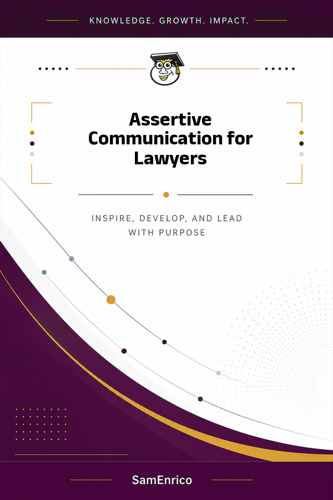
Assertive Communication for Lawyers Audiobook
Argue cases zealously without alienating judges or
by Riley Greg
Argue cases zealously without alienating judges or juries.
Formats
Free sample
Chapter 1: The Silence That Wins--–- The young prosecutor was winning. At least, that’s what he thought. He had the witness cornered, the contradiction exposed, and the jury’s attention. So why did they look away? Why did the judge sigh?
And why did his own client, seated ten feet behind him, sink lower in her chair with every clever barb he launched?This chapter dismantles the most expensive myth in legal education: the belief that zealous advocacy requires volume, interruption, or personal attack. It reveals the uncomfortable truth that the lawyer who “wins” every verbal skirmish often loses the only battle that matters—the jury’s trust. And it introduces the first and most fundamental tool of the assertive advocate: the strategic use of silence.The Expensive Myth Every lawyer has heard it. From law school mock trial competitions to the whispered advice of senior partners: “Be aggressive. Fight for every inch.
Never let them see you blink.” This advice is not entirely wrong. Zealous advocacy is a sacred duty. But somewhere along the way, “zealous” became synonymous with “loud,” “relentless,” and “combative.”Here is the data point that changed my entire understanding of courtroom communication. Researchers have studied jury decision-making for decades. One consistent finding cuts across every study: jurors do not trust lawyers who interrupt, raise their voices, or launch personal attacks on witnesses or opposing counsel.
When a lawyer behaves aggressively, jurors do not think, “He’s a fierce advocate.” They think, “He’s hiding something,” or “He’s losing control,” or most damaging of all, “He’s mean.”The myth persists because it feels true. When adrenaline floods your system during a heated cross-examination, aggression feels like power. When opposing counsel throws a punch, the instinct to punch back feels like self-defense. But the courtroom is not a boxing ring. It is an operating theater.
The best surgeons do not shout at the patient or swing wildly at the nurse. They are calm, precise, and utterly in control of themselves before they attempt to control the room.Consider the difference between two styles. The traditional aggressive advocate thinks: “I must dominate this witness. I must show the jury I am smarter, faster, and tougher than opposing counsel.” The assertive advocate thinks: “I must reveal the truth. I must be the calmest person in this room.
Every word I speak should make the jury lean in, not lean back.”Which one would you trust with your freedom…
This is the end of the free sample. Get the Audiobook to keep going. Buy now
About this book
Details
- Author
- Riley Greg
- Publisher
- SamEnrico
- Language
- English
- Genre
- Non-Fiction, Self-Help, Law
- Released
- 2026-06-06
- Pages (approx.)
- 138
- Available as
- eBook, Audiobook

Listen in the VoxFlicks app
Audiobooks and audio dramas wherever you go. Sign in with your SamEnrico account and press play.
More by Riley Greg
 Imposter Syndrome In LawRiley Greg$11.99
 Poverty and DisabilityRiley Greg$11.99
 Gratitude for BreathRiley Greg$11.99
 Mindfulness for Financial Anxiety GuideRiley Greg$11.99
 Whispers of the Silk Road: The Lost Library of DunhuangRiley Greg$11.99
 Airbnb SWOT Library GuideRiley Greg$12.99
 Citation Rules in Twenty MinutesRiley Greg$12.99
 Understanding Myopathy, Desmin StorageRiley Greg$17.99
 Clarkeite MiningRiley Greg$11.99
 How to Start a Musical Groups and Artists BusinessRiley Greg$11.99
You may also like
 Hong Kong Handover 1997Dunn Johnnie$11.99
 Zumba For Postnatal Recovery CourseNeal Christian$11.99
 Zumba for BeginnersLadner Nikia$11.99
 YouTube Comment Mining GuideHumes Pandora$12.99
 Worry Box MeditationCarlin Rudy$11.99
 Workplace Stress MeditationNguyen Lynn$11.99
 Workplace Stress and Sleep RepairHawley Ivory$11.99
 Workplace Perfectionism CureDelaney Jeffry$11.99
 Workplace Injustice Anger GuideWallen Isabelle$11.99
 Work Addiction and Burnout LinkGreenwood Ester$11.99
 Women in Yoga and WellnessBeattie Galina$11.99
 Women in Stand Up ComedyChun Evangeline$11.99