
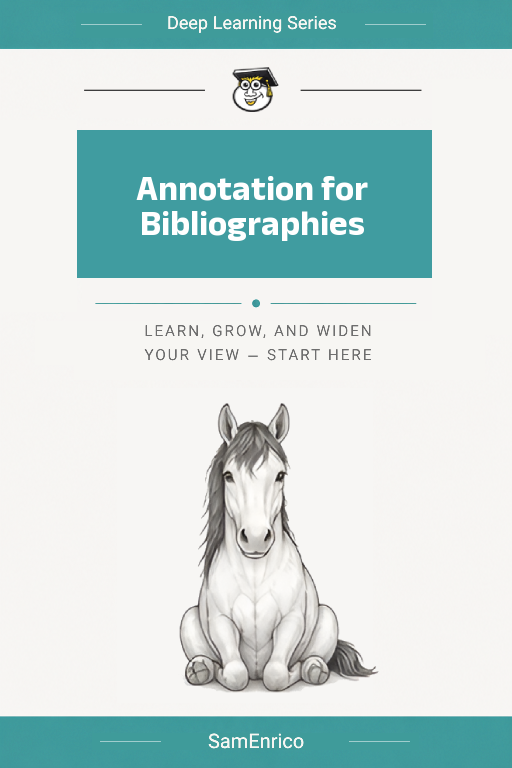
Non-FictionStudent's ShortcutAnnotated
Annotation for Bibliographies eBook
Write concise annotations summarizing and evaluati
Write concise annotations summarizing and evaluating sources for annotated bibliographies.
Formats
Free sample
Chapter 1: The Source Autopsy--Every semester, thousands of students type the same desperate search into Google: “How to write an annotated bibliography fast.” They find templates, style guides, and endless lists of formatting rules. They learn where to put the comma and how to indent the second line. Then they produce something that looks correct but feels hollow—a list of sources summarized in flat, lifeless sentences that no one, including the student, ever wants to read again.That book does not exist here.This chapter dismantles the common student perception that an annotated bibliography is merely a tedious formatting exercise. It begins by defining the annotated bibliography as a distinct genre of academic writing—one that blends citation, summary, and critique. The chapter distinguishes between a standard bibliography (a simple list of sources) and an annotated bibliography (a research tool that engages with each source’s argument and utility).
Rather than presenting multiple competing evaluation frameworks, this chapter introduces the CRAAP Test as the single unified framework that will guide every annotation in this book. Readers learn that CRAAP is not a checklist to memorize but a flexible lens for asking five essential questions about any source. The chapter maps these five questions onto the three core purposes of annotation: providing context, enabling discovery, and establishing authority. The chapter concludes by reframing the annotated bibliography as the ideal first draft of a literature review, not an isolated assignment appendix.This is not a book about commas, indents, or whether to italicize the volume number. Those things matter, but they are the furniture of the room, not the room itself.
This book is about what happens when you truly meet a source—when you stop treating it like an obstacle to be cited and start treating it like a conversation partner to be understood, challenged, and ultimately used.The Hidden Epidemic of Fake Reading Let me tell you something no professor will say out loud. Most students do not read their sources. They skim abstracts. They pull quotes from the introduction and conclusion. They cite articles they have barely understood and books they have opened only once.
This is not because students are lazy. It is because they were never taught how to read for research—how to extract the skeleton of an argument from the flesh of academic prose.The annotated bibliography is the cure.When you are forced to write an annotation, you cannot hide behind a citation. You cannot simply list the source and move on. You have to engage. You have to decide what matters.
You have to judge whether the author knows what they are talking about. In other words, you have to think.This chapter renames the game. We are not going to call it “writing an annotated bibliography.” We are going to call it what it actually is: a source autopsy. You are going to take a source, lay it on the table, and cut it open. You will identify its thesis (the spine), its methodology (the organs), its findings (the vital signs), and its limitations (the wounds).
By the time you are done, you will know that source better than the person who wrote it—or at least well enough to decide whether to trust it.What Actually Is an Annotated Bibliography?Let us start with definitions so we are speaking the same language.A standard bibliography is a list of sources. That is all. It might be called “Works Cited” (MLA), “References” (APA), or “Bibliography” (Chicago). It includes the citation information someone would need to find the source themselves. It is a map.An annotated bibliography is the same list, but every entry is followed by an annotation—a paragraph that does three things.
First, it summarizes the source’s main argument and evidence. Second, it evaluates the source’s credibility and usefulness. Third, it reflects on how the source fits into your larger research project.That third part is the secret that most students miss.An annotation is not just about the source. It is about the relationship between the source and you. Why did you choose this source?
What gap does it fill? How does it speak to the other sources on your list? A good annotation does not stand alone. It is part of a conversation.Here is an example of what not to do:Smith, John. The History of Everything.
Oxford University Press, 2020.This book talks about history. It has many chapters. I found it useful.That annotation is worthless. It tells the reader nothing they could not already guess from the title. It uses the weak verb “talks about” instead of a precise signal verb like “argues” or “demonstrates.” It offers an evaluation—“I found it useful”—without explaining why or for what purpose.
It provides no critique of the source’s authority, currency, or accuracy.Here is what a real annotation looks like:Smith, John. The History of Everything. Oxford University Press, 2020.Smith argues that historical narratives are shaped more by contemporary political needs than by available evidence, challenging the Rankean ideal of “history as it actually was.” Drawing on case studies from three centuries (the Spanish Inquisition, the French Revolution, and the Civil Rights Movement), Smith demonstrates how each generation rewrites the past to serve present interests. However, Smith’s reliance on secondary sources rather than archival research raises questions about the depth of his analysis, and his dismissal of Rankean objectivity may be overstated given his own political commitments (acknowledged in the preface). This source is valuable for my research on historical memory but will require supplementation with primary-source-driven counterarguments.That annotation is 142 words.
In those 142 words, the reader learns the thesis, the methodology, the key evidence, the limitation, and the source’s specific role in a larger project. That is efficiency. That is skill. That is what this book teaches.The Three Purposes of Every Annotation Every annotation you write should serve three purposes. Think of them as the legs of a stool.
Remove one, and the whole thing collapses.Purpose One: Context Where does this source fit in the scholarly conversation? Every academic field is an ongoing argument. People publish articles to disagree with each other, to extend each other’s work, or to overturn settled assumptions. Your annotation should place the source on this map. Is the source responding to a famous theory?
Is it citing a canonical text? Is it trying to start a new subfield? Context is the answer to the question: “Why does this source exist?”Purpose Two: Discovery What gaps and connections does this source reveal? When you read a source carefully, you will notice things it does not say. It might ignore a relevant population.
It might use outdated methods. It might assume something that is actually controversial. Those gaps are opportunities. They tell you where your own research can contribute. Discovery is the answer to the question: “What does this source make me wonder?”Purpose Three: Authority Should you trust this source?
This is the hardest purpose to fulfill because it requires judgment, not just reporting. Authority is not a binary (trustworthy vs. untrustworthy). It is a spectrum. A source can be authoritative on one…
This is the end of the free sample. Get the eBook to keep going. Buy now
About this book
Details
- Author
- Florez Tabatha
- Publisher
- SamEnrico
- Language
- English
- Genre
- Non-Fiction, Student's Shortcut, Annotated
- Released
- 2026-06-01
- Pages (approx.)
- 159
- Available as
- eBook, Audiobook

Read better in the ZLOADR app
Your eBooks on your phone or tablet. Sign in with your SamEnrico account and start reading.
More by Florez Tabatha
 ABCDE Method for SalespeopleFlorez Tabatha$11.99
 Postpartum Return to RunningFlorez Tabatha$11.99
 DBT Group Skills TrainingFlorez Tabatha$11.99
 Breath Awareness For SingersFlorez Tabatha$11.99
 Pomodoro For Language LearningFlorez Tabatha$11.99
 Long Term Rental StrategyFlorez Tabatha$11.99
 P D Ouspensky In SearchFlorez Tabatha$11.99
 Doyle Brunson AccountFlorez Tabatha$11.99
 The Iron Storm: How a Russian Genius Forged the First Battle TankFlorez Tabatha$11.99
 The Great Victorian Shipboard Swindle: Fraud on the High SeasFlorez Tabatha$11.99
 How to Produce a Halogen OvenFlorez Tabatha$11.99
 A Collector's Handbook to the Fairthorpe Electron MinorFlorez Tabatha$11.99
You may also like
 Hong Kong Handover 1997Dunn Johnnie$11.99
 Zumba For Postnatal Recovery CourseNeal Christian$11.99
 Zumba for BeginnersLadner Nikia$11.99
 YouTube Comment Mining GuideHumes Pandora$12.99
 Worry Box MeditationCarlin Rudy$11.99
 Workplace Stress MeditationNguyen Lynn$11.99
 Workplace Stress and Sleep RepairHawley Ivory$11.99
 Workplace Perfectionism CureDelaney Jeffry$11.99
 Workplace Injustice Anger GuideWallen Isabelle$11.99
 Work Addiction and Burnout LinkGreenwood Ester$11.99
 Women in Yoga and WellnessBeattie Galina$11.99
 Women in Stand Up ComedyChun Evangeline$11.99