
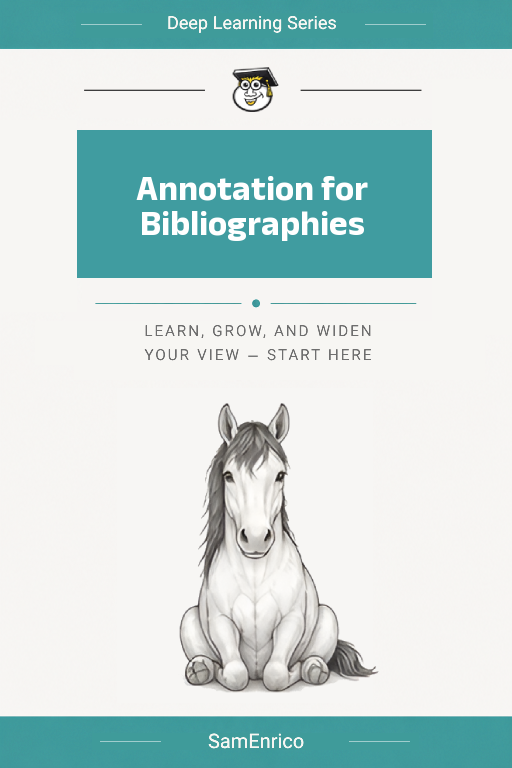
Annotation for Bibliographies
Write concise annotations summarizing and evaluati
Write concise annotations summarizing and evaluating sources for annotated bibliographies.
Formats
About this book
Free sample
Chapter 1: The Source Autopsy--Every semester, thousands of students type the same desperate search into Google: “How to write an annotated bibliography fast.” They find templates, style guides, and endless lists of formatting rules. They learn where to put the comma and how to indent the second line. Then they produce something that looks correct but feels hollow—a list of sources summarized in flat, lifeless sentences that no one, including the student, ever wants to read again.That book does not exist here.This chapter dismantles the common student perception that an annotated bibliography is merely a tedious formatting exercise. It begins by defining the annotated bibliography as a distinct genre of academic writing—one that blends citation, summary, and critique. The chapter distinguishes between a standard bibliography (a simple list of sources) and an annotated bibliography (a research tool that engages with each source’s argument and utility).
Rather than presenting multiple competing evaluation frameworks, this chapter introduces the CRAAP Test as the single unified framework that will guide every annotation in this book. Readers learn that CRAAP is not a checklist to memorize but a flexible lens for asking five essential questions about any source. The chapter maps these five questions onto the three core purposes of annotation: providing context, enabling discovery, and establishing authority. The chapter concludes by reframing the annotated bibliography as the ideal first draft of a literature review, not an isolated assignment appendix.This is not a book about commas, indents, or whether to italicize the volume number. Those things matter, but they are the furniture of the room, not the room itself.
This book is about what happens when you truly meet a source—when you stop treating it like an obstacle to be cited and start treating it like a conversation partner to be understood, challenged, and ultimately used.The Hidden Epidemic of Fake Reading Let me tell you something no professor will say out loud. Most students do not read their sources. They skim abstracts. They pull quotes from the introduction and conclusion. They cite articles they have barely understood and books they…
This is the end of the free sample. Get the eBook to keep going. Buy now
Contents
- Chapter 1
- Chapter 2
- Chapter 3
- Chapter 4
- Chapter 5
- Chapter 6
- Chapter 7
- Chapter 8
- Chapter 9
- Chapter 10
- Chapter 11
- Chapter 12
Details
- Author
- Florez Tabatha
- Publisher
- SamEnrico
- Language
- English
- Genre
- Non-Fiction, Student's Shortcut, Annotated
- Released
- 2026-06-01
- Pages (approx.)
- 159
- Available as
- eBook, Audiobook

Read better in the ZLOADR app
Your eBooks on your phone or tablet. Sign in with your SamEnrico account and start reading.
More by Florez Tabatha
 ABCDE Method for SalespeopleFlorez Tabatha$11.99
 Postpartum Return to RunningFlorez Tabatha$11.99
 DBT Group Skills TrainingFlorez Tabatha$11.99
 Breath Awareness For SingersFlorez Tabatha$11.99
 Pomodoro For Language LearningFlorez Tabatha$11.99
 Long Term Rental StrategyFlorez Tabatha$11.99
 P D Ouspensky In SearchFlorez Tabatha$11.99
 Doyle Brunson AccountFlorez Tabatha$11.99
 The Iron Storm: How a Russian Genius Forged the First Battle TankFlorez Tabatha$11.99
 The Great Victorian Shipboard Swindle: Fraud on the High SeasFlorez Tabatha$11.99
 How to Produce a Halogen OvenFlorez Tabatha$11.99
 A Collector's Handbook to the Fairthorpe Electron MinorFlorez Tabatha$11.99