
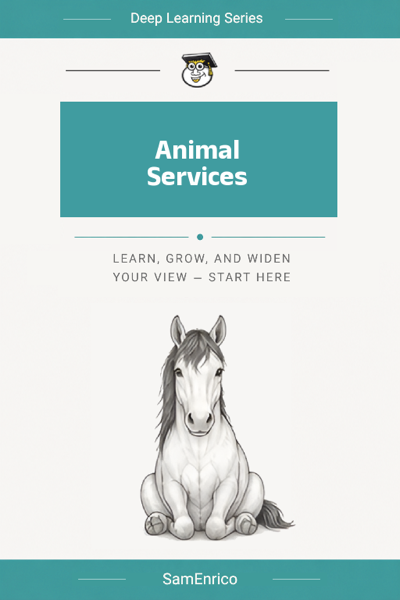
Non-FictionInformativeEducational
Animal Services eBook
A Coursebook on Animal Services
A Coursebook on Animal Services
Formats
Free sample
Chapter 1: The Unspoken Threshold...--Every person who walks through the doors of an animal shelter for the first time crosses an unspoken threshold. On one side lies the familiar world of pets as family members, of heartwarming adoption stories and heroic rescues. On the other side waits a reality that most people never see: thousands of animals entering municipal systems daily, staff making life-and-death decisions before lunch, and a philosophical battleground where deeply held beliefs about life, death, and human responsibility collide. This chapter establishes the scope, terminology, and philosophical evolution of the modern animal services field. It provides the foundational framework upon which every subsequent chapter builds.The Landscape of Animal Services The term "animal services" encompasses a far broader range of organizations and functions than most people realize.
At its core, animal services refers to the network of public and private entities responsible for the welfare, management, and disposition of animals within a community. This network includes six distinct types of entities, each with its own mission, legal authority, and operational constraints.Open-admission shelters form the backbone of municipal animal services. These facilities, whether directly operated by city government or contracted to private non-profits, must accept every animal brought to them regardless of health, behavior, age, or available space. A police officer bringing in a stray pit bull from a dogfighting raid, a family surrendering their 15-year-old incontinent cat, a Good Samaritan with a litter of neonatal kittens found in a dumpster — the open-admission shelter says yes to all. This mandate is both their moral justification and their operational nightmare.
When kennels are full, and they often are, open-admission shelters face impossible choices that limited-admission shelters never confront.Limited-admission shelters, by contrast, control their intake. Typically private non-profits with no legal obligation to accept animals from the public, they can close their doors when capacity is reached, accept only animals deemed adoptable, or maintain waiting lists. This selectivity allows them to achieve higher live release rates and maintain more comfortable conditions for their animal residents. However, critics argue that limited-admission shelters benefit from a privileged position while open-admission shelters bear the community's full burden. The relationship between these two shelter types — sometimes cooperative, sometimes contentious — shapes the animal welfare landscape of every major city.Municipal animal control operates at the intersection of public safety and animal welfare.
Unlike shelters focused primarily on rehoming, animal control officers enforce laws: leash laws, licensing requirements, dangerous dog regulations, and anti-cruelty statutes. They respond to barking complaints, investigate bites, capture aggressive strays, and issue citations. In many jurisdictions, animal control officers carry the same authority as police officers and face similar dangers — but with far less training, equipment, and public respect. The tension between enforcement and compassion defines this role, as officers must balance public safety with the welfare of animals whose owners may be neglectful, impoverished, mentally ill, or all three.Sanctuaries represent the long-term care end of the spectrum. These facilities provide lifelong housing for animals who cannot be adopted due to behavior, medical needs, or legal status.
Unlike shelters that aim for rapid placement, sanctuaries accept that residents may live out their natural lives in captivity. This mission requires vastly different infrastructure, staffing, and funding models. A sanctuary for confiscated fighting dogs needs secure kennels, behavior modification programs, and staff trained in managing canine aggression. A sanctuary for former laboratory beagles needs socialization protocols, veterinary care for chronic conditions, and enrichment programs for animals who have never experienced grass or toys. The sanctuary standard prioritizes quality of life over length of stay, a philosophical orientation that influences every aspect of operations.Research animal facilities operate under an entirely different regulatory and ethical framework.
Governed by the Animal Welfare Act, the Public Health Service Policy, and the Guide for the Care and Use of Laboratory Animals, these facilities maintain animals for biomedical research, agricultural studies, or product safety testing. The goal is not adoption but standardization — maintaining healthy, consistent animal populations for experimental protocols. This difference shapes everything from caging requirements (uniform, sanitizable, often restrictive) to euthanasia methods (approved by the American Veterinary Medical Association Panel on Euthanasia) to staffing (veterinarians and technicians trained in laboratory animal medicine). Most shelter professionals never set foot in a research facility, yet understanding this parallel world illuminates the broader field of animal services.Cruelty investigation units represent the enforcement arm of animal protection. Often housed within humane societies or law enforcement agencies, these specialized units investigate animal neglect, abandonment, hoarding, and intentional cruelty.
Their officers carry evidence collection kits, cameras, and in some jurisdictions, arrest powers. They work alongside forensic veterinarians who perform necropsies, behavioral experts who assess animal suffering, and prosecutors who build criminal cases. The work is grim, dangerous, and emotionally devastating — but also essential for holding abusers accountable and preventing future suffering.These six entity types do not exist in isolation. A single metropolitan area may contain an open-admission municipal shelter, a limited-admission private humane society, a wildlife sanctuary, a university research facility, and a cruelty investigation unit operating under the district attorney's office. These organizations may compete for funding, collaborate on transfers, or feud over philosophy.
Understanding their distinct missions, legal authorities, and operational constraints is the first step toward effective animal services management.The Philosophical Revolution Fifty years ago, the landscape looked very different. Municipal pounds operated as disposal systems for unwanted animals. Stray dogs picked up by animal control were held for a legally mandated period — typically three to five days — and then euthanized in gas chambers or by intravenous injection. Cats, viewed as semi-wild and less valuable, were often euthanized immediately. The term "live release rate" did not exist because no one calculated it.
Success was measured not by animals saved but by animals processed.This approach reflected a broader societal attitude toward companion animals. Pets were property, valuable only insofar as they served human purposes. A stray dog was a nuisance to be eliminated, not a life to be saved. Shelters employed few veterinarians and fewer behaviorists. Enrichment, socialization, and medical treatment beyond basic vaccination were rare.
The goal was efficient disposal, not compassionate care.The philosophical shift began in the 1970s and 1980s, driven by several converging forces. The animal rights movement, popularized by Peter Singer's Animal Liberation (1975) and Tom Regan's The Case for Animal Rights (1983), challenged the moral status of animals and the ethics of killing healthy, adoptable animals. Spay/neuter advocacy, led by organizations like the Humane Society of the United States and the American SPCA, promoted sterilization as a population control strategy. No-kill shelters, pioneered by Richard Avanzino at the San Francisco SPCA in the 1980s, demonstrated that high live release rates were achievable.By the 1990s, the sheltering world had split into two warring camps. The traditionalists argued that open-admission shelters had a duty to accept all animals and that euthanasia was a necessary tool for managing population and disease.
The no-kill advocates argued that euthanasia of healthy, adoptable animals was morally unacceptable and that shelters should refuse intake rather than kill. This schism, often bitter and personal, dominated shelter conferences, online forums, and local politics for two decades.The resolution came through data. As shelters began tracking outcomes systematically, a…
This is the end of the free sample. Get the eBook to keep going. Buy now
About this book
Details
- Author
- Mcgehee Alesia
- Publisher
- SamEnrico
- Language
- English
- Genre
- Non-Fiction, Informative, Educational
- Released
- 2026-05-08
- Pages (approx.)
- 151
- Available as
- eBook, Audiobook

Read better in the ZLOADR app
Your eBooks on your phone or tablet. Sign in with your SamEnrico account and start reading.
More by Mcgehee Alesia
 Caffeine Study OptimizationMcgehee Alesia$11.99
 Social Casino App CompulsionMcgehee Alesia$11.99
 From Puli Khumri To PerthMcgehee Alesia$11.99
 Dim Light Melatonin Onset TestingMcgehee Alesia$11.99
 Relapse Prevention Mindfulness ManualMcgehee Alesia$11.99
 The Veteran Overdose SurvivorMcgehee Alesia$11.99
 The Global Talent Flow ForecastMcgehee Alesia$11.99
 Kiloton to Megaton: Postwar Bomb ScalingMcgehee Alesia$11.99
 Disappointment In Pet LossMcgehee Alesia$11.99
 The Unseen War: How a Single Algorithm Reshaped Global MarketsMcgehee Alesia$11.99
 The Diamond and the Dagger: The Untold Love Story of Queen Victoria and the MaharajaMcgehee Alesia$11.99
 Apollodorus: The Architect Who Defined Rome's Eternal GloryMcgehee Alesia$11.99
You may also like
 Hong Kong Handover 1997Dunn Johnnie$11.99
 Zumba For Postnatal Recovery CourseNeal Christian$11.99
 Zumba for BeginnersLadner Nikia$11.99
 YouTube Comment Mining GuideHumes Pandora$12.99
 Worry Box MeditationCarlin Rudy$11.99
 Workplace Stress MeditationNguyen Lynn$11.99
 Workplace Stress and Sleep RepairHawley Ivory$11.99
 Workplace Perfectionism CureDelaney Jeffry$11.99
 Workplace Injustice Anger GuideWallen Isabelle$11.99
 Work Addiction and Burnout LinkGreenwood Ester$11.99
 Women in Yoga and WellnessBeattie Galina$11.99
 Women in Stand Up ComedyChun Evangeline$11.99