
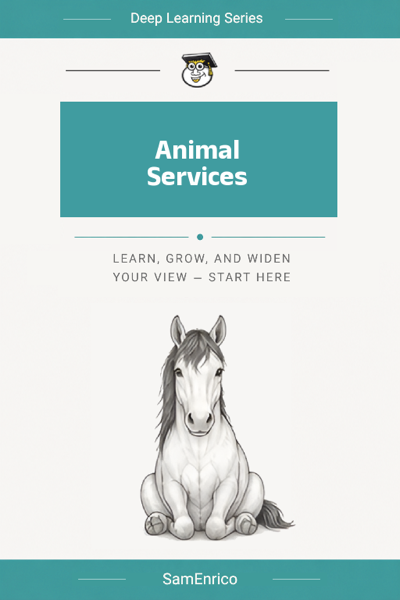
Animal Services
A Coursebook on Animal Services
A Coursebook on Animal Services
Formats
About this book
Free sample
Chapter 1: The Unspoken Threshold...--Every person who walks through the doors of an animal shelter for the first time crosses an unspoken threshold. On one side lies the familiar world of pets as family members, of heartwarming adoption stories and heroic rescues. On the other side waits a reality that most people never see: thousands of animals entering municipal systems daily, staff making life-and-death decisions before lunch, and a philosophical battleground where deeply held beliefs about life, death, and human responsibility collide. This chapter establishes the scope, terminology, and philosophical evolution of the modern animal services field. It provides the foundational framework upon which every subsequent chapter builds.The Landscape of Animal Services The term "animal services" encompasses a far broader range of organizations and functions than most people realize.
At its core, animal services refers to the network of public and private entities responsible for the welfare, management, and disposition of animals within a community. This network includes six distinct types of entities, each with its own mission, legal authority, and operational constraints.Open-admission shelters form the backbone of municipal animal services. These facilities, whether directly operated by city government or contracted to private non-profits, must accept every animal brought to them regardless of health, behavior, age, or available space. A police officer bringing in a stray pit bull from a dogfighting raid, a family surrendering their 15-year-old incontinent cat, a Good Samaritan with a litter of neonatal kittens found in a dumpster — the open-admission shelter says yes to all. This mandate is both their moral justification and their operational nightmare.
When kennels are full, and they often are, open-admission shelters face impossible choices that limited-admission shelters never confront.Limited-admission shelters, by contrast, control their intake. Typically private non-profits with no legal obligation to accept animals from the public, they can close their doors when capacity is reached, accept only animals deemed adoptable, or maintain waiting lists. This selectivity allows them to achieve higher live release rates and maintain more comfortable conditions for their animal residents. However, critics argue that limited-admission shelters benefit from a privileged position while open-admission shelters…
This is the end of the free sample. Get the eBook to keep going. Buy now
Contents
- Chapter 1
- Chapter 2
- Chapter 3
- Chapter 4
- Chapter 5
- Chapter 6
- Chapter 7
- Chapter 8
- Chapter 9
- Chapter 10
- Chapter 11
- Chapter 12
Details
- Author
- Mcgehee Alesia
- Publisher
- SamEnrico
- Language
- English
- Genre
- Non-Fiction, Informative, Educational
- Released
- 2026-05-08
- Pages (approx.)
- 151
- Available as
- eBook, Audiobook

Read better in the ZLOADR app
Your eBooks on your phone or tablet. Sign in with your SamEnrico account and start reading.
More by Mcgehee Alesia
 Caffeine Study OptimizationMcgehee Alesia$11.99
 Social Casino App CompulsionMcgehee Alesia$11.99
 From Puli Khumri To PerthMcgehee Alesia$11.99
 Dim Light Melatonin Onset TestingMcgehee Alesia$11.99
 Relapse Prevention Mindfulness ManualMcgehee Alesia$11.99
 The Veteran Overdose SurvivorMcgehee Alesia$11.99
 The Global Talent Flow ForecastMcgehee Alesia$11.99
 Kiloton to Megaton: Postwar Bomb ScalingMcgehee Alesia$11.99
 Disappointment In Pet LossMcgehee Alesia$11.99
 The Unseen War: How a Single Algorithm Reshaped Global MarketsMcgehee Alesia$11.99
 The Diamond and the Dagger: The Untold Love Story of Queen Victoria and the MaharajaMcgehee Alesia$11.99
 Apollodorus: The Architect Who Defined Rome's Eternal GloryMcgehee Alesia$11.99