
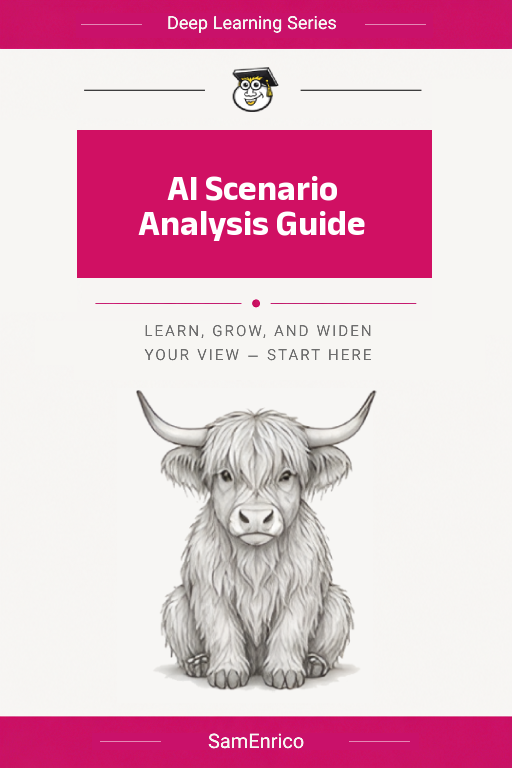
Non-FictionBusiness BriefScenario AI
AI Scenario Analysis Guide eBook
Run thousands of what-if scenarios instantly with
Run thousands of what-if scenarios instantly with AI that models different assumptions.
Formats
Free sample
Chapter 1: The Prediction Trap--–- In the winter of 2019, the global forecasting industry—a multibillion-dollar ecosystem of economists, analysts, consultants, and algorithms—was running at full capacity. Central banks published quarterly projections with fanfare. Supply chain managers optimized inventories based on twelve-month rolling forecasts. Portfolio managers calculated value-at-risk assuming normal distributions and stable correlations. Every prediction came with confidence intervals, error bands, and the implicit promise that the future was, if not knowable, at least narrow enough to bet on.Three months later, those same confidence intervals became graveyards of credibility.The pandemic did not break forecasting.
It merely revealed what had always been true: prediction is a comforting illusion, not a strategic tool. The organizations that suffered most were not those with bad forecasts. They were those that believed in forecasts at all. The organizations that survived—and some thrived—had quietly abandoned the question "What will happen?" and replaced it with a more powerful, humbler, and ultimately more profitable question: "What could happen?"This chapter dismantles the prediction trap and introduces the foundational logic of AI-powered scenario analysis. You will learn why traditional forecasting fails precisely when you need it most, how the shift from prediction to exploration changes everything, and why the only question that matters in an era of radical uncertainty is not "What's your forecast?" but "What are you not seeing?"The Great Illusion of Linear Prediction The problem with prediction is not that it is always wrong.
It is that it is almost always a little bit right—just enough to be dangerous.Weather forecasting offers a useful analogy. A prediction that tomorrow's high temperature will be 72 degrees Fahrenheit is often accurate within a degree or two. That success breeds confidence. But the same models that predict temperature accurately cannot predict whether a tornado will touch down in a specific county three weeks from now. The problem is not the model's quality; it is the horizon and the nature of the system.
Weather is chaotic but not adversarial. Economics is chaotic and adversarial. Markets are chaotic and reflexive (predictions change behavior, invalidating predictions). Geopolitics is chaotic, adversarial, and reflexive simultaneously.Traditional business forecasting—linear extrapolation of past trends—assumes that the future will resemble the past, only more so. This assumption worked tolerably well for much of the post-war period, when structural change was slow and shocks were manageable.
It has worked catastrophically badly in the twenty-first century, which has delivered a financial crisis, a pandemic, supply chain collapses, energy shocks, inflation spikes, and the rapid emergence of transformative AI—each event outside the training data of any linear model.Consider the humble quarterly earnings forecast. A company reports revenue of 1billion.Analystspredict1 billion. Analysts predict 1billion.Analystspredict1.05 billion next quarter, based on historical growth rates, pipeline data, and macroeconomic indicators. The company reports $1.04 billion. The stock drops 5 percent.
The forecast was "almost right"—within 1 percent of actual—yet it triggered a sell-off. The problem was not accuracy. The problem was the binary bet that the forecast represented: a single number that the market treated as a promise.That binary bet is the prediction trap.The Binary Bet Fallacy Most organizations run their strategy on what amounts to a single bet about the future. They build one budget, one sales plan, one supply chain configuration, one product roadmap. They may have "upside" and "downside" scenarios filed away somewhere, but those are typically linear adjustments—optimistic and pessimistic variations on the same underlying narrative.
A recession scenario might assume revenue falls 15 percent instead of growing 5 percent. That is not a different future. It is the same future with a negative sign attached.This "best case / worst case" model is seductive because it feels prudent. But it is structurally flawed for three reasons.First, it ignores the messy middle. Most real outcomes do not land at the optimistic or pessimistic extreme.
They land somewhere in between, but "in between" is not a single point—it is a vast landscape of possibilities. A company that prepares for revenue to be either +5 percent or -15 percent is unprepared for revenue to be -2 percent with a completely different cost structure, or +1 percent with a customer mix shift that destroys margins, or -8 percent with a competitor bankruptcy that opens unexpected opportunities. Binary scenarios collapse this landscape into two points and call it risk management.Second, it treats all deviations from the base case as linear deteriorations. In reality, shocks cascade. A 5 percent revenue shortfall might trigger a 15 percent profit collapse if fixed costs do not adjust.
A 10 percent oversupply in one component might create a 50 percent price crash in that market. Nonlinearity is the rule, not the exception. Linear scenarios miss this entirely.Third, and most dangerously, binary scenarios provide false reassurance. A leader who has reviewed the "worst case" and deemed it survivable feels prepared. But the worst case that actually arrives is rarely the worst case they imagined.
The 2008 financial crisis was not the worst case forecasted by banks in 2006—it was an entirely different beast, involving instruments and contagion paths that no linear model had considered. The pandemic was not a "pandemic scenario" in most corporate risk registers—because those registers imagined a flu-like event with 2 percent mortality and a vaccine in six months. Reality was different.The prediction trap, then, is not that forecasts are wrong. It is that the act of forecasting—producing a single number or a narrow range—creates a psychological commitment to that number. Organizations build plans around it.
They allocate resources based on it. They fire and hire according to it. And when reality diverges, as it always does, they are left scrambling, because the only question they asked was "What will happen?" and they got the wrong answer.Two Kinds of Uncertainty: Why Your Method Must Match Your Problem Before we can replace prediction with scenario analysis, we must understand a distinction that will run through every chapter of this book. Not all uncertainty is the same. Attempting to model all uncertainty with the same tools is like trying to fix a watch and a house with the same screwdriver.
It will not work, and you will break things.There are two fundamental types of uncertainty.Aleatory uncertainty (from the Latin alea, meaning "dice" or "game of chance") is random, repeatable, and statistically observable. The roll of a die is aleatory. The timing of equipment failure in a factory is aleatory—we have historical data on mean time between failures. Customer churn rates, given enough customers, are aleatory. Weather patterns over long time horizons have aleatory components.Aleatory uncertainty can be modeled with probability distributions.
You do not know exactly when the next machine will fail, but you know that over a thousand machines, failures will follow a pattern. You can run a Monte Carlo simulation: thousands of trials, each sampling randomly from the observed distribution. The output is a probability distribution of outcomes. This is powerful and reliable within the domain where the past is a reliable guide to the future.Epistemic uncertainty (from the Greek episteme, meaning "knowledge") stems from incomplete knowledge, novel situations, or deliberate adversaries. The question "Will a new AI regulation pass the European…
This is the end of the free sample. Get the eBook to keep going. Buy now
About this book
Details
- Author
- Cooley Alphonse
- Publisher
- SamEnrico
- Language
- English
- Genre
- Non-Fiction, Business Brief, Scenario AI
- Released
- 2026-06-01
- Pages (approx.)
- 151
- Available as
- eBook, Audiobook

Read better in the ZLOADR app
Your eBooks on your phone or tablet. Sign in with your SamEnrico account and start reading.
More by Cooley Alphonse
 Failure Self Compassion GuideCooley Alphonse$11.99
 The Workaholism Recovery GuideCooley Alphonse$11.99
 Menopause Body Odor GuideCooley Alphonse$11.99
 Martina McBride Independence GuideCooley Alphonse$11.99
 Cognitive Testing Self AssessmentCooley Alphonse$11.99
 Frozen Ambition: The Forgotten Arctic Odyssey of Karl WeyprechtCooley Alphonse$11.99
 Baba Yaga's Bone House: The Witch Who Devours the LostCooley Alphonse$11.99
 WrapperCooley Alphonse$11.99
 Understanding Free Sialic ACID Storage DiseaseCooley Alphonse$17.99
 AI Confidentiality Labeling HandbookCooley Alphonse$12.99
 How to Start a Bacteriologist (non Medical) Business (Beginners Guide)Cooley Alphonse$11.99
You may also like
 Hong Kong Handover 1997Dunn Johnnie$11.99
 Zumba For Postnatal Recovery CourseNeal Christian$11.99
 Zumba for BeginnersLadner Nikia$11.99
 YouTube Comment Mining GuideHumes Pandora$12.99
 Worry Box MeditationCarlin Rudy$11.99
 Workplace Stress MeditationNguyen Lynn$11.99
 Workplace Stress and Sleep RepairHawley Ivory$11.99
 Workplace Perfectionism CureDelaney Jeffry$11.99
 Workplace Injustice Anger GuideWallen Isabelle$11.99
 Work Addiction and Burnout LinkGreenwood Ester$11.99
 Women in Yoga and WellnessBeattie Galina$11.99
 Women in Stand Up ComedyChun Evangeline$11.99