
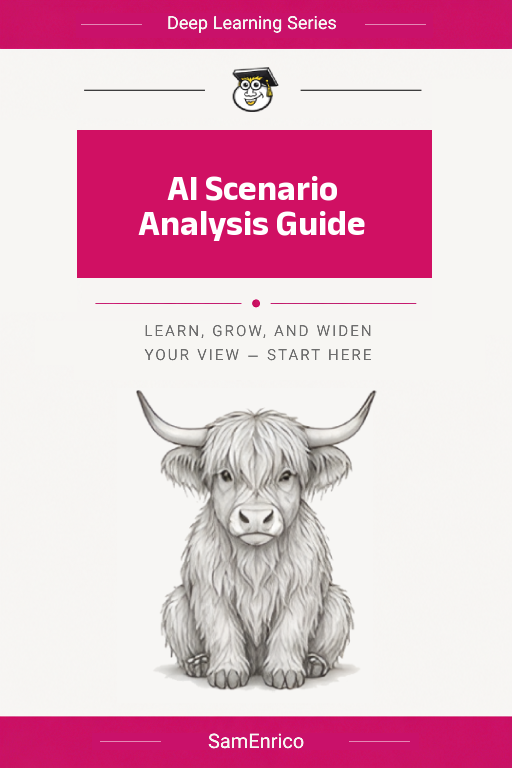
Non-FictionBusiness BriefScenario AI
AI Scenario Analysis Guide Audiobook
Run thousands of what-if scenarios instantly with
Run thousands of what-if scenarios instantly with AI that models different assumptions.
Formats
Free sample
Chapter 1: The Prediction Trap--–- In the winter of 2019, the global forecasting industry—a multibillion-dollar ecosystem of economists, analysts, consultants, and algorithms—was running at full capacity. Central banks published quarterly projections with fanfare. Supply chain managers optimized inventories based on twelve-month rolling forecasts. Portfolio managers calculated value-at-risk assuming normal distributions and stable correlations. Every prediction came with confidence intervals, error bands, and the implicit promise that the future was, if not knowable, at least narrow enough to bet on.Three months later, those same confidence intervals became graveyards of credibility.The pandemic did not break forecasting.
It merely revealed what had always been true: prediction is a comforting illusion, not a strategic tool. The organizations that suffered most were not those with bad forecasts. They were those that believed in forecasts at all. The organizations that survived—and some thrived—had quietly abandoned the question "What will happen?" and replaced it with a more powerful, humbler, and ultimately more profitable question: "What could happen?"This chapter dismantles the prediction trap and introduces the foundational logic of AI-powered scenario analysis. You will learn why traditional forecasting fails precisely when you need it most, how the shift from prediction to exploration changes everything, and why the only question that matters in an era of radical uncertainty is not "What's your forecast?" but "What are you not seeing?"The Great Illusion of Linear Prediction The problem with prediction is not that it is always wrong.
It is that it is almost always a little bit right—just enough to be dangerous.Weather forecasting offers a useful analogy. A prediction that tomorrow's high temperature will be 72 degrees Fahrenheit is often accurate within a degree or two. That success breeds confidence. But the same models that predict temperature accurately cannot predict whether a tornado will touch down in a specific county three weeks from now. The problem is not the model's quality; it is the horizon and the nature of the system.
Weather is chaotic but not adversarial. Economics is chaotic and adversarial. Markets are chaotic and reflexive (predictions change behavior, invalidating predictions). Geopolitics is chaotic, adversarial, and reflexive simultaneously.Traditional business forecasting—linear extrapolation of past trends—assumes that the future will resemble the past, only more so. This assumption worked tolerably well for much of the post-war period, when structural change was slow and shocks were manageable.
It has worked catastrophically badly in the twenty-first century, which has delivered a financial crisis, a pandemic, supply chain collapses…
This is the end of the free sample. Get the Audiobook to keep going. Buy now
About this book
Details
- Author
- Cooley Alphonse
- Publisher
- SamEnrico
- Language
- English
- Genre
- Non-Fiction, Business Brief, Scenario AI
- Released
- 2026-06-01
- Pages (approx.)
- 151
- Available as
- eBook, Audiobook

Listen in the VoxFlicks app
Audiobooks and audio dramas wherever you go. Sign in with your SamEnrico account and press play.
More by Cooley Alphonse
 Failure Self Compassion GuideCooley Alphonse$11.99
 The Workaholism Recovery GuideCooley Alphonse$11.99
 Menopause Body Odor GuideCooley Alphonse$11.99
 Martina McBride Independence GuideCooley Alphonse$11.99
 Cognitive Testing Self AssessmentCooley Alphonse$11.99
 Frozen Ambition: The Forgotten Arctic Odyssey of Karl WeyprechtCooley Alphonse$11.99
 Baba Yaga's Bone House: The Witch Who Devours the LostCooley Alphonse$11.99
 WrapperCooley Alphonse$11.99
 Understanding Free Sialic ACID Storage DiseaseCooley Alphonse$17.99
 AI Confidentiality Labeling HandbookCooley Alphonse$12.99
 How to Start a Bacteriologist (non Medical) Business (Beginners Guide)Cooley Alphonse$11.99
You may also like
 Hong Kong Handover 1997Dunn Johnnie$11.99
 Zumba For Postnatal Recovery CourseNeal Christian$11.99
 Zumba for BeginnersLadner Nikia$11.99
 YouTube Comment Mining GuideHumes Pandora$12.99
 Worry Box MeditationCarlin Rudy$11.99
 Workplace Stress MeditationNguyen Lynn$11.99
 Workplace Stress and Sleep RepairHawley Ivory$11.99
 Workplace Perfectionism CureDelaney Jeffry$11.99
 Workplace Injustice Anger GuideWallen Isabelle$11.99
 Work Addiction and Burnout LinkGreenwood Ester$11.99
 Women in Yoga and WellnessBeattie Galina$11.99
 Women in Stand Up ComedyChun Evangeline$11.99