
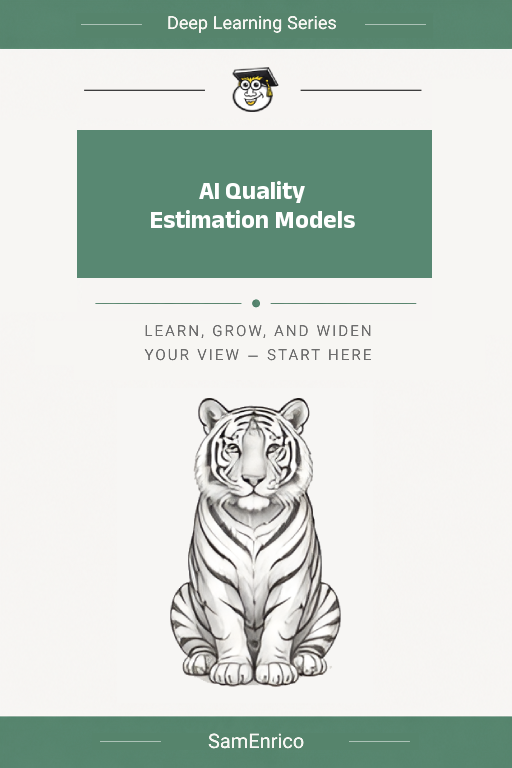
AI Quality Estimation Models Audiobook
Deploy QE models to predict translation quality sc
Deploy QE models to predict translation quality scores without human review. Flag low-confidence segments and route to human post-editors automatically.
Formats
Free sample
Chapter 1: The Million-Dollar Mistake...--The email arrived at 2:47 AM on a Tuesday. Maria, the localization director at a fast-growing fintech startup, stared at her screen. A customer in Japan had received a translation of their loan agreement that read, "Your interest rate will be adjusted monthly based on your creditworthiness" as "Your interest rate will double every month based on how much we distrust you." The mistranslation of "creditworthiness" to "distrust" was subtle but catastrophic. Three customers had already cancelled. Legal was drafting an apology.
The engineering team was blaming the machine translation engine. The vendors were blaming the human post-editors who had missed the error.Maria had a team of twelve post-editors reviewing 50,000 segments per day. They caught 99% of errors. But the 1% that slipped through—the ones that changed meaning, reversed polarity, or introduced legal ambiguity—were costing her company hundreds of thousands of dollars annually. She had done the math.
Each critical error required, on average, four hours of incident response: customer support, legal review, engineering patches, and reputational damage control. At scale, with millions of translated segments per month, the math was brutal.The paradox was this: Maria's machine translation engine produced output faster than any human could read it. Yet she could not trust that output without human review. And she could not afford to review every segment. She was trapped in what this book calls the Quality Bottleneck Paradox: the faster your translation engine becomes, the slower your overall operation feels, because humans remain the rate-limiting step.This book exists because Maria's problem is not unique.
It is the defining challenge of modern localization at scale. And the solution is not better humans, faster humans, or more humans. The solution is Quality Estimation—a class of AI models designed to predict translation quality without requiring a human to read the translation first.1.1 The Quality Bottleneck Paradox Let us begin with a simple experiment. Take a sentence in English: "The patient should take two tablets daily with food." Now translate it into German using a modern neural machine translation system. The output appears in less than a second: "Der Patient sollte zwei Tabletten täglich mit Nahrung einnehmen."Now ask yourself: Is this translation correct?
A human post-editor would need to read both sentences, compare them, check for medical terminology, verify the dosage instruction, and ensure cultural appropriateness. That takes about six to ten seconds per…
This is the end of the free sample. Get the Audiobook to keep going. Buy now
About this book
Details
- Author
- Coughlin Mercedez
- Publisher
- SamEnrico
- Language
- English
- Genre
- Non-Fiction, AI Operator
- Released
- 2026-05-30
- Pages (approx.)
- 135
- Available as
- eBook, Audiobook

Listen in the VoxFlicks app
Audiobooks and audio dramas wherever you go. Sign in with your SamEnrico account and press play.
More by Coughlin Mercedez
 Value Index Fund InvestingCoughlin Mercedez$11.99
 The Remote Crisis ManagementCoughlin Mercedez$11.99
 Post Finasteride Syndrome GuideCoughlin Mercedez$11.99
 Caregiver Stress and RelationshipsCoughlin Mercedez$11.99
 The Lost Murals of Mexico: A Secret War Against OblivionCoughlin Mercedez$11.99
 Business Continuity SpecialistCoughlin Mercedez$11.99
 How to Produce Boating and Water Sport ApparelCoughlin Mercedez$11.99
 How to Start a Bench Vice Business (Beginners Guide)Coughlin Mercedez$11.99
You may also like
 Hong Kong Handover 1997Dunn Johnnie$11.99
 Zumba For Postnatal Recovery CourseNeal Christian$11.99
 Zumba for BeginnersLadner Nikia$11.99
 YouTube Comment Mining GuideHumes Pandora$12.99
 Worry Box MeditationCarlin Rudy$11.99
 Workplace Stress MeditationNguyen Lynn$11.99
 Workplace Stress and Sleep RepairHawley Ivory$11.99
 Workplace Perfectionism CureDelaney Jeffry$11.99
 Workplace Injustice Anger GuideWallen Isabelle$11.99
 Work Addiction and Burnout LinkGreenwood Ester$11.99
 Women in Yoga and WellnessBeattie Galina$11.99
 Women in Stand Up ComedyChun Evangeline$11.99