
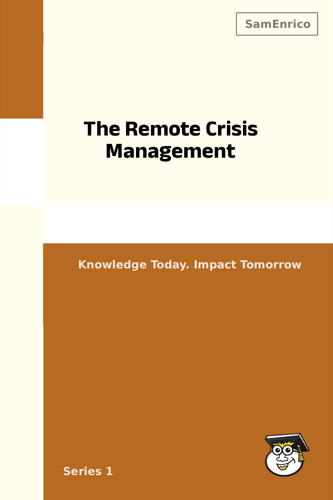
Non-FictionBusiness BriefCrisis
The Remote Crisis Management
Lead distributed teams through emergencies and urg
Lead distributed teams through emergencies and urgent situations.
Formats
About this book
Free sample
Chapter 1: The Geography of Fear...--–- The 3 AM alert arrived as a single line of text: "Multiple servers unreachable. Customer impact detected."For the New York-based engineering manager, it was 3:00 PM—the middle of a productive Tuesday. She pulled up the dashboard, saw red across three regions, and called an emergency meeting. Within fifteen minutes, she had eight engineers on a Zoom call, two senior leaders demanding updates, and a growing sense of controlled panic. Her team mobilized.
They restored service within ninety minutes. The post-mortem would later praise their "rapid response" and "effective coordination."Six thousand miles away, her Singapore-based cloud infrastructure lead woke to the same alert at 3:00 AM. He saw the same red dashboard. He checked his local systems—everything was green. He assumed the alert was a false positive, rolled over, and went back to sleep.
By the time he woke at 7:00 AM, the crisis was over. But a critical backup that only he knew how to access had been overwritten during the response. The team spent the next three days reconstructing what had been lost.The problem was not technology. It was not incompetence. It was not a failure of communication in the usual sense.It was the Geography of Fear—the hidden assumption that all team members experience a crisis simultaneously, with equal urgency, from the same vantage point.
This assumption is baked into almost every crisis management plan ever written. And it is catastrophically wrong for distributed teams.Traditional crisis management was designed for co-location. It assumes that when a fire alarm goes off, everyone hears it. When a server goes down, everyone feels the impact at the same time. When a leader calls a meeting, everyone can attend.
These assumptions have a name in the literature: the proximal bias—the unconscious belief that what is true for the person in the room is true for everyone else.For remote and distributed teams, the proximal bias is a silent killer. It creates what this chapter calls the Digital Radius of Impact (DRI) —a framework for understanding how a single event radiates differently across a…
This is the end of the free sample. Get the eBook to keep going. Buy now
Contents
- Chapter 1
- Chapter 2
- Chapter 3
- Chapter 4
- Chapter 5
- Chapter 6
- Chapter 7
- Chapter 8
- Chapter 9
- Chapter 10
- Chapter 11
- Chapter 12
Details
- Author
- Coughlin Mercedez
- Publisher
- SamEnrico
- Language
- English
- Genre
- Non-Fiction, Business Brief, Crisis
- Released
- 2026-06-07
- Pages (approx.)
- 147
- Available as
- eBook, Audiobook

Read better in the ZLOADR app
Your eBooks on your phone or tablet. Sign in with your SamEnrico account and start reading.
More by Coughlin Mercedez
 Value Index Fund InvestingCoughlin Mercedez$11.99
 Post Finasteride Syndrome GuideCoughlin Mercedez$11.99
 Caregiver Stress and RelationshipsCoughlin Mercedez$11.99
 The Lost Murals of Mexico: A Secret War Against OblivionCoughlin Mercedez$11.99
 Business Continuity SpecialistCoughlin Mercedez$11.99
 AI Quality Estimation ModelsCoughlin Mercedez$12.99
 How to Produce Boating and Water Sport ApparelCoughlin Mercedez$11.99
 How to Start a Bench Vice Business (Beginners Guide)Coughlin Mercedez$11.99
You may also like
 Hong Kong Handover 1997Dunn Johnnie$11.99
 Zumba For Postnatal Recovery CourseNeal Christian$11.99
 Zumba for BeginnersLadner Nikia$11.99
 YouTube Comment Mining GuideHumes Pandora$12.99
 Worry Box MeditationCarlin Rudy$11.99
 Workplace Stress MeditationNguyen Lynn$11.99
 Workplace Stress and Sleep RepairHawley Ivory$11.99
 Workplace Perfectionism CureDelaney Jeffry$11.99
 Workplace Injustice Anger GuideWallen Isabelle$11.99
 Work Addiction and Burnout LinkGreenwood Ester$11.99
 Women in Yoga and WellnessBeattie Galina$11.99
 Women in Stand Up ComedyChun Evangeline$11.99