
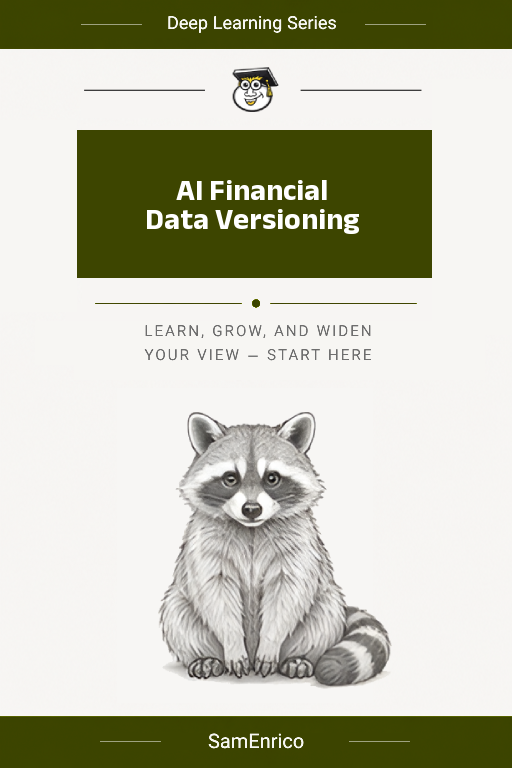
Non-FictionAI OperatorVersioning
AI Financial Data Versioning eBook
Track versions of financial data and analysis outp
Track versions of financial data and analysis outputs using AI systems.
Formats
Free sample
Chapter 1: The Billion-Dollar Typo--It was 2:47 PM on a Friday when the risk report flashed red.Not the gentle amber of a routine warning, but the deep crimson of a limit breach—the kind that triggers automated margin calls and wakes up general counsels. The chief risk officer at a mid-sized hedge fund stared at the screen, confused. The fund's flagship volatility strategy, which had generated steady 12% returns for eighteen months, was suddenly showing a 9% drawdown in a single afternoon. The models hadn't changed. The market hadn't crashed.
But the data had.The overnight batch process had ingested a new version of the volatility surface—one where a single input parameter had been adjusted. The vendor had restated its VIX futures calculation methodology, a change buried in a 47-page PDF released three weeks earlier. No one had seen it. No one had versioned it. And by the time the risk report caught the discrepancy, the fund had already levered into positions based on the old data, believing they were trading against the new reality.The loss was $47 million.
Not catastrophic enough to make headlines, but enough to end careers. The post-mortem revealed a simple truth: the fund had no way of knowing which version of market data any of its models were using at any given time. They had Git for code, spreadsheets for tracking, and hope for everything else.This is the story of financial AI in 2024. And this book exists because that story needs to change.The Invisible Crisis Every day, trillions of dollars move through systems that cannot answer three simple questions: What version of data was used to make this decision? Who changed it last?
And what downstream models might break because of that change?The financial industry has spent billions on real-time trading systems, high-frequency data feeds, and machine learning models that claim to predict market movements. But beneath all that sophistication lies a foundation of sand. Data changes constantly—corporate actions restate earnings, exchanges revise trade timestamps, vendors update their calculation methodologies—and most firms have no systematic way of tracking those changes as they propagate through their AI systems.Traditional version control tools like Git were never designed for this problem. Git excels at tracking text files—source code, configuration files, documentation. But financial data comes in Parquet files, time-series blobs, vector embeddings, and binary model artifacts.
Git chokes on files larger than a few hundred megabytes. Git-LFS can handle the size but cannot solve the deeper problem: how do you diff two versions of a vector embedding? How do you roll back a corrupted feature store without breaking every model that depends on it? How do you prove to a regulator that a specific trade decision was based on a specific version of market data from a specific point in time?The answer, as this book will show, requires a fundamental rethinking of how we build financial AI systems. It requires moving from ad-hoc versioning to systematic, AI-aware version control.
It requires treating data versions as first-class citizens, not as an afterthought in a Jupyter notebook.The Three Questions That Change Everything Before we dive into architecture, tools, and implementation, we need a framework. Throughout this book, we will return to three questions. Master these, and you master version-controlled AI for finance.Question One: Why did this version change?This is the question of provenance. Every change to a dataset, every update to a model, every new version of a prompt should have an auditable reason attached to it. Was it a corporate action?
A regulatory restatement? A bug fix in the ETL pipeline? A deliberate strategy adjustment? Without this answer, you cannot defend your decisions to a regulator, a jury, or even your own risk committee.Question Two: Who authorized it?This is the question of accountability. Version changes in finance are not neutral technical events—they have legal and financial consequences.
The person who authorizes a restatement of earnings data is different from the person who adjusts a risk model parameter. The system must track not just the change, but the identity, role, and approval chain behind it.Question Three: What downstream models or reports are affected?This is the question of impact. In traditional software development, a change to a function affects only the code that calls it. In financial AI, a change to a single data point can ripple through dozens of models, hundreds of reports, and millions of dollars of automated trading. You need to know, before you push the change, what will break.
And you need to know, after the change, what actually did break.These three questions will appear in every chapter of this book. They are not abstract ideals—they are concrete, answerable questions that any well-designed versioning system can address.What This Book Is (And Is Not)Let me be clear about the scope of this book, because the title could be misunderstood.This book is about using version control to make financial AI systems trustworthy, auditable, and reproducible. It is about building infrastructure that allows you to answer the Three Questions for every decision your AI systems make.This book is not about using AI to automate version control. While Chapters 5 and 9 will show examples of AI being used for semantic versioning of vectors and anomaly detection in data pipelines, the primary focus is on versioning as the foundation for AI, not AI as the engine of versioning. If you are looking for a book about AI systems that automatically version your data for you, this is not that book.
If you are looking for a book about how to build financial AI that you can trust, defend, and reproduce—you are in the right place.The book covers versioning of both input data (market feeds, accounting ledgers, alternative data) and output analysis (AI forecasts, anomaly detection results, LLM reasoning chains). Many practitioners focus only on the inputs, but as we will see in Chapter 8, the outputs are equally important—and equally prone to version-related failures.The Three Levels of Automated Integrity Before we close this opening chapter, I want to introduce one more framework that will appear throughout the book. The Three Questions tell us what we need to know. The Three Levels of Automated Integrity tell us how aggressively we should act on that knowledge.Level 1: Reject The first line of defense. When a new data version arrives, the system checks it against validation rules—schema constraints, statistical sanity checks, regulatory limits.
If it fails, the system rejects it before it enters production. This is preventative medicine for your data pipeline. We will implement this in Chapter 3.Level 2: Revert When a bad version slips through—because no validation is perfect—the system detects the violation and automatically rolls back to the last known clean version, flagging all downstream models that consumed the corrupted data. This is corrective medicine. We will implement this in Chapter 9.Level 3: Halt When a version change violates a hard risk limit—for example, a corporate action that would change a capital adequacy ratio below a regulatory minimum—the system halts trading or report generation until a human intervenes.
This is emergency medicine. We will implement this in Chapter 12.Most firms operate at Level 0: no automated integrity at…
This is the end of the free sample. Get the eBook to keep going. Buy now
About this book
Details
- Author
- Nicholson Katlyn
- Publisher
- SamEnrico
- Language
- English
- Genre
- Non-Fiction, AI Operator, Versioning
- Released
- 2026-05-30
- Pages (approx.)
- 154
- Available as
- eBook, Audiobook

Read better in the ZLOADR app
Your eBooks on your phone or tablet. Sign in with your SamEnrico account and start reading.
More by Nicholson Katlyn
 TM Breathing Myths Clarified WorkbookNicholson Katlyn$11.99
 Equifax's Consumer Restitution FundNicholson Katlyn$11.99
 DNA Vaccine Technology GuideNicholson Katlyn$11.99
 Negotiation Self Talk GuideNicholson Katlyn$11.99
 The Self Esteem and Partner Criticism GuideNicholson Katlyn$11.99
 The Celestial Navigators of Aksum: Africa’s Starlight EmpireNicholson Katlyn$11.99
 The Unshakeable CoreNicholson Katlyn$11.99
 How to Start a Museums of Jewellery Business (Beginners Guide)Nicholson Katlyn$11.99
 Unilever SWOT Analysis GuideNicholson Katlyn$12.99
 Understanding Myalgia Eosinophilia Associated With TryptophanNicholson Katlyn$17.99
You may also like
 Hong Kong Handover 1997Dunn Johnnie$11.99
 Zumba For Postnatal Recovery CourseNeal Christian$11.99
 Zumba for BeginnersLadner Nikia$11.99
 YouTube Comment Mining GuideHumes Pandora$12.99
 Worry Box MeditationCarlin Rudy$11.99
 Workplace Stress MeditationNguyen Lynn$11.99
 Workplace Stress and Sleep RepairHawley Ivory$11.99
 Workplace Perfectionism CureDelaney Jeffry$11.99
 Workplace Injustice Anger GuideWallen Isabelle$11.99
 Work Addiction and Burnout LinkGreenwood Ester$11.99
 Women in Yoga and WellnessBeattie Galina$11.99
 Women in Stand Up ComedyChun Evangeline$11.99