
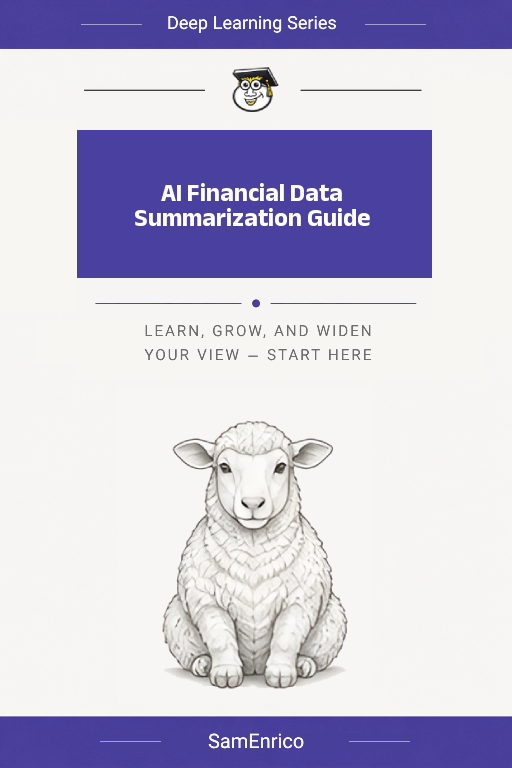
AI Financial Data Summarization Guide eBook
Generate executive summaries of lengthy financial
by Austin Ricky
Generate executive summaries of lengthy financial reports using AI text summarization.
Formats
Free sample
Chapter 1: The 4 PM Fire Drill--The email arrives at 4:07 PM on a Friday. Subject line: “URGENT – Q3 Board Materials.” The CEO needs a one-page summary of a 450-page 10-K filing by 8 AM Monday. The analyst stares at the screen, calculates the hours until deadline, and realizes there is no path to a good outcome. Pull an all-nighter and deliver something thin. Skim aggressively and miss something material.
Or admit defeat and watch someone else get the assignment next quarter.This scene plays out thousands of times every reporting season across investment banks, asset managers, corporate finance teams, and consulting firms. The specific names change. The documents change. But the fundamental math remains the same: there is too much information, too little time, and the penalty for missing something important is measured in dollars lost, regulatory fines, or career damage.Welcome to the information crisis of modern finance.The 70/30 Trap Let us name the problem. Financial professionals spend approximately 70 percent of their time on data gathering, cleaning, and basic processing.
Only 30 percent remains for actual analysis, strategic thinking, and decision-making. This statistic appears repeatedly in industry surveys from sources including the Handbook of Artificial Intelligence and Big Data Applications in Investments and proprietary research from firms like Bloomberg.Pause and consider what this means. The people hired for their judgment, pattern recognition, and strategic insight spend most of their working hours doing what amounts to advanced clerical work. They are hunting for numbers, reformatting tables, checking for consistency across documents, and extracting sentences from PDFs. The very skills that justify their compensation are underutilized because the raw material of their work is buried under an avalanche of pages.Worse, the ratio has been deteriorating.
Twenty years ago, a large public company’s annual 10-K filing might run 150 pages. Today, the same filing often exceeds 400 pages. The proliferation of risk factors, regulatory disclosures, and boilerplate language has expanded without corresponding growth in genuinely new information. More pages do not mean more signal. They mean more noise to filter.One Fortune 500 company analyzed its own reporting burden and found that its annual regulatory filings had grown 180 percent in page count over a decade while its core business description had expanded only 12 percent.
The rest was incremental disclosure requirements, legal padding, and formatting changes. The analyst’s job had become harder not because the company was more complex but because the reporting apparatus had grown like kudzu.The Mathematics of Impossible Coverage Quantify the scale of the problem. A single public company generates thousands of pages annually across a dozen document types:Form 10-K (annual report): 300–500 pages Form 10-Q (quarterly reports): 150–250 pages each, four times per year Form 8-K (material event disclosures): 5–50 pages each, often dozens per year Proxy statement (DEF 14A): 100–300 pages annually Earnings call transcripts: 30–50 pages per quarter Investor presentations: 50–100 pages per quarter Press releases: 2–5 pages each, often weekly Add to this the secondary and tertiary documents that serious analysts must monitor: competitor filings, industry reports, regulatory announcements, economic data releases, and news sentiment. A mid-sized investment firm covering 200 companies faces a yearly document volume measured in the millions of pages. No human team can process this volume comprehensively.
The choice is not between thorough and superficial. The choice is between superficial and impossible.Consider the math of attention. A reasonably fast reader processes about 300 words per minute with good comprehension. A typical page of a financial document contains roughly 500 words. Reading a single 400-page 10-K at that speed would require approximately eleven hours of nonstop reading.
That is before any analysis, any comparison to prior periods, any cross-referencing with competitor filings, or any writing of summaries for decision-makers.For a portfolio manager covering thirty companies, the quarterly reporting cycle alone demands hundreds of hours of reading. Something must give. And something does give. Analogs cut corners without admitting it. They rely on executive summaries written by the company itself, which are naturally selective and biased toward good news.
They trust that material risks will rise to the surface, though research shows that many significant risks hide in footnotes and exhibits that few readers fully examine.The False Promise of Traditional Automation Legacy tools promised relief but delivered only incremental improvement. Consider the evolution of financial technology over the past three decades.Keyword search was the first wave. The ability to press Control-F and find every appearance of “liquidity risk” across a PDF was genuinely revolutionary in the 1990s. But keyword search cannot tell you whether liquidity risk has increased, decreased, or stayed the same relative to last quarter. It cannot explain the relationship between liquidity risk and inventory turnover.
It finds sentences. It does not synthesize meaning.Boolean queries added logical operators but not intelligence. Searching for “liquidity AND risk NOT operational” still requires the user to know what they are looking for in advance. The undiscovered risk, the novel connection, the unexpected pattern—these remain invisible to Boolean logic because the analyst must specify the query before seeing the answer.Rule-based extractors automated the most repetitive tasks. A system could be programmed to find the “Current Ratio” line in a financial statement and copy the number into a spreadsheet.
This saved time but only for perfectly structured, consistently formatted documents. The moment a company changed its disclosure format, moved a table, or used slightly different terminology, the rule broke. Maintenance consumed the time saved.Early NLP sentiment analysis offered a glimpse of something smarter. Models could read a sentence and classify it as positive, negative, or neutral. Applied to earnings call transcripts, these tools could quantify whether management sounded optimistic or pessimistic.
The promise was alluring. The reality was disappointing. Generic sentiment models trained on movie reviews or product feedback could not distinguish between “our results were terrible” (clearly negative) and “our results were less terrible than expected” (often interpreted as positive by markets). They confused “the competition had a great quarter” (negative for the company) with “we had a great quarter” (positive). They missed hedging, sarcasm, and the carefully calibrated language of corporate communications.Each of these tools has its place.
Keyword search still helps find specific disclosures. Rule-based extraction still works for standardized data like XBRL-tagged financial statements. Sentiment analysis can flag potentially interesting passages for human review. But none of these tools solves the core problem: converting volume into insight. They are magnifying glasses when the task requires a telescope.The Generative Shift What changed?
Large Language Models. Specifically, the arrival of generative AI that can understand context, follow instructions, and produce human-quality text.The difference between traditional NLP and modern LLMs is best understood through an example. Hand both systems the same paragraph from a 10-K’s Management Discussion and Analysis section:“Our gross margin contracted 220 basis points to 38.5 percent during the fiscal year, primarily attributable to increased component costs following the Q2 supply chain disruption. We anticipate partial recovery in Q1 as alternative sourcing arrangements come online, though continued freight volatility presents downside risk.”A traditional sentiment analyzer would classify this as negative (contraction, disruption, risk). A keyword search would find “gross margin,” “supply chain,” and “downside risk” as separate hits.
A rule-based extractor could pull the 38.5 percent number.But a well-prompted LLM can do something none of these can: synthesize.…
This is the end of the free sample. Get the eBook to keep going. Buy now
About this book
Details
- Author
- Austin Ricky
- Publisher
- SamEnrico
- Language
- English
- Genre
- Non-Fiction, AI Operator
- Released
- 2026-05-30
- Pages (approx.)
- 120
- Available as
- eBook, Audiobook

Read better in the ZLOADR app
Your eBooks on your phone or tablet. Sign in with your SamEnrico account and start reading.
More by Austin Ricky
 Mindfulness Meditation for Social AnxietyAustin Ricky$11.99
 Boundary Setting for NomadsAustin Ricky$11.99
 Value Proposition One PagerAustin Ricky$12.99
 Emotional Intelligence For LGBTQ YouthAustin Ricky$11.99
 Drug Dependency and HousingAustin Ricky$11.99
 Acupuncture NeuropathyAustin Ricky$11.99
 The Late Assignment ForgivenessAustin Ricky$11.99
 Postpartum Bipolar GuideAustin Ricky$11.99
 UK Remote Worker Tax GuideAustin Ricky$11.99
 The Lost Olympians: How Title IX's Predecessors Fought for Women's SportsAustin Ricky$11.99
 Language Vocabulary PeggingAustin Ricky$11.99
 The Silk Road's Last Guardian: How a 13th-Century Merchant Reshaped Global TradeAustin Ricky$11.99
You may also like
 Hong Kong Handover 1997Dunn Johnnie$11.99
 Zumba For Postnatal Recovery CourseNeal Christian$11.99
 Zumba for BeginnersLadner Nikia$11.99
 YouTube Comment Mining GuideHumes Pandora$12.99
 Worry Box MeditationCarlin Rudy$11.99
 Workplace Stress MeditationNguyen Lynn$11.99
 Workplace Stress and Sleep RepairHawley Ivory$11.99
 Workplace Perfectionism CureDelaney Jeffry$11.99
 Workplace Injustice Anger GuideWallen Isabelle$11.99
 Work Addiction and Burnout LinkGreenwood Ester$11.99
 Women in Yoga and WellnessBeattie Galina$11.99
 Women in Stand Up ComedyChun Evangeline$11.99