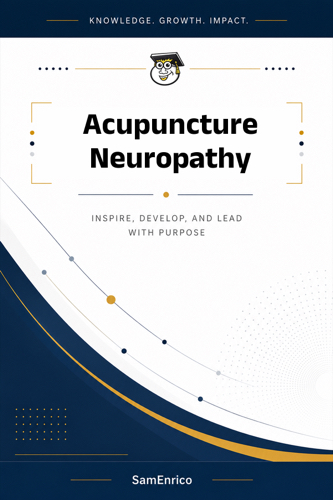
Acupuncture Neuropathy
undefined
by Austin Ricky
undefined
Formats
About this book
Free sample
Chapter 1: The Qi Paradox--–- In the winter of 1971, a New York Times columnist named James Reston lay on an operating table in Beijing, his inflamed appendix about to be removed. What happened next would alter the course of Western medicine forever. Reston, a seasoned journalist who had covered wars and presidents, found himself utterly astonished when, following his surgery, a Chinese doctor inserted several thin needles into his right elbow and beneath his knees to relieve his post-operative abdominal pain. It worked. Reston wrote about it.
And the Western world, hungry for alternatives to the rising tide of pharmaceutical side effects and the cold sterility of increasingly technological medicine, went into a frenzy. Acupuncture, an ancient art buried in the mysticism of "Qi" and meridians, had suddenly become a clinical reality on the front page of one of the world's most influential newspapers.Five decades later, we find ourselves in a peculiar and untenable position. Acupuncture is now practiced in every major hospital system across the United States, Europe, and Australia. The National Institutes of Health (NIH) has spent hundreds of millions of dollars studying it. The World Health Organization (WHO) recognizes over one hundred conditions for which acupuncture has been proven effective.
Yet, ask a room full of acupuncturists why their needles work—ask them for the biological mechanism that explains how a filament of stainless steel inserted into the skin of the foot can relieve a migraine or quiet the burning fire of diabetic neuropathy—and you will hear a dozen different answers, most of them rooted in a 2,000-year-old framework of energy channels, vital forces, and elemental imbalances.This is the Qi Paradox. The very concept that enabled acupuncture to survive for millennia—the elegant, pre-scientific metaphor of Qi (pronounced "chee") as a life-force energy flowing through meridians like rivers through a landscape—has become the single greatest barrier to its acceptance in modern, evidence-based medicine. We stand at a crossroads. One path insists on preserving the ancient language as sacred and inviolable, continuing to explain neuropathy (a disorder of the nervous system) as a "stagnation of Liver Qi" or a…
This is the end of the free sample. Get the eBook to keep going. Buy now
Contents
- Chapter 1
- Chapter 2
- Chapter 3
- Chapter 4
- Chapter 5
- Chapter 6
- Chapter 7
- Chapter 8
- Chapter 9
- Chapter 10
- Chapter 11
- Chapter 12
Details
- Author
- Austin Ricky
- Publisher
- SamEnrico
- Language
- English
- Genre
- Non-Fiction, Health & Wellness / Acupuncture
- Released
- 2026-06-08
- Pages (approx.)
- 149
- Available as
- eBook, Audiobook

Read better in the ZLOADR app
Your eBooks on your phone or tablet. Sign in with your SamEnrico account and start reading.
More by Austin Ricky
 Mindfulness Meditation for Social AnxietyAustin Ricky$11.99
 Boundary Setting for NomadsAustin Ricky$11.99
 Value Proposition One PagerAustin Ricky$12.99
 Emotional Intelligence For LGBTQ YouthAustin Ricky$11.99
 Drug Dependency and HousingAustin Ricky$11.99
 The Late Assignment ForgivenessAustin Ricky$11.99
 Postpartum Bipolar GuideAustin Ricky$11.99
 UK Remote Worker Tax GuideAustin Ricky$11.99
 The Lost Olympians: How Title IX's Predecessors Fought for Women's SportsAustin Ricky$11.99
 Language Vocabulary PeggingAustin Ricky$11.99
 The Silk Road's Last Guardian: How a 13th-Century Merchant Reshaped Global TradeAustin Ricky$11.99
 The Last Strike: The 2023 MLB Walk-Off That Defied the OddsAustin Ricky$11.99