
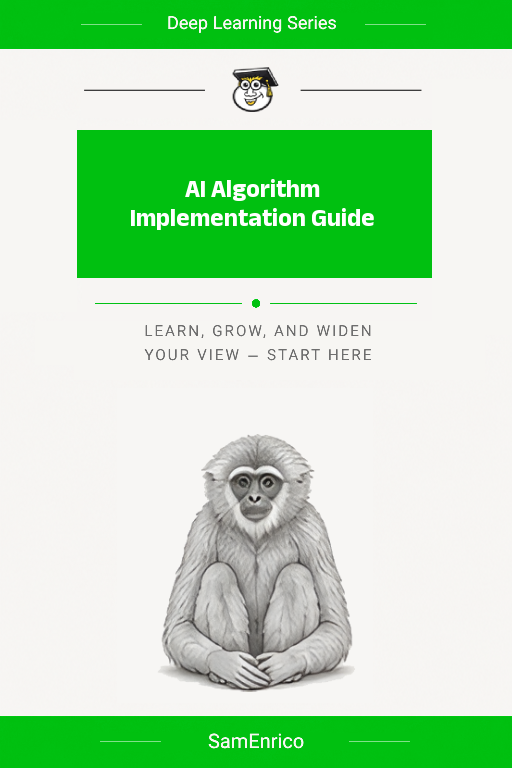
AI Algorithm Implementation Guide eBook
Implement complex algorithms with AI that explains
Implement complex algorithms with AI that explains each step.
Formats
Free sample
Chapter 1: The Tracing Habit--–- In 2018, a well-funded fintech startup called Lunar Pay lost $3.2 million in three days. Not to hackers, not to insider theft, but to their own AI algorithm. Their fraud detection model, which had scored 99.2% accuracy in testing, approved a series of obviously fraudulent transactions because the data scientists had made one subtle assumption: that algorithms behave like deterministic software. They assumed that if you gave the model the same inputs, it would produce the same reliable outputs. They were catastrophically wrong.The post-mortem revealed something embarrassing. The model wasn't broken. It was doing exactly what it was trained to do. The problem was that no one on the team had ever learned the single most important skill in AI engineering: how to think about algorithms that learn from data rather than follow fixed rules. They had copied code from a popular notebook, tweaked a few parameters, and declared victory when the accuracy metric looked good. When the model encountered real-world transactions that differed slightly from the training distribution, it started guessing randomly. The team had no systematic way to debug it because they never understood what the algorithm was actually doing under the hood.This book exists to ensure you never make that mistake.The Two Kinds of Software You Need to Know Before you write a single line of AI code, you need to internalize a distinction that most tutorials gloss over. There is a fundamental difference between traditional software engineering and AI engineering, and confusing the two is the number one predictor of project failure.Deterministic Software: The World of If-This-Then-That Traditional software is deterministic. When you write a function to calculate sales tax, the same inputs produce the same outputs every single time. If you pass in 100andataxrateof0.08,youwillalwaysgetback100 and a tax rate of 0.08, you will always get back 100andataxrateof0.08,youwillalwaysgetback8. You can test this function with a hundred different inputs, and if it passes your tests, you can deploy it with confidence. The behavior is predictable because you explicitly defined every rule.python Copy Downloaddef calculate_tax(amount, rate):
return amount * rate This is comforting. It's also completely unlike how AI algorithms work.Probabilistic Software: The World of Learning from Examples AI algorithms are probabilistic. They don't follow explicit rules. Instead, they learn patterns from data and make predictions that are statistically likely but never guaranteed. When you train a fraud detection model, you don't tell it "if amount > $10,000, flag as fraud." You show it thousands of examples of legitimate and fraudulent transactions, and the algorithm figures out its own rules. The same input might produce different outputs depending on the model's internal state, the randomness in training, or subtle shifts in the data distribution.python Copy Download# You don't write this: def detect_fraud(transaction): if transaction.amount > 10000: return True else: return False
# Instead, the algorithm learns something like this internally: # P(fraud) = sigmoid(w1*amount + w2*hour + w3*merchant_category + ...)This power comes with a cost. You cannot simply run a few tests and deploy. You cannot assume that because the model worked on your test set, it will work in production. You need a completely different mindset, a different debugging toolkit, and most importantly, a different way of reading and understanding code.The Single Most Overlooked Skill in AI Education Here is a uncomfortable truth about how most people learn AI today. They open a Jupyter notebook, find a tutorial titled "Build a Neural Network in 10 Lines of Code," copy the code, run it, see a number that looks like accuracy, and feel like they've accomplished something. They have not. They have merely executed someone else's thinking.When something goes wrong—and something always goes wrong—they have no idea how to fix it. They change random parameters, add layers, remove features, and hope the accuracy number improves. This is not engineering. This is superstition.The missing skill is something I call tracing: the disciplined practice of manually stepping through what an algorithm does with a small, concrete example before you run any code. Tracing is not new. Electrical engineers trace circuits. Compiler designers trace parse trees. But in the world of AI, tracing has been almost entirely abandoned in favor of "just run it and see what happens."This book will restore tracing as your primary learning and debugging tool.What Tracing Looks Like in Practice Tracing means taking a toy dataset—sometimes as small as four or five examples—and walking through every operation the algorithm performs. You compute distances by hand. You calculate gradients on paper. You track how weights update after each training step. You become the computer, executing the algorithm in slow motion.This sounds tedious. It is. But it is also transformative. After you have traced an algorithm three or four times, you stop treating it as magic. You see the mechanics. You know exactly what each line of code is supposed to do, and when it does something unexpected, you can pinpoint where the logic broke.Here is a concrete example that we will use throughout this book. Imagine you are building a simple algorithm to predict whether a transaction is fraudulent based on two features: transaction amount (dollars) and hour of day (0-23). Your training data has four transactions:Transaction Amount Hour Fraud?15014No (0)250003Yes (1)37515No (0)4120002Yes (1)Now, before writing any code, you would trace what a simple algorithm like K-Nearest Neighbors would do to classify a new transaction of $10,000 at 3 AM. You would manually calculate distances, find the closest neighbors, and determine the prediction. By the time you write the code, you already know exactly what it should produce. When the code gives a different answer, you don't panic. You compare your manual trace to the code's execution and find the discrepancy.The Seven Deadly Assumptions That Wreck AI Projects Through years of consulting on failed AI initiatives, I have cataloged the assumptions that separate successful AI engineers from those who produce unusable models. Every single assumption on this list is false. Every single one has cost someone millions of dollars.Assumption 1: High Accuracy Means a Good Model Accuracy is the most misleading metric in machine learning. If you are detecting fraud and only 1% of transactions are fraudulent, a model that predicts "not fraud" for every single transaction achieves 99% accuracy. It is also completely useless. Accuracy hides class imbalance, masks different error costs, and tells you nothing about where the model actually fails.Assumption 2: The Model Will Generalize to New Data Every model overfits to its training data to some degree. The question is not whether overfitting exists—it always exists—but whether you have detected it before deployment. Most teams discover generalization failures only after the model is losing money.Assumption 3: More Data Always Helps More data is not always better. Noisy data, duplicate data, or data with systematic biases will degrade your model's performance. Sometimes removing data is the single most effective improvement you can make.Assumption 4: The Training Distribution Matches Production Your training data is a historical snapshot. Production data comes from a dynamic world. Customer behavior changes. Fraud patterns evolve. Seasonality matters. The model that worked last quarter may fail tomorrow.Assumption 5: If the Code Runs, It's Correct Unlike traditional software where a runtime error means something…
This is the end of the free sample. Get the eBook to keep going. Buy now
About this book
Details
- Author
- Goldstein Felica
- Publisher
- SamEnrico
- Language
- English
- Genre
- Non-Fiction, AI Operator
- Released
- 2026-06-01
- Pages (approx.)
- 151
- Available as
- eBook, Audiobook

Read better in the ZLOADR app
Your eBooks on your phone or tablet. Sign in with your SamEnrico account and start reading.
More by Goldstein Felica
 Contract Abstraction for StartupsGoldstein Felica$11.99
 Long Term Care Basics HandbookGoldstein Felica$11.99
 Counting Breaths for ConcentrationGoldstein Felica$11.99
 China FCPA Enforcement TrackerGoldstein Felica$11.99
 Manic Episode ListeningGoldstein Felica$11.99
 Imposter Group Therapy GuideGoldstein Felica$11.99
 Stay at Home Parent TimeGoldstein Felica$11.99
 Kenya KenyattaGoldstein Felica$11.99
 Cacao Ceremony Leadership GuideGoldstein Felica$11.99
 The Unbreakable Run: The 1966 Boston Marathon's Miracle MileGoldstein Felica$11.99
 The Siege of Hattin: Saladin's Triumph Over the CrusadersGoldstein Felica$11.99
 Echoes of the Deep: The Mysterious Song of the Humpback WhaleGoldstein Felica$11.99
You may also like
 AI Presentation WorkbookSommers Tonda$11.99
 PowerPoint Copilot MasteryConway Lanita$11.99
 Branded AI DecksWindham Loni$11.99
 AI Presentation CourseGrooms Olin$11.99
 AI Presentation CertificationBlank Dolly$11.99
 AI Deck Version ControlMedley Lorina$11.99
 AI Deck Update AutomationFraser Tresa$11.99
 AI Deck Myths DebunkedCrittenden Romelia$11.99
 AI Deck Customization GuideDove Hannelore$11.99
 AI Bullet to Slide ConverterKohn Eloisa$11.99
 AI Deck Notes CreatorBarela Sunday$11.99
 AI Deck Outline GeneratorAshmore Morgan$11.99