
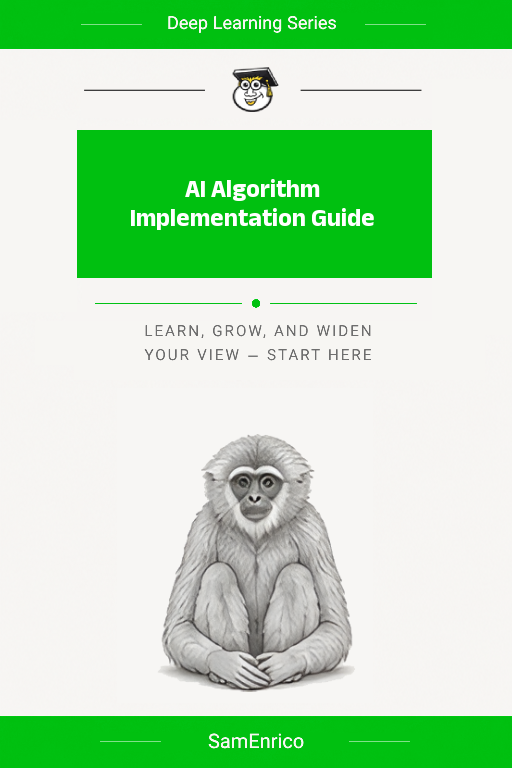
AI Algorithm Implementation Guide Audiobook
Implement complex algorithms with AI that explains
Implement complex algorithms with AI that explains each step.
Formats
Free sample
Chapter 1: The Tracing Habit--–- In 2018, a well-funded fintech startup called Lunar Pay lost $3.2 million in three days. Not to hackers, not to insider theft, but to their own AI algorithm. Their fraud detection model, which had scored 99.2% accuracy in testing, approved a series of obviously fraudulent transactions because the data scientists had made one subtle assumption: that algorithms behave like deterministic software. They assumed that if you gave the model the same inputs, it would produce the same reliable outputs. They were catastrophically wrong.The post-mortem revealed something embarrassing. The model wasn't broken. It was doing exactly what it was trained to do. The problem was that no one on the team had ever learned the single most important skill in AI engineering: how to think about algorithms that learn from data rather than follow fixed rules. They had copied code from a popular notebook, tweaked a few parameters, and declared victory when the accuracy metric looked good. When the model encountered real-world transactions that differed slightly from the training distribution, it started guessing randomly. The team had no systematic way to debug it because they never understood what the algorithm was actually doing under the hood.This book exists to ensure you never make that mistake.The Two Kinds of Software You Need to Know Before you write a single line of AI code, you need to internalize a distinction that most tutorials gloss over. There is a fundamental difference between traditional software engineering and AI engineering, and confusing the two is the number one predictor of project failure.Deterministic Software: The World of If-This-Then-That Traditional software is deterministic. When you write a function to calculate sales tax, the same inputs produce the same outputs every single time. If you pass in 100andataxrateof0.08,youwillalwaysgetback100 and a tax rate of 0.08, you will always get back 100andataxrateof0.08,youwillalwaysgetback8. You can test this function with a hundred different inputs, and if it passes your tests, you can deploy it with confidence. The behavior is predictable because you explicitly defined every rule.python Copy Downloaddef calculate_tax(amount, rate):
return amount * rate This is comforting. It's also completely unlike how AI algorithms work.Probabilistic Software: The World of Learning from Examples AI algorithms are probabilistic. They don't follow explicit rules. Instead, they learn patterns from data and make predictions that are statistically likely but never guaranteed. When you train a fraud detection…
This is the end of the free sample. Get the Audiobook to keep going. Buy now
About this book
Details
- Author
- Goldstein Felica
- Publisher
- SamEnrico
- Language
- English
- Genre
- Non-Fiction, AI Operator
- Released
- 2026-06-01
- Pages (approx.)
- 151
- Available as
- eBook, Audiobook

Listen in the VoxFlicks app
Audiobooks and audio dramas wherever you go. Sign in with your SamEnrico account and press play.
More by Goldstein Felica
 Contract Abstraction for StartupsGoldstein Felica$11.99
 Long Term Care Basics HandbookGoldstein Felica$11.99
 Counting Breaths for ConcentrationGoldstein Felica$11.99
 China FCPA Enforcement TrackerGoldstein Felica$11.99
 Manic Episode ListeningGoldstein Felica$11.99
 Imposter Group Therapy GuideGoldstein Felica$11.99
 Stay at Home Parent TimeGoldstein Felica$11.99
 Kenya KenyattaGoldstein Felica$11.99
 Cacao Ceremony Leadership GuideGoldstein Felica$11.99
 The Unbreakable Run: The 1966 Boston Marathon's Miracle MileGoldstein Felica$11.99
 The Siege of Hattin: Saladin's Triumph Over the CrusadersGoldstein Felica$11.99
 Echoes of the Deep: The Mysterious Song of the Humpback WhaleGoldstein Felica$11.99
You may also like
 AI Presentation WorkbookSommers Tonda$11.99
 PowerPoint Copilot MasteryConway Lanita$11.99
 Branded AI DecksWindham Loni$11.99
 AI Presentation CourseGrooms Olin$11.99
 AI Presentation CertificationBlank Dolly$11.99
 AI Deck Version ControlMedley Lorina$11.99
 AI Deck Update AutomationFraser Tresa$11.99
 AI Deck Myths DebunkedCrittenden Romelia$11.99
 AI Deck Customization GuideDove Hannelore$11.99
 AI Bullet to Slide ConverterKohn Eloisa$11.99
 AI Deck Notes CreatorBarela Sunday$11.99
 AI Deck Outline GeneratorAshmore Morgan$11.99