
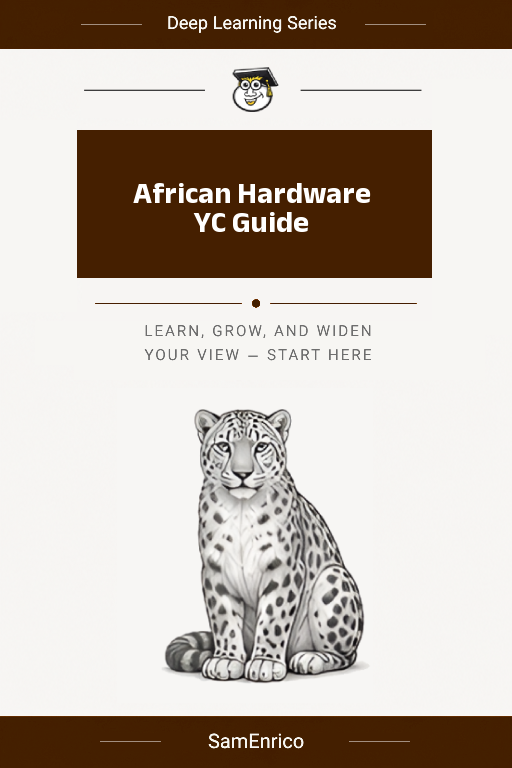
Non-FictionStartup GuideAccelerator Prep
African Hardware YC Guide eBook
Apply to Y Combinator with an African hardware sta
by Platt Rudolf
Apply to Y Combinator with an African hardware startup. Manufacturing and supply chain challenges.
Formats
Free sample
Chapter 1: The 23 Ghosts--The winter of 2022 was supposed to be the moment Africa arrived.Twenty-three startups from the continent had just been admitted to Y Combinator’s batch. Twenty-three. That was more than the previous five years combined. Flutterwave had already proven the model—a Nigerian fintech that processed billions in payments, backed by Stripe and Visa. Paystack had sold to Stripe for over $200 million.
The narrative was set: Africa was the next great startup frontier, and YC was the golden gate.I was sitting in a cramped co-working space in Yaba, Lagos, the so-called Silicon Valley of Africa, when the news broke. The founders around me celebrated. Bottles of Star Lager were opened. Someone projected the YC acceptance letter onto a stained white wall and the room cheered. We all believed the same thing: the floodgates had opened.They had not.
They were about to slam shut.Two years later, I sat in that same co-working space, now emptier. The same projector sat unused in the corner. And I was on a video call with a hardware founder who had just received her fourth rejection from YC. She had built a solar-powered cold storage unit for rural fish vendors—a real product, with real paying customers. She had applied three times.
Each time, the feedback was the same polite silence. Each time, she tweaked her pitch, her metrics, her dreams. And each time, the answer was no."I don't understand," she said, her voice crackling over the unreliable connection. "What did we do wrong?"Nothing. And everything.
The game had changed while she was playing by the old rules.This chapter is not a eulogy for Y Combinator. It is a post-mortem on a myth—the myth that the old path still works. Because here is the truth that no one in that Yaba co-working space wanted to admit in 2022: YC is quietly retreating from Africa. The golden gate is closing. And for hardware founders, the door is already locked.The data is brutal and indisputable.
After that peak of 23 African startups in Winter 2022, the numbers cratered. Spring 2023: a handful. Winter 2024: zero. Zero African startups in recent batches. Not a single one.
Meanwhile, the number of US-based AI startups in those same batches skyrocketed past 200. The message from Silicon Valley could not be clearer: we are no longer looking south.But the data only tells half the story. The other half is a visa denial letter.The Visa Wall That No One Talks About Let me tell you about the visa wall, because this is where dreams go to die quietly.Y Combinator announced in late 2023 that all founders in the batch must attend in person in San Francisco. Not optional. Not hybrid.
In person, for the entire three months. For a founder in Lagos or Nairobi or Cairo, that is not an inconvenience. It is an almost insurmountable barrier.The United States immigration system does not move at startup speed. To get a B1/B2 business visa, an African founder typically needs an interview appointment. In Lagos, the wait time for that appointment is often six to eight months.
In Nairobi, similar. In Accra, sometimes longer. Even after you secure the appointment, the consular officer has enormous discretion to deny you for any reason or no reason at all.I have watched founders sell their cars to pay for visa application fees and non-refundable plane tickets to the embassy. I have watched them sit in the waiting room with printed YC acceptance letters trembling in their hands. I have watched consular officers glance at those letters for three seconds, then stamp "DENIED" and slide the passport back under the glass."Why?" the founders ask.
The consular officer is already calling the next number.The official reason is always the same: "You have not demonstrated sufficient ties to your home country." In other words, the US government believes you will overstay your visa and disappear into the undocumented economy. Never mind that you have a company to run. Never mind that you have employees. Never mind that you have a $10,000 prototype sitting in a shipping container that you are trying to clear through customs. The assumption is that you are a risk.And here is the cruel irony: YC knows this.
The partners are not naive. They understand that requiring in-person attendance effectively filters out most international founders. But they made the calculation anyway. The batch experience, they argue, requires physical proximity. The magic happens in late-night hallway conversations, in the shared struggle of the Hacker News demo day, in the random collisions that cannot happen over Zoom.That calculation may be true for YC.
It is devastating for African founders.I have a friend—let us call him Tunde—who actually got the visa. He was the exception. He flew to San Francisco, attended the batch, did the demo day, and raised a $2 million seed round. His hardware startup made low-cost soil sensors for smallholder farmers. The product worked.
The metrics improved. Everything was going according to plan.Then he flew back to Lagos and the problems began. His supply chain fell apart because he had been away for three months. His lead engineer quit. A competitor copied his sensor design and started selling it for half the price.
Within a year, the startup was dead.Tunde told me later, over a beer in that same Yaba co-working space, that he wished he had never gone to YC. "It took my eyes off the ground," he said. "I was flying to San Francisco to impress investors who didn't understand my market, while my actual market burned."This is not an argument against YC. It is an argument against treating YC as the only path. Because for every Tunde who makes it to San Francisco, there are dozens who never get the visa, dozens more who get the visa but lose their momentum, and hundreds who never even apply because the process is too expensive, too uncertain, and too distant from their reality.The Hype Hangover: What the 2022 Bubble Hid Let me take you back to 2020 through 2022.
Interest rates were near zero. Venture capital was sloshing around the global economy like an overflowing bathtub. Every fund was looking for the next big thing, and Africa was the story they wanted to tell.Flutterwave raised 170millionata170 million at a 170millionata1 billion valuation. Paystack sold to Stripe for 200million.Wave(the Senegalesemobilemoneycompany)raised200 million. Wave (the Senegalese mobile money company) raised 200million.Wave(the Senegalesemobilemoneycompany)raised200 million at a $1.7 billion valuation.
The headlines wrote themselves: "Africa's Tech Boom Is Just Getting Started." "The Next Unicorns Are Coming from Lagos." "Silicon Valley Discovers the Mother Continent."It was a bubble. And like all bubbles, it burst.The hangover arrived in 2023. Interest rates rose. US funds cut back on international bets. The narrative shifted hard from "emerging markets are the future" to "AI is the only thing that matters." Almost overnight, African startups went from hot to not.
The partners who used to make scouting trips to Lagos stopped coming. The angel syndicates that used to co-invest shut down. The media moved on.The numbers tell the story. In 2021, African startups raised over $5…
This is the end of the free sample. Get the eBook to keep going. Buy now
About this book
Details
- Author
- Platt Rudolf
- Publisher
- SamEnrico
- Language
- English
- Genre
- Non-Fiction, Startup Guide, Accelerator Prep
- Released
- 2026-05-30
- Pages (approx.)
- 146
- Available as
- eBook, Audiobook

Read better in the ZLOADR app
Your eBooks on your phone or tablet. Sign in with your SamEnrico account and start reading.
More by Platt Rudolf
 Mechanical Engineering CreativityPlatt Rudolf$11.99
 The France Follow Up EtiquettePlatt Rudolf$11.99
 Administrative Burden Anger GuidePlatt Rudolf$11.99
 Creating a Relapse Prevention ToolboxPlatt Rudolf$11.99
 Even A Penny Helps TechniquePlatt Rudolf$11.99
 The Lioness of Sheba: The Queen Who Shaped a KingdomPlatt Rudolf$11.99
 Understanding Trisomy 6Platt Rudolf$17.99
 How to Become a Pipe-smoker-machine OperatorPlatt Rudolf$11.99
 Cross-Border VAT Recovery GuidePlatt Rudolf$12.99
 Commission AnalystPlatt Rudolf$11.99
You may also like
 Hong Kong Handover 1997Dunn Johnnie$11.99
 Zumba For Postnatal Recovery CourseNeal Christian$11.99
 Zumba for BeginnersLadner Nikia$11.99
 YouTube Comment Mining GuideHumes Pandora$12.99
 Worry Box MeditationCarlin Rudy$11.99
 Workplace Stress MeditationNguyen Lynn$11.99
 Workplace Stress and Sleep RepairHawley Ivory$11.99
 Workplace Perfectionism CureDelaney Jeffry$11.99
 Workplace Injustice Anger GuideWallen Isabelle$11.99
 Work Addiction and Burnout LinkGreenwood Ester$11.99
 Women in Yoga and WellnessBeattie Galina$11.99
 Women in Stand Up ComedyChun Evangeline$11.99