
Non-FictionSelf-HelpLearning Science
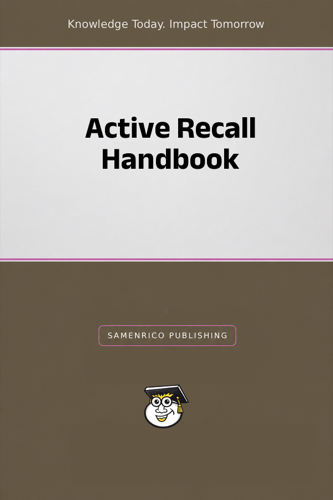
Active Recall Handbook eBook
Forces brain retrieval instead of passive review.
by Vick Alise
Forces brain retrieval instead of passive review.
Formats
Free sample
Chapter 1: The Highlighting Hangover...--–- Sarah had spent forty-seven hours studying for her medical school anatomy final. Her desk was a shrine to effort: four colors of highlighters, thirty-seven pages of handwritten notes, and a textbook with more underlined passages than blank space. She had reread the chapter on the brachial plexus seven times. She had summarized each paragraph in the margins. She had color-coded every nerve, every branch, every potential clinical correlation.
When she closed her book the night before the exam, she felt something she had learned to trust: the warm, fuzzy confidence of familiarity. She knew this material. She could practically see the pages in her mind.Two days later, she stared at her score: sixty-two percent.Not a failure, but close enough to feel like one. The worst part was not the grade. The worst part was the confusion.
"I knew this," she whispered to herself in the empty hallway outside the exam room. "I really knew it." But the exam had not asked her to recognize the brachial plexus on a multiple-choice diagram. It had asked her to describe, from memory, the clinical consequences of an upper trunk injury. It had asked her to recall, not to recognize. And in that gap between recognition and recall, Sarah’s forty-seven hours had evaporated like morning fog.This chapter is for everyone who has ever felt exactly what Sarah felt.
It is for the college student who rereads chapters three times before an exam and still freezes. It is for the professional studying for a certification who highlights entire PDFs and then cannot remember a single key point. It is for the lifelong learner who watches educational videos at 1.5x speed, nodding along, only to realize a week later that almost nothing stuck. The problem is not your intelligence, your effort, or your dedication. The problem is that you have been taught to study in ways that feel productive but are, in fact, almost worthless.
And the first step to fixing that problem is understanding why your brain lies to you about what learning actually looks like.The Great Study Myth Let us begin with an uncomfortable truth. The most common study methods—rereading textbooks, highlighting passages, and summarizing notes while looking at the source—are among the least effective strategies ever measured in cognitive science research. This is not an opinion. It is a conclusion supported by more than a century of experimental evidence, replicated across thousands of participants, from elementary school students to medical residents to elderly adults learning new skills. And yet, these methods remain the default for the vast majority of learners.Why?
Because they feel good.When you reread a chapter you have already read, the text flows smoothly. The words are familiar. Your brain processes the information with less effort than it did the first time. That feeling of ease, of smooth cognitive processing, is what psychologists call fluency. And fluency is dangerously deceptive.
It produces the illusion of competence—the subjective sensation that you have mastered material when you have, in fact, only grown comfortable with its appearance.Consider a simple experiment you can run on yourself right now. Read the following sentence carefully: "The ball was thrown by the boy." Easy, right? Now, without looking back, what were the exact words? Most people remember the gist—a boy threw a ball—but not the precise phrasing. Now try a different task: complete this sentence: "The ball was thrown by the ______." That tiny gap forces your brain to retrieve.
It feels harder. It takes an extra fraction of a second. But that extra fraction of a second is the difference between passive familiarity and active memory. That is the difference between Sarah's warm, fuzzy confidence and actual exam performance.Rereading, highlighting, and open-book summarization are the study equivalents of watching a cooking show and believing you can now prepare a five-course meal. You have seen the technique.
You have heard the explanation. You might even nod along as the chef explains why she deglazes the pan with wine instead of stock. But when you stand in your own kitchen, ingredients spread across the counter, the illusion shatters. Seeing is not doing. Recognizing is not recalling.
And studying for recognition is the single most common mistake learners make.Recognition Versus Recall: The Critical Distinction You Have Never Been Taught To understand why your study habits are failing you, you must understand a fundamental distinction that most students never learn. Cognitive psychologists divide memory retrieval into two broad categories: recognition and recall.Recognition is the ability to identify something you have encountered before. Multiple-choice questions test recognition. When you see four options and one looks familiar, you are using recognition. Recognition is relatively easy because the correct answer is present in front of you.
Your brain does not have to generate it from nothing; it only has to select it from a menu. Recognition is the cognitive equivalent of picking your car out of a parking lot. You do not have to draw the car from memory. You just have to spot the one that matches.Recall, by contrast, is the ability to produce information from memory without any cues. Essay questions test recall.
Problem-solving tests recall. Explaining a concept to a colleague tests recall. When you sit down to write a paragraph about the causes of World War I, no one hands you a list of options. Your brain must search its vast archives, locate the relevant information, and assemble it into coherent language. Recall is the cognitive equivalent of drawing your car from memory, including the shape of the headlights, the placement of the side mirror, and the pattern of wear on the driver's seat.Here is the problem that destroys thousands of study hours every semester: most students study for recognition but are tested on recall.When Sarah reread her anatomy textbook, she was training her brain to recognize the material.
Each pass through the chapter made the text feel more familiar. The fluency illusion grew stronger. She confused the ease of processing with the depth of learning. But the exam demanded recall. It asked her to produce information without cues.
And her brain, trained only on recognition, had no practice generating those answers from scratch.This is not a minor mismatch. It is a category error. Studying for recognition when you need recall is like training for a marathon by watching videos of other people running. You will feel informed. You will not be prepared.The Anatomy of a Flawed Study Session Let us look inside a typical study session.
You open your textbook to Chapter 6. You read the first paragraph. You take out a highlighter and mark three sentences that seem important. You read the second paragraph. You highlight two more sentences.
By the end of the chapter, your page looks like a rainbow exploded on it. You feel a sense of accomplishment. You have done something. You have been active—moving a highlighter, flipping pages, scanning text. But what has your brain actually done?The answer is surprisingly little.Highlighting, despite its popularity, produces near-zero measurable benefit in most studies.
The act of marking text does not encode information into memory. It simply identifies what you might want to study…
This is the end of the free sample. Get the eBook to keep going. Buy now
About this book
Details
- Author
- Vick Alise
- Publisher
- SamEnrico
- Language
- English
- Genre
- Non-Fiction, Self-Help, Learning Science
- Released
- 2026-06-08
- Pages (approx.)
- 142
- Available as
- eBook, Audiobook

Read better in the ZLOADR app
Your eBooks on your phone or tablet. Sign in with your SamEnrico account and start reading.
More by Vick Alise
 The Shared Experience StarterVick Alise$11.99
 Franchising Your Local Brand Across Borders Real Estate GuideVick Alise$11.99
 Assertiveness in TherapyVick Alise$11.99
 Tall Girl Self EsteemVick Alise$11.99
 Stimulant Hepatitis RiskVick Alise$11.99
 Skinwalker Ranch ConnectionVick Alise$11.99
 Fetal Alcohol Syndrome GamblingVick Alise$11.99
 Grace in Motion: The Grandeur of Black Ballet’s Royal CourtsVick Alise$11.99
 The Healing Hands of Ankhnesmeryre: Egypt's Forgotten Medical GeniusVick Alise$11.99
 Mastering The Art of Bakti NegaraVick Alise$11.99
 How to Produce Spray PaintVick Alise$11.99
 How to Produce GraphiteVick Alise$11.99
You may also like
 Hong Kong Handover 1997Dunn Johnnie$11.99
 Zumba For Postnatal Recovery CourseNeal Christian$11.99
 Zumba for BeginnersLadner Nikia$11.99
 YouTube Comment Mining GuideHumes Pandora$12.99
 Worry Box MeditationCarlin Rudy$11.99
 Workplace Stress MeditationNguyen Lynn$11.99
 Workplace Stress and Sleep RepairHawley Ivory$11.99
 Workplace Perfectionism CureDelaney Jeffry$11.99
 Workplace Injustice Anger GuideWallen Isabelle$11.99
 Work Addiction and Burnout LinkGreenwood Ester$11.99
 Women in Yoga and WellnessBeattie Galina$11.99
 Women in Stand Up ComedyChun Evangeline$11.99