
Non-FictionInformativeEducational
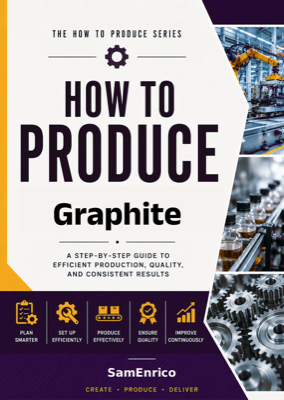
How to Produce Graphite
This publication, published by SamEnrico, covers H
by Vick Alise
This publication, published by SamEnrico, covers How to Produce Graphite
Formats
About this book
Free sample
Chapter 1: The Invisible Backbone–- Every time you charge a smartphone, start an electric vehicle, or even use a cordless power tool, you rely on a material that most people have never thought about. It is black, soft to the touch, and looks more like soot than the technological marvel it truly is. That material is graphite, and without it, the modern world as we know it would simply cease to function. Not because gasoline would run out or because power plants would shut down, but because every single lithium-ion battery—every one of the billions produced each year—would stop working. No other material has been found that can do what graphite does in a battery.
After decades of research involving thousands of scientists and billions of dollars, the humble crystalline form of carbon remains irreplaceable. This chapter reveals why graphite has become the invisible backbone of the energy transition, how global supply chains have become dangerously concentrated, and why understanding this material is no longer a niche interest but a strategic necessity for investors, policymakers, and anyone who cares about the future of transportation.The Battery Secret That Changed Everything To understand graphite’s importance, one must first understand the lithium-ion battery. The battery has four essential components: a cathode (typically containing lithium, cobalt, nickel, and manganese), an anode (almost always graphite), a separator (a thin polymer membrane that keeps the cathode and anode apart while allowing lithium ions to pass), and an electrolyte (a lithium salt dissolved in organic solvents that conducts ions between the electrodes). When the battery charges, lithium ions are pulled from the cathode and travel through the electrolyte toward the anode. They then insert themselves between the hexagonal layers of the graphite structure—a process called intercalation.
When the battery discharges, those same lithium ions travel back to the cathode, releasing electrical energy that powers the device.What makes graphite uniquely suited for this role is its crystal structure. Carbon atoms in graphite are arranged in stacked hexagonal sheets, like a deck of cards with each card being a single atomic layer of graphene.…
This is the end of the free sample. Get the eBook to keep going. Buy now
Contents
- Chapter 1
- Chapter 2
- Chapter 3
- Chapter 4
- Chapter 5
- Chapter 6
- Chapter 7
- Chapter 8
- Chapter 9
- Chapter 10
- Chapter 11
- Chapter 12
Details
- Author
- Vick Alise
- Publisher
- SamEnrico
- Language
- English
- Genre
- Non-Fiction, Informative, Educational
- Released
- 2026-06-02
- Pages (approx.)
- 135
- Available as
- eBook, Audiobook

Read better in the ZLOADR app
Your eBooks on your phone or tablet. Sign in with your SamEnrico account and start reading.
More by Vick Alise
 The Shared Experience StarterVick Alise$11.99
 Franchising Your Local Brand Across Borders Real Estate GuideVick Alise$11.99
 Assertiveness in TherapyVick Alise$11.99
 Tall Girl Self EsteemVick Alise$11.99
 Active Recall HandbookVick Alise$11.99
 Stimulant Hepatitis RiskVick Alise$11.99
 Skinwalker Ranch ConnectionVick Alise$11.99
 Fetal Alcohol Syndrome GamblingVick Alise$11.99
 Grace in Motion: The Grandeur of Black Ballet’s Royal CourtsVick Alise$11.99
 The Healing Hands of Ankhnesmeryre: Egypt's Forgotten Medical GeniusVick Alise$11.99
 Mastering The Art of Bakti NegaraVick Alise$11.99
 How to Produce Spray PaintVick Alise$11.99
You may also like
 Hong Kong Handover 1997Dunn Johnnie$11.99
 Zumba For Postnatal Recovery CourseNeal Christian$11.99
 Zumba for BeginnersLadner Nikia$11.99
 YouTube Comment Mining GuideHumes Pandora$12.99
 Worry Box MeditationCarlin Rudy$11.99
 Workplace Stress MeditationNguyen Lynn$11.99
 Workplace Stress and Sleep RepairHawley Ivory$11.99
 Workplace Perfectionism CureDelaney Jeffry$11.99
 Workplace Injustice Anger GuideWallen Isabelle$11.99
 Work Addiction and Burnout LinkGreenwood Ester$11.99
 Women in Yoga and WellnessBeattie Galina$11.99
 Women in Stand Up ComedyChun Evangeline$11.99