
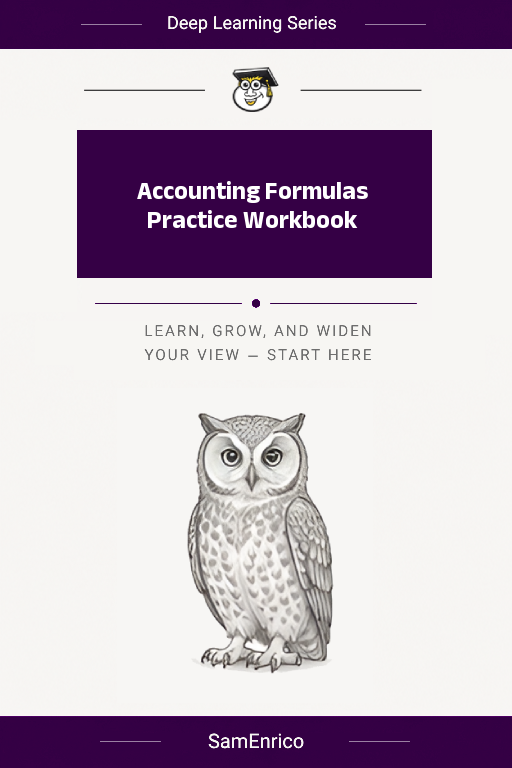
Non-FictionStudent's ShortcutPractice
Accounting Formulas Practice Workbook eBook
Apply every formula with real company financial st
by Porter Sonja
Apply every formula with real company financial statements and answer keys.
Formats
Free sample
Chapter 1: The Unbreakable Scale--Every financial statement in the world, from a lemonade stand’s napkin scribble to Apple’s billion-dollar annual report, balances on a single, unbreakable rule. It is not a suggestion. It is not a guideline. It is the law of double-entry accounting, and once you understand it, you will never look at a company the same way again.This rule is called the accounting equation, and it is deceptively simple:Assets = Liabilities + Equity That’s it. Three categories.
One equals sign. And yet, this tiny formula is the foundation upon which every public company’s financial reports are built. When you hear that a company “cooked the books,” they broke this equation. When you hear that a company “restated earnings,” they fixed this equation. When Warren Buffett decides to buy a company, the first thing he checks is whether this equation holds.In this chapter, you will not merely memorize the accounting equation.
You will break it, rebuild it, and apply it to one of the largest retailers in history: Walmart. By the time you finish the 50 transaction drills and the real-company analysis, this equation will be etched into your muscle memory. You will see it behind every balance sheet, every income statement, and every cash flow report for the rest of your career.Let us begin with the anatomy of the equation.The Three Pillars of Every Business Before you can use the equation, you must understand what each term actually means in plain English. Accounting textbooks love to drown readers in definitions. We will take the opposite approach: we will define each term by what it does.Assets are what the company owns or controls that have future economic value.
Cash in the bank. Inventory on shelves. Equipment in factories. Patents. Accounts receivable (money customers owe).
If a company can sell it, use it, or collect it, it is an asset. The key word is control. If a company leases a building for ten years, that lease gives them control—so it counts as an asset (specifically a “right-of-use asset”).Liabilities are what the company owes to others. Bank loans. Accounts payable (money owed to suppliers).
Salaries owed to employees. Taxes owed to the government. Rent owed for next month. A liability is a claim on the company’s assets by someone who is not an owner.Equity is what is left over for the owners after you subtract liabilities from assets. It is the residual claim.
If a company liquidated today—sold all its assets and paid off all its liabilities—the remaining cash would go to shareholders. That remaining cash is equity. Equity has two main components: money invested by owners (paid-in capital) and profits that have been kept in the business (retained earnings).Here is the intuition that textbooks rarely state directly: The accounting equation is a zero-sum game. Every transaction affects at least two accounts. If an asset increases, either another asset decreases (you paid cash to buy inventory) or a liability increases (you borrowed money to buy inventory) or equity increases (an owner invested money).
The equals sign is not decorative. It is a constraint.Now let us see this constraint in action.The 50 Transaction Drills (Batched for Active Learning)The following drills are organized into five batches of ten transactions each. Following the Active Learning Protocol from the Introduction, you will complete one batch, then check your answers before moving to the next batch. This prevents compounding errors while preserving the benefits of retrieval practice.For each transaction, identify which two accounts change and whether each account increases (+) or decreases (-). The accounting equation must remain in balance after every transaction.Example: Buy inventory for $10,000 cash.Inventory (Asset) increases by $10,000 (+)Cash (Asset) decreases by $10,000 (-)Equation: Assets increase and decrease by same amount.
Balance maintained.Critical Note: Some transactions affect equity directly (revenues, expenses, dividends, owner investments). We will mark those clearly.Batch 1: Foundational Transactions (Check after #10)Invest $50,000 cash into a new business in exchange for common stock.Borrow $30,000 from a bank, signing a note payable.Purchase equipment for $20,000 cash.Purchase inventory for $15,000 on account (credit terms, pay later).Sell goods costing 5,000for5,000 for 5,000for8,000 cash. (Two accounts: one for cash, one for inventory. Also record the revenue.)Pay $3,000 to a supplier for inventory purchased earlier on account.Receive $2,000 from a customer for services to be performed next month. (This is unearned revenue—a liability.)Pay $1,500 in salaries to employees.Purchase a two-year insurance policy for $2,400 cash.The owner withdraws $1,000 cash for personal use.
(This is a dividend, which reduces equity.)After Batch 1, check your answers in the Answer Key Index. Log any errors in your Error Log Template before proceeding.Batch 2: Operating Transactions (Check after #20)Provide services worth $4,000 to a customer who pays immediately.Provide services worth $6,000 to a customer who will pay in 30 days.Pay $500 for utilities expense.Purchase office supplies for $800 cash.At month end, $300 of office supplies remain. Record the supplies used as expense.Pay $2,000 toward the principal of the bank loan from transaction #2.Pay $200 interest on the bank loan.Receive $4,000 from the customer in transaction #12 (partial payment).Record depreciation of $1,000 on the equipment from transaction #3.The company issues additional common stock for $10,000 cash.After Batch 2, check your answers. Log errors.Batch 3: Accruals and Deferrals (Check after #30)At month end, $500 of salaries have been earned by employees but will not be paid until next month.The insurance policy from transaction #9: record one month of expense.Customer from transaction #7 receives the promised services. Now reduce the liability.The company declares and pays a $2,000 dividend.Purchase a patent for $12,000 cash.
(Patent is an intangible asset.)Record amortization of the patent: $200 for the month.Sell equipment originally costing 20,000 (transaction #3) for 15,000 cash. The equipment has accumulated depreciation of $4,000.Receive a $5,000 invoice from a law firm for services already performed. Pay immediately.A customer prepays $7,000 for a large order to be delivered next quarter.Pay $1,200 for a one-year advertising contract. Record as prepaid expense.After Batch 3, check your answers. Log errors.Batch 4: Complex Scenarios (Check after #40)Issue 1,000 shares of 1parvaluecommonstockfor1 par value common stock for 1parvaluecommonstockfor25 per share.Convert a $10,000 accounts payable into a 6-month note payable.A piece of land on the books for 100,000isnowworth100,000 is now worth 100,000isnowworth150,000.
Do we adjust? (Answer: Under historical cost accounting, no.)Collect $3,000 of accounts receivable that were previously written off as uncollectible.Write off $2,000 of accounts receivable as uncollectible (direct write-off method).Record bad debt expense of $1,500 using the allowance method.Pay a 10,000cashdividend.Thecompanyhad10,000 cash dividend. The company had 10,000cashdividend.Thecompanyhad50,000 of retained earnings.Receive inventory costing 12,000.Pay12,000. Pay 12,000.Pay4,000 cash and put the rest on account.Return defective inventory costing $2,000 to a supplier for a full refund.The company signs a five-year lease for a building. Total lease payments are $240,000.
Record the right-of-use asset and lease liability.After Batch 4, check your answers. Log errors.Batch 5: Advanced and Exam-Style (Check after #50)Declare a 10% stock dividend. The company has 100,000 shares outstanding, 1parvalue,marketprice1 par value, market price 1parvalue,marketprice15 per share.Distribute the stock dividend declared in #41.Purchase treasury stock: 5,000 shares at $18 per share.Reissue 2,000 treasury shares at $22 per share.Reissue 1,000 treasury shares at $15 per share (below cost).Retire 1,000…
This is the end of the free sample. Get the eBook to keep going. Buy now
About this book
Details
- Author
- Porter Sonja
- Publisher
- SamEnrico
- Language
- English
- Genre
- Non-Fiction, Student's Shortcut, Practice
- Released
- 2026-06-01
- Pages (approx.)
- 159
- Available as
- eBook, Audiobook

Read better in the ZLOADR app
Your eBooks on your phone or tablet. Sign in with your SamEnrico account and start reading.
More by Porter Sonja
 Uber Driver App Feature GuidePorter Sonja$11.99
 Processing Nightmares For Autistic AdultsPorter Sonja$11.99
 Immigrant Construction MagnatePorter Sonja$11.99
 Bob Dylan VoicePorter Sonja$11.99
 The Self Hypnosis for SkepticsPorter Sonja$11.99
 Virtual Background GuidePorter Sonja$11.99
 Grit Habits Daily GuidePorter Sonja$11.99
 Combined Pill GuidePorter Sonja$11.99
 The Golden Quill: The Lost Sonnets of the Songhai RenaissancePorter Sonja$11.99
 The Spy Who Saved a Nation: The Daring Rescue of Simón Bolívar’s EnvoyPorter Sonja$11.99
 A Collector's Handbook to the Skoda 450Porter Sonja$11.99
 Polish GDPR Compliance for Remote DataPorter Sonja$12.99
You may also like
 Hong Kong Handover 1997Dunn Johnnie$11.99
 Zumba For Postnatal Recovery CourseNeal Christian$11.99
 Zumba for BeginnersLadner Nikia$11.99
 YouTube Comment Mining GuideHumes Pandora$12.99
 Worry Box MeditationCarlin Rudy$11.99
 Workplace Stress MeditationNguyen Lynn$11.99
 Workplace Stress and Sleep RepairHawley Ivory$11.99
 Workplace Perfectionism CureDelaney Jeffry$11.99
 Workplace Injustice Anger GuideWallen Isabelle$11.99
 Work Addiction and Burnout LinkGreenwood Ester$11.99
 Women in Yoga and WellnessBeattie Galina$11.99
 Women in Stand Up ComedyChun Evangeline$11.99