
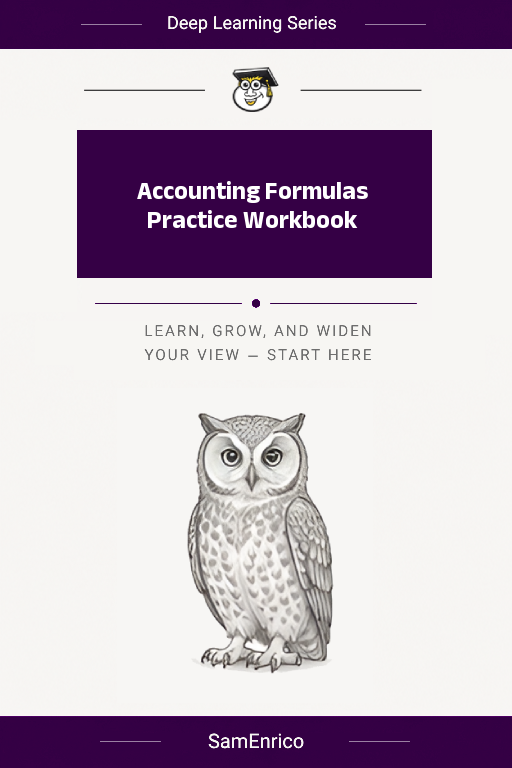
Non-FictionStudent's ShortcutPractice
Accounting Formulas Practice Workbook Audiobook
Apply every formula with real company financial st
by Porter Sonja
Apply every formula with real company financial statements and answer keys.
Formats
Free sample
Chapter 1: The Unbreakable Scale--Every financial statement in the world, from a lemonade stand’s napkin scribble to Apple’s billion-dollar annual report, balances on a single, unbreakable rule. It is not a suggestion. It is not a guideline. It is the law of double-entry accounting, and once you understand it, you will never look at a company the same way again.This rule is called the accounting equation, and it is deceptively simple:Assets = Liabilities + Equity That’s it. Three categories.
One equals sign. And yet, this tiny formula is the foundation upon which every public company’s financial reports are built. When you hear that a company “cooked the books,” they broke this equation. When you hear that a company “restated earnings,” they fixed this equation. When Warren Buffett decides to buy a company, the first thing he checks is whether this equation holds.In this chapter, you will not merely memorize the accounting equation.
You will break it, rebuild it, and apply it to one of the largest retailers in history: Walmart. By the time you finish the 50 transaction drills and the real-company analysis, this equation will be etched into your muscle memory. You will see it behind every balance sheet, every income statement, and every cash flow report for the rest of your career.Let us begin with the anatomy of the equation.The Three Pillars of Every Business Before you can use the equation, you must understand what each term actually means in plain English. Accounting textbooks love to drown readers in definitions. We will take the opposite approach: we will define each term by what it does.Assets are what the company owns or controls that have future economic value.
Cash in the bank. Inventory on shelves. Equipment in factories. Patents. Accounts receivable (money customers owe).
If a company can sell it, use it, or collect it, it is an asset. The key word is control. If a company leases a building for ten years, that lease gives them control—so it counts as an asset (specifically a “right-of-use asset”).Liabilities are what the company owes to others. Bank loans. Accounts payable (money owed to suppliers).
Salaries owed to employees. Taxes owed to the government. Rent owed for next month. A liability is a claim on the company’s assets by someone who is not an owner.Equity is what is left over for the owners after…
This is the end of the free sample. Get the Audiobook to keep going. Buy now
About this book
Details
- Author
- Porter Sonja
- Publisher
- SamEnrico
- Language
- English
- Genre
- Non-Fiction, Student's Shortcut, Practice
- Released
- 2026-06-01
- Pages (approx.)
- 159
- Available as
- eBook, Audiobook

Listen in the VoxFlicks app
Audiobooks and audio dramas wherever you go. Sign in with your SamEnrico account and press play.
More by Porter Sonja
 Uber Driver App Feature GuidePorter Sonja$11.99
 Processing Nightmares For Autistic AdultsPorter Sonja$11.99
 Immigrant Construction MagnatePorter Sonja$11.99
 Bob Dylan VoicePorter Sonja$11.99
 The Self Hypnosis for SkepticsPorter Sonja$11.99
 Virtual Background GuidePorter Sonja$11.99
 Grit Habits Daily GuidePorter Sonja$11.99
 Combined Pill GuidePorter Sonja$11.99
 The Golden Quill: The Lost Sonnets of the Songhai RenaissancePorter Sonja$11.99
 The Spy Who Saved a Nation: The Daring Rescue of Simón Bolívar’s EnvoyPorter Sonja$11.99
 A Collector's Handbook to the Skoda 450Porter Sonja$11.99
 Polish GDPR Compliance for Remote DataPorter Sonja$12.99
You may also like
 Hong Kong Handover 1997Dunn Johnnie$11.99
 Zumba For Postnatal Recovery CourseNeal Christian$11.99
 Zumba for BeginnersLadner Nikia$11.99
 YouTube Comment Mining GuideHumes Pandora$12.99
 Worry Box MeditationCarlin Rudy$11.99
 Workplace Stress MeditationNguyen Lynn$11.99
 Workplace Stress and Sleep RepairHawley Ivory$11.99
 Workplace Perfectionism CureDelaney Jeffry$11.99
 Workplace Injustice Anger GuideWallen Isabelle$11.99
 Work Addiction and Burnout LinkGreenwood Ester$11.99
 Women in Yoga and WellnessBeattie Galina$11.99
 Women in Stand Up ComedyChun Evangeline$11.99