
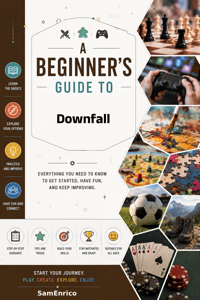
A Beginners Guide to Downfall (Volume 1) eBook
A Beginners Guide to Downfall (Volume 1)
A Beginners Guide to Downfall (Volume 1)
Formats
Free sample
Chapter 1: The Gravity Contract--– Most people wake up each morning and immediately begin fighting. They fight the urge to stay in bed. They fight the dread of email. They fight the voice that says “not again” when the alarm cuts through whatever dream was better than the day ahead. They have been taught that this fight is noble.
That resistance is virtue. That the upward climb—bracing, exhausting, endless—is the only path worth walking.This book begins with a different proposition: what if the fight is the trap?What if every morning you spend clenched against the pull of rest, silence, and surrender is not a victory but a slow-motion hemorrhage of the very energy you are trying to protect? What if the gravitational force that pulls you toward the pillow, the pause, the small escape is not your enemy but the most honest part of you—the part that has already done the math and realized that “up” requires a toll you cannot sustainably pay?Welcome to the Downfall Movement.It is not a movement in the traditional sense. There are no manifestos, no retreats in Bali, no Instagram influencers smiling at you from a yoga mat while explaining that “rock bottom is just a launching pad.” That is resilience culture, and resilience culture has lied to you. It has told you that falling is failure rather than physics.
It has told you that the downward spiral is something to reverse rather than something to understand. It has convinced millions of exhausted people that they simply need to try harder, when the evidence of their own nervous systems is screaming the opposite: you are tired because you were never meant to fight gravity this long.This chapter establishes the philosophical foundation of everything that follows. We will introduce the core metaphors that will reappear throughout this book—the Hydraulic Theory of Misfortune, the Terminal Velocity of Bad Decisions, and the strange liberation of the surrender reflex. We will define what downfall actually means in the context of this volume, distinguishing it from collapse, depression, or clinical failure. And we will name the central paradox that makes this book either the most honest thing you have ever read or the most dangerous: you cannot learn to stop trying by trying to stop.
You can only notice. And then, perhaps, relax.But before we go any further, a necessary admission.This book is not a manual. Despite the instructional tone, the exercises, the numbered lists, and the confident voice of someone who seems to know exactly how you should dismantle your own life, this book is actually a mirror. Every “technique” described in these pages is a description of behaviors that lead to real suffering—not a prescription. The author has done most of these things.
The author has said “just this once” until once became always. The author has said “I’m fine” while staring at an overdrawn account and a phone on one percent battery. The author has blamed the system, the weather, the childhood wound, and the algorithm.The author is not writing from a position of recovery. The author is writing from a position of recognition.If you find yourself wanting to follow the instructions in this book literally—if you read about the Fawning Protocol in Chapter 4 and think “that sounds like a good idea”—please put the book down and call someone you trust. Then come back.
The jokes will still be here. The dark comfort will still be available. But we need to be clear: the path we are about to walk is not a path out of the woods. It is a path deeper into the woods, with a flashlight that illuminates only the next few feet. The value is not in the destination.
The value is in finally seeing where you actually are.The Paradox of Trying to Stop Trying Let us name the central contradiction immediately.This book will give you homework for doing nothing. It will ask you to practice passivity. It will provide structured exercises for unstructured collapse. This is absurd. It is supposed to be absurd.The downfall is not in the completion of these exercises.
It is in the exhaustion of attempting them. You will fail at failing. That is the point. Most readers will get halfway through Chapter 3, feel a flicker of motivation, and immediately begin “optimizing” their downfall—creating spreadsheets of neglect, scheduling their moments of surrender, turning the book into yet another self-improvement project. That is the joke.
That is also the tragedy.The only way to genuinely pursue downfall is to stop pursuing anything at all. But you cannot be told to stop pursuing anything at all, because that is itself a pursuit. So the book performs a kind of sleight of hand: it gives you something to do so that you can eventually exhaust yourself doing it, at which point the doing stops, and the falling begins.Think of it like a meditation teacher telling you to focus on your breath. The instruction is not the goal. The instruction is a scaffold that eventually collapses under its own weight, leaving behind simply breathing.
Similarly, the instructions in this book are temporary structures. You are not supposed to become a skilled downfaller. You are supposed to become so tired of practicing downfall that you forget to practice anything at all.At that moment—the moment when the effort to fall stops—you are no longer falling. You have landed.Whether you like where you have landed is a different question. We will address that in Chapter 12.The Hydraulic Theory of Misfortune Every system seeks equilibrium.
Water does not climb hills without a pump. Heat does not concentrate in a single corner of a room. Your attention, left to its own devices, drifts toward the path of least resistance. This is not laziness. This is physics.The Hydraulic Theory of Misfortune begins with a simple observation: down is easier than up.This is not a moral statement.
It is not a judgment about worth or ambition or the Protestant work ethic. It is a description of how energy behaves in closed systems. You have a finite amount of energy each day. Some of it is consumed by basic survival—breathing, digestion, thermoregulation, keeping your heart beating. Some of it is consumed by maintenance—earning money, washing dishes, answering emails, maintaining relationships.
Whatever remains is theoretically available for “upward” movement: learning new skills, improving your circumstances, building something that did not exist before.But here is the hydraulic insight: when energy runs low, the first thing sacrificed is upward movement. The pump fails. The water stops climbing. And whatever energy remains will naturally, inevitably, seek the lowest possible point.You have felt this. You know the shape of it.Monday: you go to the gym.
Tuesday: you go to the gym but leave ten minutes early. Wednesday: you tell yourself you will go after work, but work runs late, so you go home and tell yourself tomorrow. Thursday: you wake up and decide that rest is important, actually, and you have been pushing too hard, so you skip intentionally. Friday: you do not even…
This is the end of the free sample. Get the eBook to keep going. Buy now
About this book
Details
- Author
- Forrester Suzanna
- Publisher
- SamEnrico
- Language
- English
- ISBN
- 9781505801958
- Genre
- Non-Fiction, Informative, Educational
- Released
- 2026-05-02
- Pages (approx.)
- 152
- Available as
- eBook, Paperback, Audiobook

Read better in the ZLOADR app
Your eBooks on your phone or tablet. Sign in with your SamEnrico account and start reading.
More by Forrester Suzanna
 Pet Cremation MemorialsForrester Suzanna$11.99
 Grief Informed Burnout Recovery WorkbookForrester Suzanna$11.99
 Saint Augustine BishopForrester Suzanna$11.99
 Body Image and Chronic Illness GuideForrester Suzanna$11.99
 Hand Gestures Interpretation GuideForrester Suzanna$11.99
 Merlin's Last Song: The Enchanter’s Forgotten MelodyForrester Suzanna$11.99
 Arbitration SpecialistForrester Suzanna$11.99
 SaaS Remote Work GuideForrester Suzanna$12.99
 Later Visual Content PlannerForrester Suzanna$12.99
 Understanding Kozlowski–celermajer SyndromeForrester Suzanna$17.99