
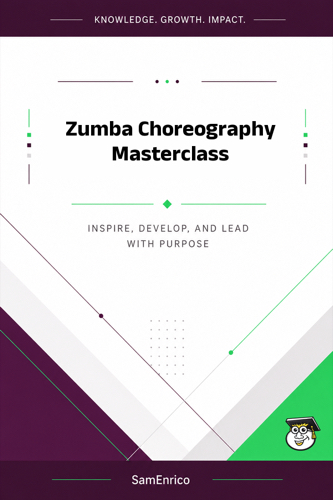
Non-FictionHealth & WellnessChoreography
Zumba Choreography Masterclass eBook
Teaches how to build 8 count blocks and combine in
by Jacob Leann
Teaches how to build 8 count blocks and combine into full song routines.
Formats
Free sample
Chapter 1: Finding the Invisible One--–- The bass drops. Thirty faces stare at you in the mirror. The song starts, and you feel every eye waiting for your first move. You step on the downbeat—or at least you think you do. But by count five, something feels wrong.
Your body is moving, but the music seems to be somewhere else. You watch your students stumble, their eyes flicking from your feet to each other, searching for the beat you promised them. This is the moment most new Zumba instructors dread, and the reason nearly forty percent quit within their first six months. Not because they lack energy. Not because they don't know the steps.
But because they never learned one fundamental skill that separates a nervous step-counter from a confident stage commander: how to find the One.The Myth of Natural Rhythm Let me tell you something that might surprise you. Natural rhythm is almost entirely a myth. Every Zumba instructor you have ever watched and admired—the one who seems to float through songs, who changes moves exactly when the music changes, whose class never misses a beat—started exactly where you are right now. They stepped on the wrong foot. They froze mid-chorus.
They watched students wander off-beat and felt the hot shame of knowing it was their fault. The difference between those instructors and the ones who quit is not talent. It is not years of dance training. It is one specific, teachable, repeatable skill: the ability to decode music like a choreographer rather than listening to it like a fan.I have trained over five hundred Zumba instructors across twelve countries. The ones who succeed are rarely the ones with the most dance experience.
They are the ones who learn to hear the invisible architecture beneath the vocals, the scaffolding of beats and phrases that holds every song together. This chapter will teach you that architecture. By the time you finish reading, you will never again start a song on the wrong foot. You will hear the One in your sleep. And your students will stop looking at each other in confusion and start looking at you with the one expression every instructor craves: pure, uncomplicated joy.Why Most Instructors Start Wrong Before we fix the problem, we need to understand why it happens.
Most people listen to music the way they watch a movie—they follow the storyline, the vocals, the most obvious emotional arc. When a song starts, the average person hears the singer first. Maybe the guitar riff or the synth melody. The beat is somewhere in the background, felt more than heard. This is fine for a passenger on a road trip.
It is catastrophic for a Zumba instructor standing in front of forty people who are paying you to tell them exactly when to move.The human brain is wired to prioritize melody over rhythm. This is not a flaw; it is a survival mechanism. Our ancestors needed to hear a predator's growl (a melodic, changing sound) more urgently than the steady rhythm of their own footsteps. Unfortunately, this hardwiring works directly against you when you step onto the Zumba floor. You will naturally gravitate toward the vocals, the horns, the most attention-grabbing part of the song.
And nine times out of ten, that part does not start on the One.I want you to try something right now. Hum the opening of "Despacito" by Luis Fonsi. What do you hear first? For almost everyone, it is the guitar arpeggio or the voice. The actual downbeat—the One—does not arrive until after a four-count pickup.
If you start moving on that guitar, you will be early. Your students will follow your early start, and by the time the chorus hits, your entire class will be half a beat ahead of the music, looking like a row of windshield wipers in a storm.The Anatomy of a Beat Let us step back and understand what we are actually listening for. Every piece of music in the Zumba repertoire—Salsa, Merengue, Reggaeton, Cumbia, Bachata—is built on a foundation of recurring pulses called beats. These beats are organized into groups called measures. In almost all popular music, each measure contains four beats.
Count "1, 2, 3, 4" at a steady pace. That is one measure. Do it again. That is a second measure. The first beat of every measure—the "1"—is the strongest, most grounded pulse.
It is the moment your foot should hit the floor with the most weight. It is the anchor that keeps everyone together.Here is where most instructors get lost. They can count 1-2-3-4 just fine for the first measure. But by the third measure, they have drifted. Why?
Because they are counting the wrong thing. They are counting the vocals or the melody instead of the percussion. The melody is a bird flying over the rhythm; the percussion is the ground beneath it. You must learn to ignore the bird and trust the ground.In Zumba music, the percussion section typically includes a kick drum (the thud that you feel in your chest), a snare drum or clap (the sharp sound on beats 2 and 4), and a hi-hat or shaker (the continuous sizzle that fills the space between beats). Your job is to lock onto the kick drum.
The kick drum almost always plays on beat 1 and beat 3. When you can hear that kick drum as clearly as you hear the singer's voice, you have taken your first step toward mastery.The Eight-Count Rule Now we need to talk about why Zumba uses blocks of eight counts instead of four. Remember how each measure has four beats? Two measures together create an eight-count phrase. This is not an arbitrary choice.
Almost all Latin and pop music is built on eight-bar phrases. A bar is another word for a measure. So an eight-bar phrase is sixteen beats. But Zumba simplifies this by working in eight-count blocks—two measures at a time. Why?
Because the human body responds better to eight-count patterns than to four-count patterns. A four-count pattern feels too short; your brain is still processing the movement when the pattern repeats. An eight-count pattern gives you enough time to establish a rhythm, add a variation, and return to a starting position before repeating.Here is a concrete example. Put on any Salsa song and simply march in place. Count out loud: "1, 2, 3, 4, 5, 6, 7, 8." Then repeat.
Feel how the music naturally supports that eight-count structure. The vocals might change after thirty-two counts. The percussion might add a bell or a cowbell after sixty-four counts. But the underlying eight-count grid never wavers. Your choreography must live inside that grid.
Every time you change a move, you should do it on the 1 of a new eight-count block. Every time you finish a combination, you should return to your starting position on the 8.The Difference Between Four-Four and Syncopation You may have heard that Merengue and Bachata are in six-eight time. This is a common myth that has caused more confusion among Zumba instructors than almost any other misconception. Let me correct this clearly and permanently. Merengue and Bachata are in four-four time.
Count "1, 2, 3, 4" over a Merengue track. The beats are there. However, these genres have a distinctive syncopated…
This is the end of the free sample. Get the eBook to keep going. Buy now
About this book
Details
- Author
- Jacob Leann
- Publisher
- SamEnrico
- Language
- English
- Genre
- Non-Fiction, Health & Wellness, Choreography
- Released
- 2026-06-08
- Pages (approx.)
- 126
- Available as
- eBook, Audiobook

Read better in the ZLOADR app
Your eBooks on your phone or tablet. Sign in with your SamEnrico account and start reading.
More by Jacob Leann
 Functional Analysis for ProductsJacob Leann$11.99
 Anki For GRE VerbalJacob Leann$11.99
 The High Functioning AlcoholicJacob Leann$11.99
 Australian Outback WalkaboutJacob Leann$11.99
 Forgiving a BullyJacob Leann$11.99
 Mindfulness for Decision MakingJacob Leann$11.99
 Distraction Management for ProgrammersJacob Leann$11.99
 Whispers in the Sawdust: The Curse of the Black PineJacob Leann$11.99
 The Trollwife’s Lament: A Nordic Mountain BalladJacob Leann$11.99
 How to Produce Radiology Equipment and AccessoriesJacob Leann$11.99
 How to Produce an Entertainment CenterJacob Leann$11.99
 US Business Credit Portfolio Management WorkbookJacob Leann$12.99
You may also like
 Hong Kong Handover 1997Dunn Johnnie$11.99
 Zumba For Postnatal Recovery CourseNeal Christian$11.99
 Zumba for BeginnersLadner Nikia$11.99
 YouTube Comment Mining GuideHumes Pandora$12.99
 Worry Box MeditationCarlin Rudy$11.99
 Workplace Stress MeditationNguyen Lynn$11.99
 Workplace Stress and Sleep RepairHawley Ivory$11.99
 Workplace Perfectionism CureDelaney Jeffry$11.99
 Workplace Injustice Anger GuideWallen Isabelle$11.99
 Work Addiction and Burnout LinkGreenwood Ester$11.99
 Women in Yoga and WellnessBeattie Galina$11.99
 Women in Stand Up ComedyChun Evangeline$11.99