
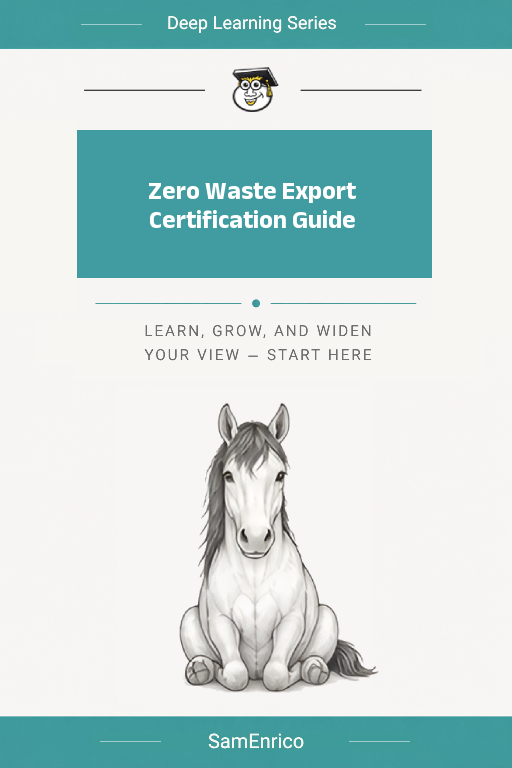
Zero Waste Export Certification Guide eBook
Achieve 90 percent waste diversion rate for produc
Achieve 90 percent waste diversion rate for products exported to European circular economy buyers.
Formats
Free sample
Chapter 1: The Hidden Ledger...--–- In a glass-walled conference room overlooking the Port of Rotterdam, a procurement director for one of Europe’s largest retail chains slid a single sheet of paper across the table. On it was a termination notice. The supplier—a mid-sized textile manufacturer from Southeast Asia—had passed every quality inspection, met every delivery deadline, and beaten every price negotiation for seven years. None of that mattered anymore. The reason for termination, written in the stark language of corporate compliance, was simple: the supplier could not certify a 90 percent waste diversion rate.The supplier’s export manager, a veteran of twenty years in international trade, had never heard of such a requirement.
He had heard of quality certifications, safety certifications, labor certifications, and even sustainability certifications. But a waste diversion requirement? A numerical threshold for keeping material out of landfills? That, he thought, was something for municipal recycling programs, not for international supply contracts. He was wrong.
And by the time he realized how wrong he was, his company had lost a contract worth €18 million annually, and the relationships built over seven years had evaporated in a single meeting.This is not an isolated story. Across Europe, from the automotive factories of Stuttgart to the cosmetics headquarters of Paris to the packaging procurement desks of Amsterdam, a fundamental shift is underway. Waste diversion is no longer a feel-good metric buried in corporate sustainability reports. It has become a binding contractual requirement, a non-negotiable condition for market access, and a sudden, brutal filter separating exporters who will thrive in the European circular economy from those who will be locked out.This chapter is the foundation of everything that follows in this book. Here, we establish the single most important number you will encounter: 90 percent.
We explain why that number, not 80 percent, not 85 percent, not 95 percent, has become the global credibility standard for zero waste claims. We document how European buyers have transformed voluntary green preferences into mandatory supply chain requirements. And we make the case that exporters who cannot certify a 90 percent waste diversion rate face not just higher costs, but eventual and complete exclusion from the European market—a market of 447 million consumers and €2.4 trillion in annual imports.By the end of this chapter, you will understand exactly what is at stake. More importantly, you will understand why the remaining eleven chapters of this book are not optional reading. They are your survival manual.The Quiet Revolution in European Procurement For most of the past three decades, sustainability was a marketing exercise.
Companies issued glossy reports, made ambitious pledges, and hired armies of communications professionals to tell the world how green they were. These efforts were rewarded with positive brand perception, occasional awards, and the warm feeling of doing something good. But they were rarely, if ever, tied to the hard realities of supply chain contracts. An exporter could have the worst environmental record imaginable and still win a contract if the price was right and the quality met specifications.That era is over. And the end came not with a bang, but with a quiet revolution in how European buyers write their contracts.The revolution began with the European Union's Circular Economy Action Plan (CEAP), adopted in 2020 and substantially revised in 2024.
The CEAP is not a single law but a framework of 54 separate actions spanning product design, production processes, consumption patterns, and end-of-life management. Its ambition is staggering: to transform Europe from a linear "take-make-dispose" economy into a circular one where waste is designed out of the system, materials are kept in use, and natural systems are regenerated.What exporters need to understand is that the CEAP is not merely a policy document. It is a legal and commercial weapon. Its provisions have been transposed into binding regulations (like the Packaging and Packaging Waste Regulation we will cover in Chapter 4) and have cascaded into private procurement standards adopted by Europe's largest buyers. When a company like IKEA, H&M, Carrefour, Unilever, or Bosch updates its supplier requirements, it is not acting out of voluntary benevolence.
It is responding to regulatory pressure from Brussels, national capitals, and increasingly aggressive environmental enforcement agencies.Consider the following data points, each of which represents a fundamental shift in the commercial landscape:Between 2020 and 2025, the number of European procurement tenders containing explicit waste diversion requirements increased by over 400 percent. A tender for public infrastructure in France now requires bidders to certify a minimum 90 percent diversion rate for construction waste. A request for proposals from a German automotive manufacturer requires tier-one suppliers to report diversion rates for all production scrap, packaging waste, and hazardous materials. A contract for logistics services in the Netherlands includes financial penalties for every ton of waste that cannot be traced to a verifiable diversion pathway.The message is unmistakable. Waste diversion has moved from the appendix of sustainability reports to the body of binding contracts.
And the threshold that has emerged as the de facto standard is 90 percent.Why 90 Percent? The Origin of the Benchmark The 90 percent figure did not appear by accident. It is not a round number chosen for convenience. It emerged from two decades of certification standards, industry practice, and regulatory expectations. Understanding its origin is essential because it reveals why 90 percent is not negotiable and why efforts to claim 80 percent or even 85 percent will fail to satisfy European buyers.The modern zero waste movement traces its origins to the early 2000s, when a handful of companies began pursuing "zero waste to landfill" as an aspirational goal.
The problem was that no standard existed for what "zero waste" actually meant. Some companies claimed zero waste when they sent materials to incinerators. Others claimed zero waste when they recycled only a fraction of their total stream. The term became so diluted that it lost all meaning—a classic case of greenwashing undermining a worthy concept.This changed with the introduction of UL 2799, the first comprehensive standard for zero waste to landfill certification. Developed by UL (formerly Underwriters Laboratories), a global safety certification company with over a century of credibility, UL 2799 established a rigorous framework for measuring and verifying waste diversion.
The standard's key innovation was its recognition that 100 percent diversion is extraordinarily difficult to achieve, especially for complex industrial operations. Rather than setting an impossible bar that would discourage participation, UL 2799 created a tiered system with Silver, Gold, and Platinum levels.The Silver tier—90 to 94 percent diversion—was deliberately set at a level that is challenging but achievable for most well-managed operations. It required facilities to divert the vast majority of their waste while allowing a small residual stream of materials that truly cannot be recovered with existing technology or at reasonable cost. This pragmatic approach made certification accessible while maintaining credibility. And it is why 90 percent, not 100 percent, became the operational definition of zero waste in practice.European regulators took note.
When drafting the CEAP and subsequent regulations, they explicitly referenced the 90 percent benchmark as an indicator of best practice. While no EU law currently mandates 90 percent diversion for all exporters, the regulatory framework creates powerful incentives for buyers to require it. Tax benefits, reduced Extended Producer Responsibility fees, and…
This is the end of the free sample. Get the eBook to keep going. Buy now
About this book
Details
- Author
- Ransom Delmar
- Publisher
- SamEnrico
- Language
- English
- Genre
- Non-Fiction, Business Brief
- Released
- 2026-06-01
- Pages (approx.)
- 145
- Available as
- eBook, Audiobook

Read better in the ZLOADR app
Your eBooks on your phone or tablet. Sign in with your SamEnrico account and start reading.
More by Ransom Delmar
 FDA Warning Letter Recall LinkRansom Delmar$11.99
 Comparison Cessation WorkbookRansom Delmar$11.99
 Scarring Disfigurement Love GuideRansom Delmar$11.99
 Lucid Dreaming Journal MethodRansom Delmar$11.99
 Strength Training For HikersRansom Delmar$11.99
 Canva AI PresentationRansom Delmar$11.99
 Hungarian Logistics Hub PotentialRansom Delmar$11.99
 Creative Dream Play TherapyRansom Delmar$11.99
 D Day Survivor OmahaRansom Delmar$11.99
 The Harmonic Genius: Arthur Blythe and the Birth of Avant-Garde JazzRansom Delmar$11.99
 The Bitcoin Laundromat: How a Crypto Startup Became a Money Laundering SuperhighwayRansom Delmar$11.99
 Zapier Automation for Marketing and SalesRansom Delmar$11.99
You may also like
 Franchising Your Local Brand Across Borders Child Labor LawsWilson Ida$11.99
 Franchising Your Local Brand Across Borders Beneficial OwnershipGordon Debbie$11.99
 Franchising Your Local Brand Across Borders Trade SecretsKeener Tatum$11.99
 Franchising Your Local Brand Across Borders Performance DashboardsCota Lisette$11.99
 Franchising Your Local Brand Across Borders Parallel ImportsBailey Wallace$11.99
 Franchising Your Local Brand Across Borders Packaging RegulationsRandle Adaline$11.99
 Franchising Your Local Brand Across Borders Know Your CustomerMyers Adam$11.99
 Franchising Your Local Brand Across Borders Human TraffickingFranklin Lee$11.99
 Franchising Your Local Brand Across Borders Government IncentivesLogsdon Beckie$11.99
 Franchising Your Local Brand Across Borders Carbon FootprintMcfarlane Margot$11.99
 Franchising Your Local Brand Across Borders Bribery LawsStarr Cortney$11.99
 Franchising Your Local Brand Across Borders Best Practice SharingBryson Vernia$11.99