
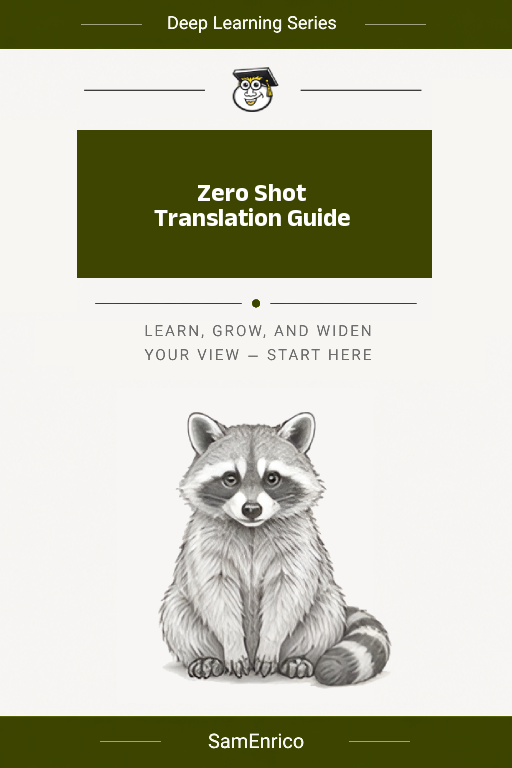
Zero Shot Translation Guide eBook
Translate rare languages using zero-shot NMT techn
by Timm Leatha
Translate rare languages using zero-shot NMT techniques. Combine with human review for indigenous and low-resource language pairs.
Formats
Free sample
Chapter 1: The Digital Grave--At 3:47 on a Tuesday afternoon in 2023, a 74-year-old woman named Ngaanyatjarra did something no human had done in forty years. She spoke a full sentence in Wangkajunga, her mother's tongue, to her granddaughter. The sentence was simple: "The goanna lizard sleeps under the red sand until the rain comes." Her granddaughter, who grew up speaking English and a simplified pidgin, understood the words but could not form a response. She replied in English: "That's cool, Grandma."The old woman died eighteen months later. With her died a complete theory of animal tracks, a classification system for desert stars that differs from Western astronomy in every fundamental way, a grammatical structure that encodes certainty differently than any European language, and a word for a specific kind of silence that follows a dust storm—a word that took three English sentences to approximate.Wangakjunga is what linguists call a "zero-resource language." It has no dictionary.
No grammar book. No Bible translation. No school curriculum. No social media presence. No recorded telephone conversation.
No written corpus at all. What it has is six elderly speakers, the youngest of whom is sixty-eight years old, and a granddaughter who can understand but not speak.This book is about building translation technology for Wangkajunga. And for Bribri. And for Mizo. And for the seven thousand other languages that exist in the digital dark—languages that together represent ninety percent of human linguistic diversity but receive less than two percent of natural language processing research funding.But first, you need to understand why this matters.
Not as an engineering problem. As a human one.The Rich-Get-Richer Catastrophe Here is a number that should shock you: between 2010 and 2024, the number of academic papers published on machine translation for English increased by 1,400 percent. For Chinese, 900 percent. For Spanish, 700 percent. For Wangkajunga?
Zero. For Bribri? Zero. For the five hundred languages of Papua New Guinea that collectively have fewer than a million speakers? A single paper, published in 2019, co-authored by a missionary linguist who has since retired.This is not malice.
It is economics. The same forces that made English the language of aviation, diplomacy, and the internet have made it the language of artificial intelligence. Large language models are trained on text. Most text is in English. Therefore, large language models are good at English.
Therefore, researchers use them for English tasks. Therefore, more funding goes to English tasks. Therefore, more text is generated in English. The loop tightens.The result is what computational linguists call the "rich-get-richer" problem, though a more honest name would be the "digital extinction" problem. A language with a hundred million speakers gets a hundred million dollars of research investment.
A language with ten thousand speakers gets ten thousand dollars, usually from a desperate graduate student with a one-year grant. A language with a hundred speakers gets nothing.And yet, consider what is lost when a language dies. Not words. Worldviews.When Ngaanyatjarra spoke of the goanna lizard sleeping under red sand, she was not just describing an animal. She was encoding a relationship between seasonality (rain), geology (sand color), animal behavior (nocturnal burrowing), and time perception (sleep as duration, not event).
English requires separate sentences for each of these dimensions. Wangkajunga does it in a single clause. The grammar itself is a theory of cause and effect.This is not romanticism. This is testable. Linguists have documented that speakers of languages with obligatory evidential marking (you must state how you know something) perform better on source-monitoring tasks.
Speakers of languages with spatial frames of reference tied to cardinal directions (north/south/east/west rather than left/right) never get lost in the dark. Language is not a label on top of thought. Language is thought's architecture.When a language dies, that architecture collapses. And we have no replacement.Defining the Enemy: A Three-Tier Taxonomy Before we build anything, we need to know what we are building for. The term "low-resource language" is thrown around so loosely in NLP papers that it has become meaningless.
A language with fifty thousand translated Bible verses is called low-resource. A language with fifty sentences scribbled on a missionary's notepad is also called low-resource. These are not the same.This book uses a three-tier taxonomy. Learn it now. It will appear in every subsequent chapter.Tier 1 – Zero-Resource Languages (0-100 sentence pairs, often no written standard)These are the true edge cases.
Wangkajunga belongs here. So do most of the remaining five hundred Australian Aboriginal languages. So do the forty-seven languages of Bolivia that have never been written down. So do the sign languages of remote villages in Indonesia, each one a unique manual grammar with no relation to spoken language.If you are working with a Tier 1 language, you have no parallel corpus. You have no monolingual corpus.
You may not even have a standard orthography. What you have is field notes—word lists with example sentences collected by a linguist who spent six months in the community twenty years ago. Or you have audio recordings with no transcription. Or you have a single elderly speaker who is willing to work with you but has never seen their language written.Tier 1 solutions do not use back-translation (requires monolingual text). They do not use synthetic data generation (requires a seed corpus to prompt from).
They rely almost exclusively on phonetic pivoting through related languages and direct transfer from high-resource relatives. The goal for Tier 1 is not fluency. The goal is any functional translation at all—a system that can produce a grammatically broken but semantically recognizable output that a human can edit into usability.Tier 2 – Low-Resource Languages (100-5,000 sentence pairs)Bribri, a Chibchan language of Costa Rica with approximately ten thousand speakers, belongs here. So do most of the indigenous languages of the Americas that have Bible translations but no digital presence. So do the majority of African languages that have radio broadcasts but no newspapers.If you are working with a Tier 2 language, you have a small parallel corpus.
It may be a New Testament (roughly 7,000 unique sentences) or a set of legal documents translated for land rights cases (500-2,000 sentences) or a collection of folk stories recorded and translated by anthropologists (200-1,000 sentences). You may also have monolingual text—radio transcripts, social media from diaspora communities, or educational materials produced by language revitalization programs.Tier 2 solutions use synthetic data generation (prompting LLMs to produce additional parallel sentences) and back-translation (training a reverse model to generate synthetic data from monolingual text). They use Lo RA fine-tuning (Chapter 7) and active learning loops (Chapter 8). The goal for Tier 2 is functional domain-specific translation—a system that works for healthcare or land rights or education, even if it fails for poetry or ceremony.Tier 3 – Moderate-Resource Languages (5,000-100,000 sentence pairs)Guarani, spoken by 6.5 million people in Paraguay with a robust media presence, belongs here. So do Quechua varieties with official status in Peru and Bolivia.
So do regional languages of India like Bodo and Manipuri, which have Wikipedia presences and government translation efforts.If you are working with a Tier 3 language, you have a substantial parallel corpus. You may have a complete Bible (30,000+ sentences), government documents (tens of thousands)…
This is the end of the free sample. Get the eBook to keep going. Buy now
About this book
Details
- Author
- Timm Leatha
- Publisher
- SamEnrico
- Language
- English
- Genre
- Non-Fiction, AI Operator
- Released
- 2026-05-29
- Pages (approx.)
- 143
- Available as
- eBook, Audiobook

Read better in the ZLOADR app
Your eBooks on your phone or tablet. Sign in with your SamEnrico account and start reading.
More by Timm Leatha
 Navajo Code Talker MemoirTimm Leatha$11.99
 Trichotillomania Guide for MenTimm Leatha$11.99
 Emotional Intelligence Journal WorkbookTimm Leatha$11.99
 Stress Management for Long DistanceTimm Leatha$11.99
 Tulips and Tides: The Dutch Golden Age and the Birth of Global TradeTimm Leatha$11.99
 C# Software EngineerTimm Leatha$11.99
 10 Ways to Use Alberta Wheat Pool (Recipe Book)Timm Leatha$11.99
 How to Produce Body Hair BleachTimm Leatha$11.99
You may also like
 Hong Kong Handover 1997Dunn Johnnie$11.99
 Zumba For Postnatal Recovery CourseNeal Christian$11.99
 Zumba for BeginnersLadner Nikia$11.99
 YouTube Comment Mining GuideHumes Pandora$12.99
 Worry Box MeditationCarlin Rudy$11.99
 Workplace Stress MeditationNguyen Lynn$11.99
 Workplace Stress and Sleep RepairHawley Ivory$11.99
 Workplace Perfectionism CureDelaney Jeffry$11.99
 Workplace Injustice Anger GuideWallen Isabelle$11.99
 Work Addiction and Burnout LinkGreenwood Ester$11.99
 Women in Yoga and WellnessBeattie Galina$11.99
 Women in Stand Up ComedyChun Evangeline$11.99