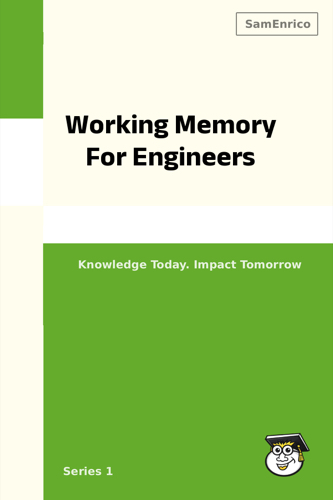
Working Memory For Engineers Audiobook
Applies spatial and logical memory to design probl
by Knutson Leo
Applies spatial and logical memory to design problems.
Formats
Free sample
Chapter 1: The Ten-Second Leak--–- The paradox announces itself without warning. You have just spent forty-seven minutes performing a complex finite element analysis, holding twelve variables in your head, tracking boundary conditions, interpreting stress contours, and cross-referencing material properties from three different tables. Your mind feels sharp, capable, even brilliant. Then a colleague walks over and asks, “What’s the bolt diameter on that flange?” You stare at them. The answer—a number you have seen a hundred times, a number written on the drawing directly in front of you—has vanished.
Completely. Your colleague waits. You feel your face warm. “I know this,” you say, and now you are fumbling through papers like a first-year intern. The number eventually returns, of course, but the damage is done.
You look forgetful. Unreliable. Maybe even a little stupid.The truth, which this chapter will reveal in full, is exactly the opposite. That moment of forgetting is not evidence of a failing mind. It is evidence of a mind that was working exactly as it should—pushing out routine, low-priority information to make space for complex, high-stakes reasoning.
The problem is not that your memory is bad. The problem is that you have been taught to think about memory in the wrong way.This book exists because engineers face a unique cognitive challenge that no other profession quite matches. Surgeons hold anatomy in mind but rarely manipulate three-dimensional spatial relationships while performing sequential logical reasoning simultaneously. Lawyers hold argument structures but do not visualize stress trajectories. Programmers hold logical flows but seldom rotate mental models of physical assemblies.
Engineers do all of these things, often within the same hour. And the cognitive systems that support these tasks—your visuo-spatial sketchpad, your phonological loop, and your central executive—operate under strict biological limits that no amount of willpower can overcome.This chapter introduces the foundational concept that drives the entire book: the distinction between long-term memory and working memory, the nature of working memory as a limited-capacity mental workspace, and the hidden cost of interruptions that you experience dozens of times per day without ever noticing. By the end of this chapter, you will understand why brilliant engineers forget simple things, why multitasking is a dangerous illusion, and why the strategies that worked for you in school are actively harming you in professional practice. More importantly, you will begin to see your own cognitive patterns more…
This is the end of the free sample. Get the Audiobook to keep going. Buy now
About this book
Details
- Author
- Knutson Leo
- Publisher
- SamEnrico
- Language
- English
- Genre
- Non-Fiction, Self-Help, Engineering Psychology
- Released
- 2026-06-06
- Pages (approx.)
- 148
- Available as
- eBook, Audiobook

Listen in the VoxFlicks app
Audiobooks and audio dramas wherever you go. Sign in with your SamEnrico account and press play.
More by Knutson Leo
 Diazepam Alcohol Detox GuideKnutson Leo$11.99
 Self Esteem Narcissistic AbuseKnutson Leo$11.99
 Personal Brand Ghostwriter GuideKnutson Leo$11.99
 Familial Advanced Sleep PhaseKnutson Leo$11.99
 DBT Trigger Coping SkillsKnutson Leo$11.99
 Feedback EQ SkillsKnutson Leo$11.99
 Employment Leave InsuranceKnutson Leo$11.99
 The Last Broadcast of Radio Free EuropeKnutson Leo$11.99
 The Nautical Warriors of the Great Zimbabwe: Mastering the Indian OceanKnutson Leo$11.99
 American Foxhound: Scent-driven & ActiveKnutson Leo$11.99
 JEE Common Mistakes AnalysisKnutson Leo$12.99
 Price Matching Inflation StrategyKnutson Leo$12.99