
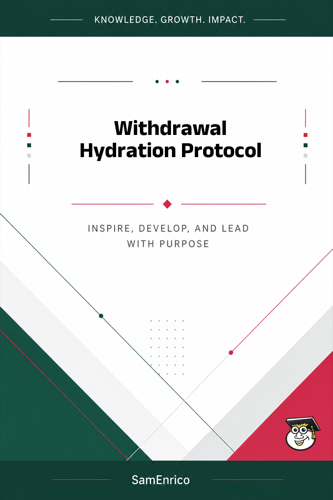
Non-FictionHealth & WellnessHydration Therapy
Withdrawal Hydration Protocol eBook
Prevents dehydration and electrolyte imbalance dur
Prevents dehydration and electrolyte imbalance during vomiting and diarrhea from detox.
Formats
Free sample
Chapter 1: The Water Trap--–- The first time my brother tried to detox at home, he did exactly what every instinct told him to do. He drank water. Lots of it. Glass after glass, gulping it down like a man who had just crossed a desert. Within twenty minutes, it all came back up—violently, projectile, soaking the bathroom floor.
He tried again, slower this time, sipping from a plastic bottle he kept pressed against his chest like a lifeline. That stayed down for almost an hour before his stomach rejected it too. By hour twelve, his lips were cracked and bleeding. By hour eighteen, he was hallucinating shadows on the wall. By hour twenty-four, a neighbor found him on the kitchen floor, his pulse so weak and thready that the paramedics later said he was minutes away from cardiac arrest.The ER nurse told him to go home and hydrate.She meant well.
She was wrong. And so is almost everything you have been told about drinking water when your body is in crisis.This book exists because of that night—and because of the hundreds of nights just like it that play out in apartments, basements, and sober living homes across the country every single week. People in withdrawal from alcohol, opioids, benzodiazepines, and other substances are dying not from the toxicity of the drugs leaving their system, but from something far more basic: they are drowning in the wrong fluids while dying of thirst for the right ones.Welcome to the Water Trap.The Most Dangerous Advice in Recovery Let us name the enemy immediately. It is not dehydration itself—though dehydration is the weapon. The enemy is a piece of conventional wisdom so ubiquitous, so seemingly innocent, that it has killed more people in withdrawal than almost any other single piece of advice.
Here it is: "Just drink plenty of water."Eight glasses a day. Stay hydrated. Sip fluids. Water is life.All true statements for a healthy person sitting in an air-conditioned room. All potentially lethal instructions for someone whose autonomic nervous system has been thrown into chaos by the sudden absence of alcohol, opioids, or benzodiazepines.Why?
Because withdrawal is not a state of simple thirst. It is a state of gastrointestinal rebellion. The vagus nerve—that long, wandering nerve that connects your brain to your gut—goes into overdrive. Your stomach clenches. Your intestines cramp.
Your body triggers the vomiting reflex not as a response to something you ate, but as a response to the sudden chemical imbalance in your brain.When you drink water in that state, one of two things happens. Either your stomach rejects it immediately—triggering the gag reflex and sending it back up within minutes—or it passes into your small intestine, where the inflammation caused by diarrhea prevents proper absorption. In either case, the water you just drank is not hydrating you. It is either leaving the way it came or rushing through you like a river through a broken dam.Worse, plain water actively dilutes what little electrolytes remain in your bloodstream. This condition, called hyponatremia, can cause seizures, brain swelling, and death—even in people who are technically "hydrated" by volume.Water is life, yes.
But the wrong water at the wrong time is a poison.The Anatomy of a Withdrawal Crisis To understand why the Water Trap is so deadly, you need to understand what is actually happening inside your body during detox. Let us walk through it step by step.Your body has spent weeks, months, or years adapting to the constant presence of a substance. That substance—alcohol, opioids, or benzodiazepines—has been acting as a chemical crutch, artificially suppressing certain systems and stimulating others. Your brain, always seeking balance, has adjusted its own chemistry to compensate. It has grown more receptors for certain neurotransmitters.
It has changed the way it produces stress hormones. It has, in short, rebuilt itself around the drug.Then you take the drug away.Suddenly, those suppressed systems spring back to life with explosive force. The autonomic nervous system—the part of your body that controls breathing, heart rate, digestion, and temperature without you having to think about it—goes into what doctors call a hyperadrenergic state. That is a fancy way of saying your fight-or-flight response is stuck in the "on" position.Your heart races. Your blood pressure spikes.
Your body temperature fluctuates wildly. And your gut, which is exquisitely sensitive to stress hormones, begins to rebel.For some people, this manifests as nausea. For others, it is full-blown cyclic vomiting—waves of retching that come every twenty to thirty minutes, sometimes lasting for days. For still others, the primary symptom is secretory diarrhea: the intestinal lining essentially leaks fluid into the bowel, producing watery stools that can strip the body of critical minerals within hours.These two symptoms—vomiting and diarrhea—are not side effects of withdrawal. They are the primary threats.
In medical terms, they are the mechanisms by which withdrawal can kill you.Let us look at the numbers.A single episode of severe diarrhea can contain up to 250 milliliters of fluid—roughly the volume of a small juice box. If you are having diarrhea ten times a day, that is 2.5 liters of fluid loss. A single episode of vomiting can expel 200 to 300 milliliters. Combine the two, and a person in acute withdrawal can lose three to four liters of fluid per day.To put that in perspective, the average adult body contains about forty liters of water. Losing just four liters—ten percent of total body water—puts you in the severe dehydration zone.
Lose six liters, and your organs begin to fail. Lose eight liters, and you die.But fluid loss is only half the story. The real danger is electrolyte loss.The Invisible Conductor Electrolytes are minerals in your blood and other body fluids that carry an electric charge. They are the battery that powers every cell in your body. Sodium, potassium, calcium, magnesium, chloride, bicarbonate—these are not abstract concepts from a high school chemistry class.
They are the reason your heart beats, your muscles contract, and your nerves transmit signals.Think of it this way. Your body is a house. Water is the wiring. Electrolytes are the electricity. You can have all the wiring in the world—you can flood your body with water—but without the electrical charge, nothing works.Sodium is the master conductor.
It regulates fluid balance, blood pressure, and nerve function. When sodium levels drop too low (hyponatremia), water moves from your bloodstream into your brain cells, causing them to swell. The result: confusion, seizures, coma, death. When sodium levels climb too high (hypernatremia), your brain cells shrink, tearing away from the skull and causing internal bleeding.Potassium is the heart's spark plug. It controls the electrical activity that makes your cardiac muscle contract in rhythm.
When potassium levels drop too low (hypokalemia), your heartbeat becomes irregular—first a skipped beat, then a fluttering sensation, then a chaotic arrhythmia that can stop your heart entirely.One episode of diarrhea can strip your body of 40 to 60 milliequivalents of potassium. For context, the normal adult total…
This is the end of the free sample. Get the eBook to keep going. Buy now
About this book
Details
- Author
- Keeton Marita
- Publisher
- SamEnrico
- Language
- English
- Genre
- Non-Fiction, Health & Wellness, Hydration Therapy
- Released
- 2026-06-09
- Pages (approx.)
- 146
- Available as
- eBook, Audiobook

Read better in the ZLOADR app
Your eBooks on your phone or tablet. Sign in with your SamEnrico account and start reading.
More by Keeton Marita
 Supporting Loved Ones with MDDKeeton Marita$11.99
 Self Esteem For ActorsKeeton Marita$11.99
 Stop Parent ProcrastinationKeeton Marita$11.99
 Yes And Improv TechniqueKeeton Marita$11.99
 Whole Food Plant BasedKeeton Marita$11.99
 Anger And Mental IllnessKeeton Marita$11.99
 Blue Zone Sleep ScheduleKeeton Marita$11.99
 The Phantom Heist: The Great Train Robbery of 1963Keeton Marita$11.99
 The Hollow Hill: Where the Tuatha Dé Danann Still WhisperKeeton Marita$11.99
 A Collector's Handbook to the Hampton NineKeeton Marita$11.99A Collector's Handbook to the Hampton NineKeeton Marita$11.99
 Payoneer US Account GuideKeeton Marita$12.99
You may also like
 Hong Kong Handover 1997Dunn Johnnie$11.99
 Zumba For Postnatal Recovery CourseNeal Christian$11.99
 Zumba for BeginnersLadner Nikia$11.99
 YouTube Comment Mining GuideHumes Pandora$12.99
 Worry Box MeditationCarlin Rudy$11.99
 Workplace Stress MeditationNguyen Lynn$11.99
 Workplace Stress and Sleep RepairHawley Ivory$11.99
 Workplace Perfectionism CureDelaney Jeffry$11.99
 Workplace Injustice Anger GuideWallen Isabelle$11.99
 Work Addiction and Burnout LinkGreenwood Ester$11.99
 Women in Yoga and WellnessBeattie Galina$11.99
 Women in Stand Up ComedyChun Evangeline$11.99