
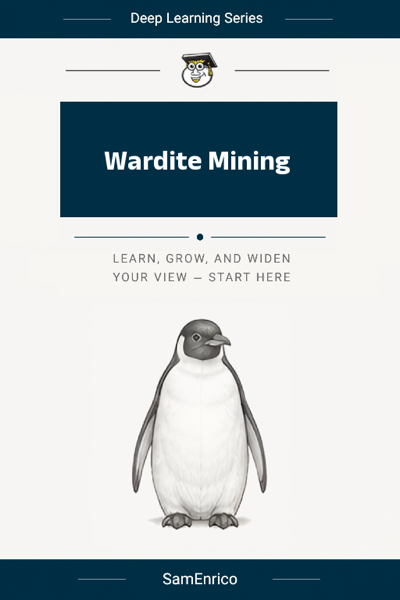
Non-FictionInformativeEducational
Wardite Mining eBook
A Coursebook on Wardite Mining
by Gunn Carrol
A Coursebook on Wardite Mining
Formats
Free sample
Chapter 1: The Crystal Sleuth...–- The first lesson any Wardite miner learns is that you are not a miner at all. You are a detective, a geologist, a paleontologist, and a surgeon, all rolled into one mud-caked, sunburned person holding a dental pick in one hand and a broken toothbrush in the other. The men who blast thousand-ton faces of granite for copper are miners. The women who operate draglines in coal country are miners. You—the person reading this sentence—are something else entirely.
You are a hunter of ghosts, a seeker of the geochemical whisper left behind when lithium-rich pegmatites exhale their last hydrothermal breath. And your quarry, a modest hydrous sodium aluminum phosphate by the name of Wardite, will test your patience, your skill, and your sanity in ways that no commodity miner will ever understand.Before we descend into the clay pits of Utah, the frozen veins of the Yukon, and the forgotten pegmatites of Germany and Brazil, we must answer a deceptively simple question: what, exactly, is Wardite? And why would anyone build a book—let alone a life—around chasing it?The answer begins not with a hammer, but with a chemical formula: Na Al₃(PO₄)₂(OH)₄·2H₂O. To the uninitiated, that string of letters and numbers looks like the password to a forgotten email account. But to the Wardite hunter, it is a treasure map.
The formula tells us that Wardite is a hydrous sodium aluminum phosphate. Break that down: sodium (Na), aluminum (Al), phosphate (PO₄), hydroxide (OH), and water molecules (H₂O) loosely bound into the crystal structure. The word "hydrous" is critical. Those two water molecules are not merely trapped inside the crystal like air bubbles in ice; they are structural, integral to the mineral's stability. Remove them too quickly—say, by drying a freshly excavated specimen on a hot dashboard—and the crystal lattice collapses into a network of fine cracks called crazing.
We will spend considerable time in Chapter 8 on the "24-Hour Window" (specifically for Fairfield clay specimens, a distinction we will honor throughout this book). But for now, remember: Wardite carries its own destruction inside its chemical bones.The Accidental Discovery The story of Wardite begins, as so many mineral stories do, not with a grand scientific expedition but with a man scratching in the dirt. The year was 1896. The place was Clay Canyon, near the small farming community of Fairfield, Utah County. The man was John M.
Davison, a prospector of no particular renown before or after this moment. Davison was not searching for Wardite—no one was, because it did not yet have a name. He was looking for variscite, a greenish phosphate mineral that had become moderately popular as a semiprecious gemstone for cabochons. The Fairfield area, underlain by weathered aluminum-phosphate-rich clays, had already yielded promising variscite nodules. Davison, like a handful of other local collectors, was digging through the ochre-yellow clay, prying out nodules the size of potatoes, hoping to find gem-grade material inside.But on that day in 1896, Davison cracked open a nodule and found something unusual.
Mixed with the expected variscite were small, glassy crystals with a pale greenish-white color and a peculiar shape—pseudo-octahedral, meaning they looked like octahedrons but were subtly different under magnification. They were harder than variscite, with a greasy luster that caught the light. Davison, no mineralogist himself, did what any sensible prospector would do: he sent samples to an expert.That expert was Henry A. Ward—and here we encounter the second most important name in our story. Henry Augustus Ward (1834–1906) was not merely a collector but a colossus of 19th-century natural history.
A student of Louis Agassiz at Harvard, Ward traveled the world in his twenties, amassing specimens from the Amazon, the Nile, the Rocky Mountains, and beyond. He founded Ward's Natural Science Establishment in Rochester, New York, a company that supplied fossils, minerals, taxidermy specimens, and anatomical models to museums, universities, and colleges across America. If you have ever visited a small liberal arts college and seen a mounted skeleton of a mastodon in their science building, there is a good chance it came from Ward's. He was the Steve Jobs of natural history education—not necessarily the discoverer of the materials he sold, but the visionary who understood how to put them into the hands of millions.When Davison's samples arrived at Ward's laboratory, Henry Ward recognized immediately that they represented something new. He passed the specimens to his staff mineralogist, a man named John H.
Caswell, who performed the first chemical and crystallographic analysis. The results indicated a previously undescribed species: a hydrous sodium aluminum phosphate with tetragonal symmetry and a distinctive pseudo-octahedral crystal habit. In 1897, Ward published a brief notice in the American Journal of Science, announcing the new mineral and naming it "wardite" in his own honor.This act of self-naming might strike modern readers as immodest, but it was entirely in keeping with the conventions of the time. In the late 19th century, mineralogists routinely named new species after themselves, their patrons, their mentors, or their monarchs. Henry Ward had built an empire on naming things—his catalogue of fossils, his branded museum displays, his natural history supplies.
Naming a mineral after himself was not arrogance; it was brand extension. More importantly, the name stuck. The International Mineralogical Association (IMA) later ratified wardite as a valid species, and despite occasional attempts to rename it (usually in favor of a more descriptive term), the original name has persisted for over 125 years.What Makes Wardite Special?We must pause here to address a question that every Wardite hunter eventually faces from friends, family, and skeptical fellow rockhounds: why does this obscure phosphate deserve a book? Why collect Wardite when you could be searching for gold nuggets, dinosaur bones, or even the far more famous turquoise?The answer has three parts, corresponding to three different kinds of value: scientific, aesthetic, and systematic.Scientific value. Wardite is a secondary phosphate mineral, meaning it did not crystallize directly from magma.
Instead, it formed when hydrothermal fluids—hot, chemically reactive water—altered pre-existing minerals in phosphate-rich pegmatites. The most common precursor is amblygonite, a lithium sodium aluminum phosphate. As amblygonite weathered or reacted with low-temperature fluids, its chemical constituents rearranged into new assemblages. Under the right conditions—specific p H ranges, specific temperatures (roughly 100–200°C), and specific chemical activities—Wardite precipitated as a replacement mineral. Understanding Wardite's paragenesis teaches geologists about the broader processes of supergene alteration, the formation of phosphate nodules, and the geochemical cycling of aluminum and phosphorus in near-surface environments.
In short, Wardite is a clue in a much larger mystery.Aesthetic value. The best Wardite specimens are genuinely beautiful. Crystals range from colorless to pale green, blue-green, yellow-green, and occasionally a striking bluish-white. The pseudo-octahedral habit (again, we will explore crystallography in Chapter 2) produces sharp, geometric forms that rival the best fluorite or garnet crystals. When set against a dark matrix of limonite or clay, the pale green crystals glow like mint frost on winter branches.
Rapid Creek, Yukon, has produced transparent, gem-quality crystals up to several centimeters across—materials so clear that you can see the shape of a toothbrush…
This is the end of the free sample. Get the eBook to keep going. Buy now
About this book
Details
- Author
- Gunn Carrol
- Publisher
- SamEnrico
- Language
- English
- Genre
- Non-Fiction, Informative, Educational
- Released
- 2026-05-09
- Pages (approx.)
- 136
- Available as
- eBook, Audiobook

Read better in the ZLOADR app
Your eBooks on your phone or tablet. Sign in with your SamEnrico account and start reading.
More by Gunn Carrol
 Elevator Small Talk GuideGunn Carrol$11.99
 Email Delay Send GuideGunn Carrol$11.99
 Blue Zone Fermented Foods GuideGunn Carrol$11.99
 Heavy Meal Sleep InterferenceGunn Carrol$11.99
 The Budget Meal Planning GuideGunn Carrol$11.99
 Ipsus: The Day the Diadochi ShatteredGunn Carrol$11.99
 Understanding Willems–de Vries SyndromeGunn Carrol$17.99
 Ghana Startup Community GuideGunn Carrol$12.99
 Founder Leave of Absence PlanGunn Carrol$12.99
 How to Start a Fish Paste Business (Beginners Guide)Gunn Carrol$11.99
You may also like
 Hong Kong Handover 1997Dunn Johnnie$11.99
 Zumba For Postnatal Recovery CourseNeal Christian$11.99
 Zumba for BeginnersLadner Nikia$11.99
 YouTube Comment Mining GuideHumes Pandora$12.99
 Worry Box MeditationCarlin Rudy$11.99
 Workplace Stress MeditationNguyen Lynn$11.99
 Workplace Stress and Sleep RepairHawley Ivory$11.99
 Workplace Perfectionism CureDelaney Jeffry$11.99
 Workplace Injustice Anger GuideWallen Isabelle$11.99
 Work Addiction and Burnout LinkGreenwood Ester$11.99
 Women in Yoga and WellnessBeattie Galina$11.99
 Women in Stand Up ComedyChun Evangeline$11.99