
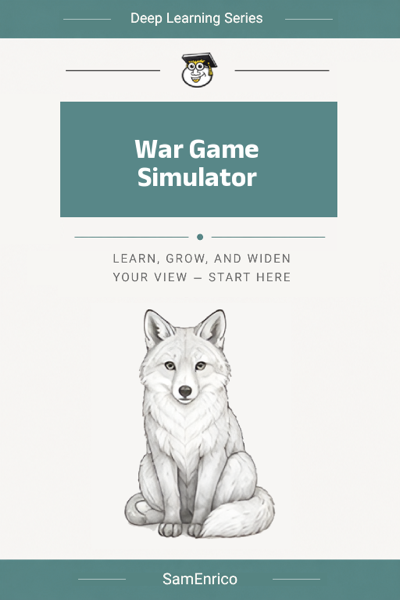
Non-FictionInformativeEducational
War Game Simulator eBook
A Coursebook on War Game Simulator
A Coursebook on War Game Simulator
Formats
Free sample
Chapter 1: The Imitation of War...--–- The room was dark except for the glow of the projector screen. At the front, a retired Army colonel stood beside a large sand table, its surface sculpted into ridges and valleys representing a stretch of German countryside. Wooden blocks painted blue and red sat in neat formations. Twenty officers leaned forward in their chairs, each holding a notepad. The colonel picked up a blue block and moved it three inches forward.
"The 2nd Armored advances along this axis," he said. "How does the 1st SS react?" One of the officers—a major with tired eyes—raised his hand. "They fall back to the next ridgeline. They've lost their anti-tank capability after the morning engagement." The colonel nodded. He moved a red block backward.
The game continued. No computers. No algorithms. Just men, a sand table, and the silent agreement that this imitation of war was worth their time because somewhere, in some future battle, the patterns they practiced here might save lives. I was twenty-four years old, a graduate student in military history, and I had just discovered that war gaming was not a hobby for basement-dwelling enthusiasts.
It was a profession. A discipline. A way of thinking about conflict that had shaped the outcomes of real wars for two hundred years. I did not know it then, but that night in that dark room was the first step of a journey that would lead me to design simulations for three different military services, consult on wargames for government agencies, and write the book you are now holding.This chapter is the gateway. Before you learn how to build a war game simulator, before you master the rules and data and probability, you need to understand what war gaming actually is and why anyone bothers with it.
By the end of this chapter, you will be able to define war game simulation, distinguish it from related concepts like game theory and operational analysis, identify the full spectrum of gaming purposes (educational, analytical, recreational), and recognize both the power and the limits of simulated conflict. More importantly, you will understand that war gaming is not about predicting the future. It is about preparing for it.What Is a War Game Simulator, Anyway?Let us start with the most basic question and answer it clearly. A war game simulator is a structured environment where human decision-makers interact with a representation of conflict, with outcomes determined by a combination of rules, data, and adjudication. That is a dense sentence, so let me unpack it.First, it is structured.
Unlike free-form brainstorming or casual conversation about strategy, a war game has rules. Those rules may be rigid (die rolls on a table) or flexible (umpire discretion), but they exist. The structure ensures that the game is not just a debate but a simulation with consequences.Second, it involves human decision-makers. This is the crucial distinction between war gaming and pure computer modeling. A war game is not an algorithm that runs without human input.
It is a tool for exploring how real people—with real biases, real uncertainties, and real limitations—make decisions under pressure. War gaming without human players is just modeling. Modeling is useful, but it is not war gaming. (Throughout this book, we use "war game simulator" broadly to include both human-in-the-loop systems and fully automated analytical tools, but we will always note where the distinction matters.)Third, it involves a representation of conflict. The representation may be abstract (colored blocks on a hex map) or detailed (full-motion 3D graphics).
It may represent a single sniper duel or a multi-theater nuclear war. But it is always a representation, not the thing itself. The map is not the territory. The rules are not physics. The players are not actually shooting at each other.
That representation is the simulator.Finally, outcomes are determined by a combination of rules, data, and adjudication. The rules specify what players can do and how actions are resolved. The data provides the factual underpinning—how fast a tank moves, how accurate a missile is, how long it takes to reload. Adjudication is the process of applying rules and data to specific player actions.This definition separates war gaming from several related concepts. Game theory is the mathematical study of rational decision-making in competitive situations.
Game theory produces optimal strategies for simplified scenarios. War gaming produces observed behavior in realistic scenarios. Game theory tells you what a perfectly rational player should do. War gaming tells you what actual humans actually do. Operational analysis is the quantitative study of military systems using data and models.
Operational analysis answers questions like "What is the probability that a Javelin missile destroys a T-72 tank?" War gaming asks, "Given that probability, how does a platoon leader decide when to fire?" Field exercises involve real troops moving over real terrain with real equipment. They are the most realistic training tool, but they are also the most expensive and logistically constrained. War gaming is cheaper, faster, and can explore scenarios that would be impossible or unethical to create in the field.A war game simulator, then, sits at the intersection of modeling, simulation, and competitive decision-making. It borrows the rigor of modeling, the dynamics of simulation, and the unpredictability of competition. That intersection is where this book lives.The Spectrum of War Gaming Purposes Not all war games are the same.
They serve different purposes, and those purposes shape every aspect of design. Understanding the spectrum of purposes is the first step to becoming a competent designer.Educational War Games The oldest and most common purpose is education. Educational war games aim to teach lessons about strategy, tactics, logistics, command and control, and decision-making under uncertainty. They prioritize learning outcomes over analytical precision. A perfectly balanced game with statistically valid outcomes is less valuable than a game that makes players wrestle with realistic dilemmas and remember the lessons afterward.Educational games are used in military staff colleges (the Naval War College, the Army Command and General Staff College), service academies (West Point, the Naval Academy, the Air Force Academy), and professional military education programs worldwide.
They are also used in academic settings—political science departments, international relations programs, and military history courses. And they are used in civilian contexts: corporate strategy training, emergency management exercises, and crisis response drills.The hallmark of an educational game is the after-action review (AAR). The game itself is just the raw material. The learning happens when players stop moving pieces and start asking questions: Why did I make that decision? What information did I have?
What information did I lack? What assumptions turned out to be wrong? What would I do differently next time? A war game without an AAR is entertainment, not education.Analytical War Games The second major purpose is analysis. Analytical war games aim to produce insights that inform real-world decisions about strategy, policy, force structure, and concept development.
They prioritize data collection and rigorous methodology over player engagement. An analytical game that is boring but produces actionable insights is successful. An educational game that is exciting but teaches no lessons is a failure.Analytical games serve multiple functions.…
This is the end of the free sample. Get the eBook to keep going. Buy now
About this book
Details
- Author
- Honeycutt Bobbie
- Publisher
- SamEnrico
- Language
- English
- Genre
- Non-Fiction, Informative, Educational
- Released
- 2026-05-08
- Pages (approx.)
- 145
- Available as
- eBook, Audiobook

Read better in the ZLOADR app
Your eBooks on your phone or tablet. Sign in with your SamEnrico account and start reading.
More by Honeycutt Bobbie
 Vegan Keto Nutrition CourseHoneycutt Bobbie$11.99
 The Remote Work Daily ThreeHoneycutt Bobbie$11.99
 Email Batching SystemHoneycutt Bobbie$11.99
 The Posture Correction StretchHoneycutt Bobbie$11.99
 Franchising Your Local Brand Across Borders Quality ControlHoneycutt Bobbie$11.99
 The Lost Crown of the Maya: A Smuggler’s Gold RushHoneycutt Bobbie$11.99
 The Great Vaccine Gamble: How Big Pharma and Governments Shaped the COVID-19 ResponseHoneycutt Bobbie$11.99
 IP Litigation Budget GuideHoneycutt Bobbie$12.99
 Sales Script Recording AppHoneycutt Bobbie$12.99
 Understanding Curth–macklin Type Ichthyosis HystrixHoneycutt Bobbie$17.99
 How to Become a Scrap SeparatorHoneycutt Bobbie$11.99
You may also like
 Hong Kong Handover 1997Dunn Johnnie$11.99
 Zumba For Postnatal Recovery CourseNeal Christian$11.99
 Zumba for BeginnersLadner Nikia$11.99
 YouTube Comment Mining GuideHumes Pandora$12.99
 Worry Box MeditationCarlin Rudy$11.99
 Workplace Stress MeditationNguyen Lynn$11.99
 Workplace Stress and Sleep RepairHawley Ivory$11.99
 Workplace Perfectionism CureDelaney Jeffry$11.99
 Workplace Injustice Anger GuideWallen Isabelle$11.99
 Work Addiction and Burnout LinkGreenwood Ester$11.99
 Women in Yoga and WellnessBeattie Galina$11.99
 Women in Stand Up ComedyChun Evangeline$11.99