
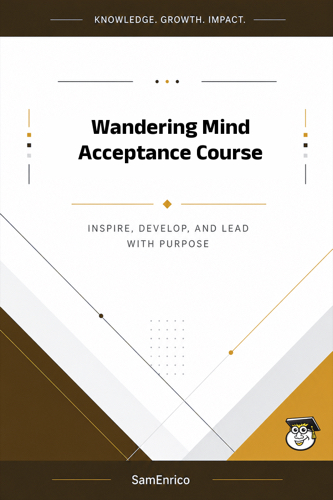
Non-FictionSelf-HelpFocusSelf Compassion
Wandering Mind Acceptance Course eBook
Stop fighting distractions and learn to gently ret
by Gaines Lacy
Stop fighting distractions and learn to gently return attention without judgment.
Formats
Free sample
Chapter 1: The 47% Lie--–- Let me tell you something no productivity guru will admit: your mind is supposed to wander.You have been told otherwise, of course. You have been told that focus is a moral virtue, that distraction is a character flaw, that a wandering mind is a leaky bucket you need to patch with willpower, apps, and guilt. You have bought the timers. You have installed the blockers. You have set the Pomodoro.
And still, somewhere between opening your laptop and answering the first email, you find yourself scrolling, daydreaming, planning dinner, replaying an argument from three years ago, or wondering whether penguins have knees. (They do. They're just hidden under feathers.)Then comes the shame. The quiet, familiar voice: What is wrong with me?Here is the answer that will change everything: absolutely nothing.Your wandering mind is not broken. It is not lazy.
It is not a design flaw in your particular model of human. Your mind is doing exactly what three hundred thousand years of evolution programmed it to do. The problem is not that you wander. The problem is that you have been fighting a biological inevitability with the wrong tools—and losing, not because you are weak, but because the war was unwinnable from the start.This book is not another focus manual. It will not teach you to chain your attention to a desk for eight hours.
It will not offer a "proven system to eliminate distraction" because such systems are lies dressed in data. What this book offers is something far more radical and far more effective: a complete ceasefire in the war against your own mind.Welcome to the Wandering Mind Acceptance Course.The Discovery That Changed Everything In 2010, psychologists Matthew Killingsworth and Daniel Gilbert published a study that should have ended the self-help industry's obsession with perfect focus. They developed an i Phone app that pinged thousands of people at random moments throughout the day, asking three questions: What are you doing right now? Where is your attention? How do you feel?The results were staggering.
People's minds were wandering 46.9 percent of their waking hours—nearly half of their lives. For almost every activity except sex, the mind was somewhere else more often than it was present.But here is the part the productivity gurus never quote: people who were mind-wandering reported being less happy than those who were present. The conclusion seemed obvious: wandering is bad, presence is good. End of story.Except it wasn't. Because the same researchers found something else.
When people were wandering to pleasant topics (daydreaming about a vacation, reminiscing about a happy memory), their happiness levels matched or exceeded those of people who were focused on an unpleasant task. In other words, wandering isn't the enemy. Unhappy wandering is.And here is the deeper truth that study revealed, the one that changed how I think about attention entirely: the very act of fighting wandering—of judging it, resenting it, trying to crush it—was correlated with the lowest happiness scores of all.You cannot beat your mind into submission. But you can stop losing to it.The Myth of the Always-On Brain Let me introduce you to a part of your brain you have never been taught to love. It is called the default mode network, or DMN.
Neuroscientists discovered it in the early 2000s when they noticed something peculiar: certain brain regions lit up not when people were doing tasks, but when they were doing nothing at all—lying in a scanner, waiting for the next instruction, supposedly resting.The DMN is your brain's idle mode. When you are not actively focused on something external, this network activates. It runs through your memories, simulates future scenarios, processes social dynamics, and weaves the narrative you call "you." It is responsible for self-reflection, creative insight, moral reasoning, and—yes—daydreaming.Here is what most people get wrong about the DMN. They think it is a distraction machine, a bug in the software. In fact, it is essential to your humanity.
Patients with damage to the DMN lose their sense of self. They cannot plan for the future. They cannot understand other people's perspectives. They become, in a very real sense, less than fully human.The wandering mind is not a flaw. It is a feature.
A feature that happens to be active for 30 to 50 percent of your waking hours, whether you like it or not.The cultural lie of "always-on" concentration—the myth that you can and should be laser-focused from nine to five—is not just unrealistic. It is anti-biological. Your brain was not designed for continuous focus. It was designed to oscillate between focused attention (the task-positive network) and wandering attention (the default mode network). Each mode serves a purpose.
Each mode is necessary. And each mode becomes a problem only when you try to force one to dominate the other.The War That Cannot Be Won Imagine you are standing in a field. You have been told that there is a dangerous animal nearby—let us call it Distraction—and that you must keep it away at all costs. You are armed with willpower, guilt, and a $4.99 meditation app. Every time Distraction appears, you swing at it.
Every time you miss, you feel worse. Every time you land a blow, another Distraction appears somewhere else.This is not a sustainable strategy. It is not even a sensible one. Because the animal is not actually an enemy. It is a stray dog that follows you everywhere, and the more you swing at it, the more it barks.The war against wandering is unwinnable not because you lack discipline, but because the battlefield is your own mind.
Every attempt to suppress a thought requires mental energy. That energy depletes. When it depletes, the suppressed thoughts return with greater force—a phenomenon psychologists call the ironic rebound effect, first demonstrated by Daniel Wegner in his famous "white bear" experiments.Here is what Wegner found: when you tell people not to think about a white bear, they cannot stop thinking about white bears. When you tell them not to feel anxious, their anxiety spikes. When you tell yourself not to get distracted, you have just guaranteed that your brain will scan for distractions constantly, finding them everywhere.The very act of fighting wandering creates more wandering.This is not a motivational problem.
It is neurology. Your brain's alarm system (the amygdala) cannot distinguish between a physical threat and a self-critical thought. When you say "I shouldn't be distracted," your brain hears "danger" and activates a stress response. Cortisol rises. Your attention narrows to threat detection—which, ironically, means you start looking for distractions to avoid.
And when you find one (because you always will), the self-criticism intensifies, the cortisol spikes again, and the loop continues.Fight → Frustration → Cortisol → More wandering → More fighting.This is the stress loop. And it is the single greatest obstacle to sustainable attention. Not distractions themselves. Your relationship to them.What Acceptance Is (And What It Is Not)I need to be very clear about something. Acceptance is not resignation.
It is not giving up. It is not throwing your hands in the air and saying, "Well, I guess I'll…
This is the end of the free sample. Get the eBook to keep going. Buy now
About this book
Details
- Author
- Gaines Lacy
- Publisher
- SamEnrico
- Language
- English
- Genre
- Non-Fiction, Self-Help, Focus, Self Compassion
- Released
- 2026-06-10
- Pages (approx.)
- 135
- Available as
- eBook, Audiobook

Read better in the ZLOADR app
Your eBooks on your phone or tablet. Sign in with your SamEnrico account and start reading.
More by Gaines Lacy
 Food Intolerance and HistamineGaines Lacy$11.99
 Complicated Grief Self Help GuideGaines Lacy$11.99
 Product Manager Creative GuideGaines Lacy$11.99
 The Four Days' Battle: The Naval War That Shattered a Sea EmpireGaines Lacy$11.99
 The Blue Zone Purpose FactorGaines Lacy$11.99
 Understanding Sterility Due to Immotile FlagellaGaines Lacy$17.99
 Supplier Portal Self ServiceGaines Lacy$12.99
 Cash Flow AI PredictionGaines Lacy$12.99
 Button CollectingGaines Lacy$11.99
 How to Become a Sheet-metal-pattern CutterGaines Lacy$11.99
You may also like
 Hong Kong Handover 1997Dunn Johnnie$11.99
 Zumba For Postnatal Recovery CourseNeal Christian$11.99
 Zumba for BeginnersLadner Nikia$11.99
 YouTube Comment Mining GuideHumes Pandora$12.99
 Worry Box MeditationCarlin Rudy$11.99
 Workplace Stress MeditationNguyen Lynn$11.99
 Workplace Stress and Sleep RepairHawley Ivory$11.99
 Workplace Perfectionism CureDelaney Jeffry$11.99
 Workplace Injustice Anger GuideWallen Isabelle$11.99
 Work Addiction and Burnout LinkGreenwood Ester$11.99
 Women in Yoga and WellnessBeattie Galina$11.99
 Women in Stand Up ComedyChun Evangeline$11.99