
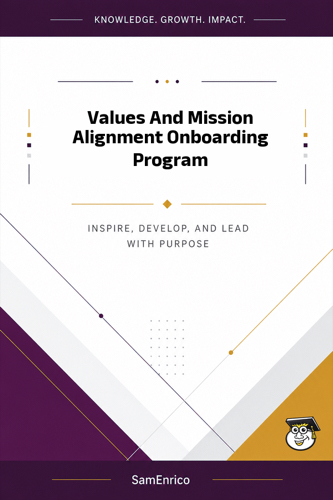
Non-FictionBusiness BriefEmployee Onboarding
Values And Mission Alignment Onboarding Program eBook
Immerse new hires in your company culture from day
by Glenn Karin
Immerse new hires in your company culture from day one using this practical orientation guide.
Formats
Free sample
Chapter 1: The $47,000 Lie--– - Every time you hire someone, you are telling them a lie. You don’t mean to. The lie isn’t in the offer letter or the salary negotiation or the cheerful “welcome aboard” email. The lie is deeper, more structural, and far more expensive. You are telling new hires that they have joined a team where their work matters, where their voice is heard, and where the values printed on the wall are the values that govern daily life.
Then you hand them a laptop, point them to a desk, and disappear. Within ninety days, twenty-two percent of them will have one foot out the door. Within eighteen months, nearly half will be gone. And before they leave, they will quietly, politely, professionally disengage—showing up, checking boxes, and contributing exactly nothing beyond the minimum required to avoid being fired. This phenomenon has a name.
It is called quiet quitting. And it is not a failure of the employee. It is a failure of onboarding.The Great Resignation made headlines. The Great Resentment is what came after. Millions of workers didn’t actually leave their jobs—they stayed, but they stopped caring.
Gallup’s State of the Global Workplace report found that only twenty-three percent of employees are engaged at work. The remaining seventy-seven percent are either quietly quitting (actively disengaged) or loudly quitting (already searching for an exit). The cost of this disengagement in the United States alone is estimated at over eight trillion dollars in lost productivity annually. But here is what the headlines miss: most of that disengagement is locked in during the first ninety days. The pattern is set before the new hire has memorized the Wi-Fi password.
The question is not whether your onboarding program is good. The question is whether it is actively poisoning your culture.This chapter exists to name the lie, count its cost, and offer a radically different path forward. You will learn why traditional onboarding is designed for compliance rather than connection, how the neuroscience of trust proves that belonging is a biological necessity not a soft skill, and why the single most important document your company will ever sign is not a contract with a client but a psychological safety agreement among teammates. By the end of this chapter, you will have a calculator that tells you exactly how much money your current onboarding failures are costing you, a case study of a company that fixed the problem (and one that made it worse), and a roadmap for the remaining eleven chapters of this book. The lie ends here.The Great Misunderstanding: Orientation Is Not Onboarding Most companies confuse two completely different activities.
The first is orientation. Orientation is the mechanical process of getting a new employee into the system. It includes the I-9 form, the direct deposit setup, the benefits enrollment, the IT login credentials, the security badge, and the mandatory harassment video that no one watches. Orientation is necessary. Nobody disputes that.
But orientation is not onboarding. Onboarding is the emotional and cultural integration of a new human being into a existing social system. Orientation takes two to four hours. Onboarding takes ninety days. Orientation checks boxes.
Onboarding builds belonging. And when companies collapse these two activities into one—when they call orientation “onboarding” and move on—they commit the single most expensive error in talent management.Consider the data. The Society for Human Resource Management (SHRM) reports that organizations with a strong onboarding process improve new hire retention by eighty-two percent and productivity by over seventy percent. Conversely, organizations with no structured onboarding lose twenty percent of their new hires within the first forty-five days. Not eighteen months.
Forty-five days. That means one out of every five people you hired this year will be gone before they have received their second paycheck. The cost of replacing a single salaried employee ranges from fifty to two hundred percent of their annual salary. For a manager earning eighty thousand dollars, that replacement cost can exceed one hundred thousand dollars when you factor in recruitment fees, interview time, training hours, and lost productivity during the vacancy period. Now multiply that by every new hire you made last year.
That number is not a rounding error. That number is a crisis.The deeper problem is that orientation-focused onboarding trains new hires to expect bureaucracy rather than belonging. When a new employee’s first day consists of sitting alone in a conference room watching compliance videos and filling out tax forms, the message is unmistakable: you are a cog in a machine. Your individuality is irrelevant. Your questions are an interruption.
Your excitement is misplaced. That message is absorbed within hours, but its effects last for years. The new hire doesn’t quit immediately. Instead, they lower their expectations. They stop volunteering ideas.
They stop staying late. They stop caring. And they tell their friends not to work at your company. That is the quiet quitting that never appears on any exit interview.The Neuroscience of Betrayal: Why Your Brain Quits Before You Do To understand why bad onboarding creates lasting damage, you need to understand what happens inside the human brain when a new person enters a group. The field of social neuroscience has demonstrated that the brain processes social pain—rejection, exclusion, isolation—using the same neural circuitry that processes physical pain.
The dorsal anterior cingulate cortex activates whether you are being punched in the arm or ignored by a group of colleagues. From the brain’s perspective, social exclusion is a survival threat. For the vast majority of human history, being excluded from the tribe meant death. No food sharing, no protection from predators, no mating opportunities. The brain evolved to treat belonging as a matter of life and death.
And it has not caught up with the modern office.When a new hire walks into an organization on Day One, their brain is scanning for threats. Are these people friendly? Will they help me when I fail? Do I belong here? These are not soft, touchy-feely questions.
They are biological imperatives. The brain’s amygdala, responsible for threat detection, activates within milliseconds of any ambiguous social cue. When the amygdala fires, it suppresses the prefrontal cortex—the part of the brain responsible for complex reasoning, creativity, and problem-solving. A new hire who feels psychologically unsafe loses access to thirty percent or more of their cognitive capacity. They become dumber, less creative, and more error-prone precisely when your organization needs them to be smart, innovative, and accurate.
This is not a metaphor. This is measurable physiology.The Harvard Business Review published a landmark study on the neuroscience of trust, synthesizing research from dozens of laboratories. The findings were stark: employees in high-trust organizations reported seventy-four percent less stress, one hundred six percent more energy at work, fifty percent higher productivity, and seventy-six percent more engagement compared to employees in low-trust organizations. The mechanism is not mysterious. Trust downregulates the amygdala.
When trust is present, the prefrontal cortex stays online. People think clearly, collaborate generously, and take smart risks. When trust is absent, the brain operates in survival mode. People hide mistakes, hoard information, and…
This is the end of the free sample. Get the eBook to keep going. Buy now
About this book
Details
- Author
- Glenn Karin
- Publisher
- SamEnrico
- Language
- English
- Genre
- Non-Fiction, Business Brief, Employee Onboarding
- Released
- 2026-06-09
- Pages (approx.)
- 158
- Available as
- eBook, Audiobook

Read better in the ZLOADR app
Your eBooks on your phone or tablet. Sign in with your SamEnrico account and start reading.
More by Glenn Karin
 Long And Short Breath RecognitionGlenn Karin$11.99
 SAA Core Wisdom Step StudyGlenn Karin$11.99
 Franchise Builder's Franchise Loan GuideGlenn Karin$11.99
 The Comeback Kid: How a Fallen Star Reclaimed the WorldGlenn Karin$11.99
 Quantum Rhapsody: The Lost Symphony of Schrödinger’s CatGlenn Karin$11.99
 Understanding Hypertelorism and Tetralogy of FallotGlenn Karin$17.99
 How to Start a Casting of Titanium Products Business (Beginners Guide)Glenn Karin$11.99
 SME Cash Flow ForecastingGlenn Karin$12.99
 Crypto Compliance And Risk HandbookGlenn Karin$12.99
 Designer WebGlenn Karin$11.99
You may also like
 Hong Kong Handover 1997Dunn Johnnie$11.99
 Zumba For Postnatal Recovery CourseNeal Christian$11.99
 Zumba for BeginnersLadner Nikia$11.99
 YouTube Comment Mining GuideHumes Pandora$12.99
 Worry Box MeditationCarlin Rudy$11.99
 Workplace Stress MeditationNguyen Lynn$11.99
 Workplace Stress and Sleep RepairHawley Ivory$11.99
 Workplace Perfectionism CureDelaney Jeffry$11.99
 Workplace Injustice Anger GuideWallen Isabelle$11.99
 Work Addiction and Burnout LinkGreenwood Ester$11.99
 Women in Yoga and WellnessBeattie Galina$11.99
 Women in Stand Up ComedyChun Evangeline$11.99