
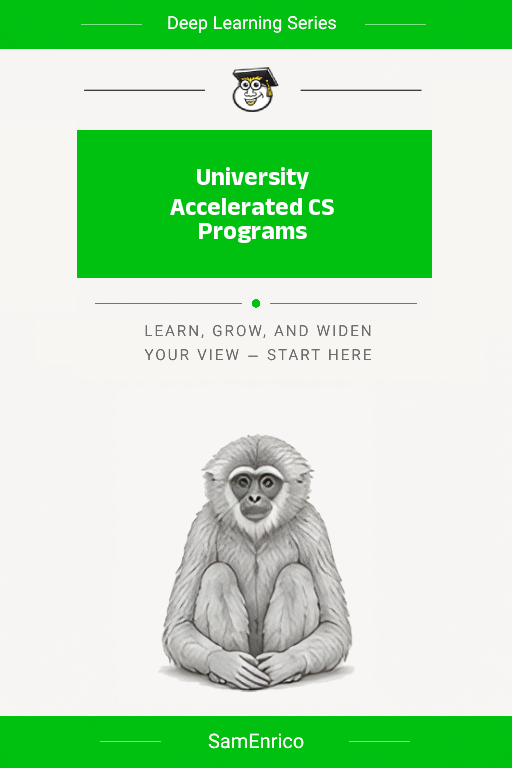
Non-FictionStudent's ShortcutAccelerated DegreeNon Major Guide
University Accelerated CS Programs eBook
Find one year master degrees and accelerated CS pr
Find one year master degrees and accelerated CS programs for non majors offering bootcamp speed with degree credibility.
Formats
Free sample
Chapter 1: The $40,000 Mistake--–- Maria had done everything right. In 2021, she quit her job as a high school English teacher, poured her savings into a 12-week coding bootcamp, and emerged with a certificate promising she was now a "full-stack developer." She got hired within two months at a mid-sized tech company in Austin, Texas, making $75,000 — more than double her teaching salary. She cried happy tears when she signed the offer letter.Two years later, she was stuck.Maria could build React components from memory. She could spin up a Node.js server in her sleep. But when she applied for a senior engineer role internally, her manager gently told her she wasn't eligible.
"The promotion requires a degree," he said. "Company policy. No exceptions." When she tried to jump to another company, recruiters loved her portfolio but then asked the same question: "Do you have a degree in computer science or a related field?" When she said no, the conversation cooled. When she explored visa sponsorship (her partner was being transferred to London, and she wanted to work remotely for a US company), she discovered that immigration pathways required a formal degree — not just experience.Maria had traded speed for credibility. She didn't know that a third option existed.James made the opposite choice.
Also in 2021, James — a former bank teller — enrolled in a traditional, on-campus master's program in computer science at a well-regarded state university. He took the GRE, borrowed 90,000,andspentfouryears(yes,four)completingprerequisites,corecourses,andathesishedidn′tcareabout.Hegraduatedin2025withpristinecredentialsand90,000, and spent four years (yes, four) completing prerequisites, core courses, and a thesis he didn't care about. He graduated in 2025 with pristine credentials and 90,000,andspentfouryears(yes,four)completingprerequisites,corecourses,andathesishedidn′tcareabout.Hegraduatedin2025withpristinecredentialsand1,200 monthly loan payments. He also graduated with skills that were already outdated: the program taught Hadoop (not Spark), Java Swing (not React), and theoretical algorithms with no cloud computing. He got a job — a good one, eventually — but he spent his first six months learning the tools his degree had ignored.James had traded credibility for speed.
He didn't know a third option existed either.This book is for the millions of people between Maria and James. You want the speed of a bootcamp — the intensity, the project-based learning, the fast transition into a new career. But you also want the credibility of a degree — the HR filter, the visa pathway, the long-term career ceiling that a certificate cannot break through. You want both. And until very recently, both was impossible.That has changed.The Trap You Didn't Know You Were In The technology industry has sold career-switchers a false choice for the past decade.
On one side: bootcamps, promising transformation in months. On the other side: traditional degrees, promising legitimacy across decades. The industry has positioned these as opposing poles, as if you must choose between speed and substance.Bootcamps flourished from 2015 to 2021 because they solved a real problem. Universities were too slow, too expensive, and too hostile to non-majors. If you had a degree in English or history or business, a traditional CS master's program would first make you take two years of undergraduate prerequisites — calculus, discrete math, introductory programming, data structures — before you could even apply.
By the time you finished, you'd spent four years and six figures. Bootcamps offered a different bargain: give us twelve weeks and fifteen thousand dollars, and we will teach you exactly what employers need right now. For a few glorious years, that bargain worked. Bootcamp graduates got hired. They got promoted.
They changed their lives.Then the market matured.By 2022, employers had begun to notice the pattern. Bootcamp graduates were excellent at building React components and REST APIs. They could pass a technical interview that asked about reversing a linked list or finding a palindrome. But they struggled with systems design. They didn't understand how databases scaled.
They couldn't explain what happened when a server crashed. They had been taught the top layer of the stack — the part users see — but not the layers beneath. And crucially, they hit a ceiling. Promotions to senior engineer required formal credentials. Visa sponsorships required degrees.
Leadership roles required credibility that a certificate could not provide.The "hiring cliff" that bootcamp graduates face typically arrives between year two and year three of their careers. You get hired, you perform well, you build confidence, and then you try to advance — and suddenly, the lack of a degree becomes an immovable object. It is not fair. It is not a reflection of your ability. But it is real.Meanwhile, traditional degrees have become even slower and more expensive.
The average master's in computer science now costs between 50,000and50,000 and 50,000and120,000. The average time to completion for a non-major is three to four years, once you account for prerequisites. And the curriculum is often divorced from industry reality: you will learn about Turing machines and compiler design before you learn about cloud deployment or continuous integration. Universities are conservative institutions. They teach what they have always taught.
The market moves faster than they do.Maria and James represent the extremes of a broken system. But between them lies a new category of education that almost no one knows about.The Third Category: Accelerated University Programs Starting around 2018, but accelerating dramatically during the pandemic, top research universities began to realize that they were losing millions of potential students to bootcamps. They also realized that technology had solved many of the problems that made traditional programs slow and expensive. Online learning, automated grading, asynchronous video lectures, and cloud-based development environments meant that universities could scale rigorous education in ways that were impossible a decade earlier.Georgia Tech was the pioneer. In 2014, they launched the Online Master of Science in Computer Science (OMSCS) with an audacious price: $7,000 total.
The academic establishment said it was impossible. They said you couldn't deliver a rigorous CS master's at scale. They said employers wouldn't respect an online degree. They were wrong. OMSCS now has over 15,000 students enrolled and has graduated thousands.
Its graduates work at Google, Microsoft, Apple, and every major tech company. Employers cannot tell the difference between on-campus and online graduates because — this is important — the degree does not say "online." It says "Master of Science in Computer Science."OMSCS proved the model. UT Austin followed with its MS in Data Science Online (10,000).UIUClaunchedits MCSonline(10,000). UIUC launched its MCS online (10,000).UIUClaunchedits MCSonline(22,000, faster-paced). University of Colorado Boulder, Arizona State, and a dozen others created similar programs.
The University of Pennsylvania created MCIT (Master of Computer and Information Technology) specifically for non-majors, though at a higher price point.But here is what almost no American knows: Europe has been doing this even better for decades.The United Kingdom offers "conversion MSc" programs — one-year master's degrees explicitly designed for students with no prior computer science background. University College London, University of Bristol, University of Birmingham, and others have run these programs for twenty years. You enter with a degree in history, philosophy, or economics. You exit twelve months later with a Master of Science in Computer Science. No prerequisites.
No GRE. Just twelve months of immersion.These programs are the best-kept secret in accelerated computer science education. They are faster than any US…
This is the end of the free sample. Get the eBook to keep going. Buy now
About this book
Details
- Author
- Barron Tressa
- Publisher
- SamEnrico
- Language
- English
- Genre
- Non-Fiction, Student's Shortcut, Accelerated Degree, Non Major Guide
- Released
- 2026-06-01
- Pages (approx.)
- 150
- Available as
- eBook, Audiobook

Read better in the ZLOADR app
Your eBooks on your phone or tablet. Sign in with your SamEnrico account and start reading.
More by Barron Tressa
 Panic Disorder Hyperventilation Control CourseBarron Tressa$11.99
 The Bartenura CommentatorBarron Tressa$11.99
 Public Speaking TranceBarron Tressa$11.99
 Meth Recovery Affirmations CourseBarron Tressa$11.99
 Parental Anger Reframing WorkbookBarron Tressa$11.99
 The Poisoned Chalice: The Untold Assassination of King Amasis IIBarron Tressa$11.99
 The Last Waltz of the Titanic: A Mechanical ElegyBarron Tressa$11.99
 Understanding Brachymetapody Anodontia Hypotrichosis AlbinoidismBarron Tressa$17.99
 Indian Ecommerce Outlook 2030Barron Tressa$12.99
 10 Ways to Use Coleslaw (Recipe Book)Barron Tressa$11.99
 Head of LegalBarron Tressa$11.99
You may also like
 Hong Kong Handover 1997Dunn Johnnie$11.99
 Zumba For Postnatal Recovery CourseNeal Christian$11.99
 Zumba for BeginnersLadner Nikia$11.99
 YouTube Comment Mining GuideHumes Pandora$12.99
 Worry Box MeditationCarlin Rudy$11.99
 Workplace Stress MeditationNguyen Lynn$11.99
 Workplace Stress and Sleep RepairHawley Ivory$11.99
 Workplace Perfectionism CureDelaney Jeffry$11.99
 Workplace Injustice Anger GuideWallen Isabelle$11.99
 Work Addiction and Burnout LinkGreenwood Ester$11.99
 Women in Yoga and WellnessBeattie Galina$11.99
 Women in Stand Up ComedyChun Evangeline$11.99