
Non-FictionInformativeEducational
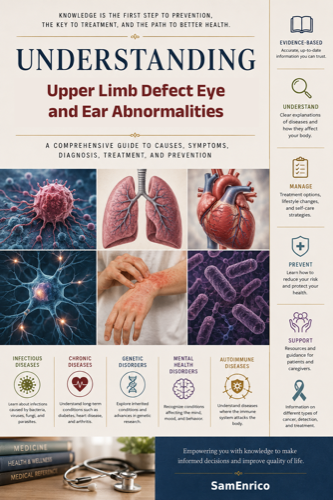
Understanding Upper Limb Defect Eye and Ear Abnormalities eBook
This disease publication, published by SamEnrico,
by Ha Emely
This disease publication, published by SamEnrico, covers Understanding Upper Limb Defect Eye and Ear Abnormalities
Formats
Free sample
Chapter 1: The Stranger in the Mirror...--A child is born, and the first thing a parent does is count. Ten fingers. Ten toes. Two eyes. Two ears.
One mouth. One nose. The counting is reflexive, almost primal—a silent inventory that confirms wholeness before the first cry fades. But what happens when the count comes up wrong? When the fingers number seven instead of ten?
When an eye is missing, or an ear is a tiny nub of cartilage where a graceful curve should be? In that suspended moment between delivery room silence and the first urgent whisper of "call genetics," a family's entire universe shifts. This book exists for those families, and for the clinicians who stand beside them in that moment of discovery.Understanding upper limb defects, eye abnormalities, and ear malformations is not merely an academic exercise in embryology or genetic sequencing. It is an exercise in redefining normal. Every day, somewhere in the world, a child is born with a combination of these anomalies—a thumb that never formed, a coloboma shaped like a keyhole in the iris, a microtia that transforms the outer ear into a question mark of skin and cartilage.
These children are not broken. They are differently built. And the medical system that must serve them is only beginning to catch up to that fundamental truth.This chapter opens a door into a world that most physicians encounter only a few times in their careers, yet one that demands immediate, confident action when it appears. We will explore the scope of congenital anomalies affecting the upper limb, eye, and ear—not as isolated curiosities but as interconnected developmental events that share a common embryologic timeline and, often, a common genetic language. By the time you finish this chapter, you will understand why a child with a missing thumb deserves a cardiac evaluation, why a baby with a small eye might also have hearing loss, and why the parent sitting across from you in the clinic needs not just your knowledge but your presence.The Epidemiology of Difference: How Common Are These Anomalies?Let us begin with numbers, because numbers ground us in reality.
Congenital anomalies collectively affect approximately 2 to 3 percent of all live births worldwide, according to the World Health Organization. That translates to roughly 8 million newborns each year who enter the world with some form of structural difference. Among these, anomalies of the upper limb occur in approximately 1 in 500 to 1 in 1,000 live births. Eye malformations—ranging from microphthalmia (abnormally small eye) to anophthalmia (complete absence of the eye)—occur in about 1 in 5,000 to 1 in 10,000 births. Ear malformations, including microtia and anotia, have a similar prevalence, ranging from 1 in 6,000 to 1 in 12,000 births depending on geographic and ethnic factors.But these numbers, taken separately, tell only part of the story.
The critical insight—the one that drives the entire purpose of this book—is that these anomalies do not occur independently as often as chance would predict. When an upper limb defect is present, the likelihood of an associated eye or ear abnormality rises significantly. In some syndrome contexts, such as CHARGE syndrome, the co-occurrence approaches 100 percent for specific pairs of anomalies. This is not coincidence. This is embryologic destiny.The prevalence of combined defects varies by specific combination.
Radial ray defects (anomalies affecting the thumb-side of the forearm and hand) co-occur with congenital heart disease in approximately 30 to 50 percent of syndromic cases. Coloboma of the eye (a gap in ocular structures) accompanies ear anomalies in nearly 80 percent of CHARGE syndrome cases. Microtia is associated with renal malformations in approximately 30 percent of cases when part of a syndrome. These numbers are not scare statistics. They are roadmaps.
They tell the clinician exactly where to look next.Geographic and demographic variations add another layer of complexity. The incidence of microtia, for example, is significantly higher in Hispanic and Asian populations, with rates reaching 1 in 3,000 births in some Native American communities. Upper limb reduction defects show no consistent ethnic predilection but do show a slight male predominance. Anophthalmia and microphthalmia are more common in consanguineous populations, reflecting the role of autosomal recessive genetic causes. These patterns are clues—epidemiologic breadcrumbs that lead toward underlying mechanisms.The Terminology Terrain: Speaking the Same Language Before we venture further, we must establish a shared vocabulary.
The field of dysmorphology—the study of abnormal form—has developed a precise language for describing congenital anomalies. Using this language correctly is not pedantry; it is the difference between a diagnostic dead end and a genetic breakthrough.A malformation is an intrinsic defect in the developmental process itself. The tissue never had the chance to form correctly because the genetic or molecular instructions were flawed from the start. A child with a cleft hand—where the central digits fail to form, creating a V-shaped gap—has a malformation. The blueprint was wrong.
A disruption, in contrast, occurs when normal tissue is destroyed after development has begun. Amniotic band syndrome, where strands of amniotic membrane wrap around and amputate digits or limbs, is a classic disruption. The limb was forming normally until an external force intervened.A deformation results from mechanical forces acting on otherwise normal tissue. The classic example is clubfoot, where intrauterine positioning compresses the foot into an abnormal posture. The foot itself is structurally normal; the position is not.
A sequence is a cascade of anomalies triggered by a single initial event. In Pierre Robin sequence, a small mandible (micrognathia) displaces the tongue backward, which prevents the palatal shelves from closing, resulting in a cleft palate. One cause, multiple effects in a predictable chain.A syndrome is a pattern of multiple anomalies that are believed to share a common underlying cause. In this book, we will use the term "syndrome" for conditions with either a known molecular cause (like CHARGE syndrome with its CHD7 mutations) OR a consistently observed clinical pattern that is widely accepted as a syndrome even when the genetic cause remains elusive (such as Goldenhar syndrome, recognizing the ongoing debate about terminology). An association, by contrast, refers to a non-random co-occurrence of anomalies that does not yet have a single identified cause.
VACTERL association—which includes vertebral, anal, cardiac, tracheal, esophageal, renal, and limb anomalies—is the archetypal association.Why does this distinction matter? Because families and clinicians need clarity. When a parent searches online after a diagnosis, they will encounter all these terms. They need the professional in the room to explain not just what their child has, but what kind of "what" it is. Is this a malformation that might recur in future pregnancies?
Or a disruption caused by an environmental exposure that carries no recurrence risk? These distinctions are not academic. They shape reproductive decisions, insurance coverage, and the very language of hope.The Psychosocial Earthquake: What Families Experience in the First Hours Now we arrive at the heart of why this chapter—and indeed this entire book—is structured the way it is. Every discussion of epidemiology, genetics, and embryology must ultimately serve the person in the room: the parent holding a child who looks different than expected. The psychosocial impact of a diagnosis of upper limb, eye, or ear anomalies begins in the delivery room…
This is the end of the free sample. Get the eBook to keep going. Buy now
About this book
Details
- Author
- Ha Emely
- Publisher
- SamEnrico
- Language
- English
- Genre
- Non-Fiction, Informative, Educational
- Released
- 2026-05-11
- Pages (approx.)
- 155
- Available as
- eBook, Audiobook

Read better in the ZLOADR app
Your eBooks on your phone or tablet. Sign in with your SamEnrico account and start reading.
More by Ha Emely
 Labeling Anger RestructuringHa Emely$11.99
 The Yet Mindset For TeensHa Emely$11.99
 Chronic Pain Opioid GuideHa Emely$11.99
 UK Business NegotiationHa Emely$11.99
 The Body Shame Healing GuideHa Emely$11.99
 The Stone and the Spirit: The Guilds That Built Heaven on EarthHa Emely$11.99
 Finish Line Chute ManagementHa Emely$11.99
 Water Stewardship Export GuideHa Emely$12.99
 Pre Seed Mistakes to AvoidHa Emely$12.99
 How to Start a Petrol Industrial Engines Business (Beginners Guide)Ha Emely$11.99
You may also like
 Hong Kong Handover 1997Dunn Johnnie$11.99
 Zumba For Postnatal Recovery CourseNeal Christian$11.99
 Zumba for BeginnersLadner Nikia$11.99
 YouTube Comment Mining GuideHumes Pandora$12.99
 Worry Box MeditationCarlin Rudy$11.99
 Workplace Stress MeditationNguyen Lynn$11.99
 Workplace Stress and Sleep RepairHawley Ivory$11.99
 Workplace Perfectionism CureDelaney Jeffry$11.99
 Workplace Injustice Anger GuideWallen Isabelle$11.99
 Work Addiction and Burnout LinkGreenwood Ester$11.99
 Women in Yoga and WellnessBeattie Galina$11.99
 Women in Stand Up ComedyChun Evangeline$11.99