
Non-FictionInformativeEducational
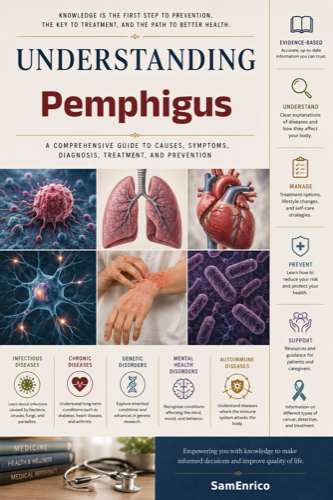
Understanding Pemphigus eBook
This disease publication, published by SamEnrico,
This disease publication, published by SamEnrico, covers Understanding Pemphigus
Formats
Free sample
Chapter 1: The Unseen War...--The first time a blister appeared on her gums, thirty-four-year-old Sarah thought she had burned her mouth on hot pizza. She ran her tongue over the small, painful bubble, dismissed it, and went about her week. When the second blister arrived—and then a third, spreading across her soft palate like a map of an unfamiliar country—she made an appointment with her dentist. The dentist frowned, prescribed a mouthwash for "possible herpes," and sent her home. Two months later, Sarah had lost fifteen pounds because eating felt like chewing broken glass.
Three months after that, the blisters had climbed down her throat, made their way to her chest, and exploded into raw, weeping erosions that covered twenty percent of her body. She could no longer work, could no longer hug her children without pain, and had begun to wonder if she was dying.She was not dying. But she had pemphigus, and no one had told her what that meant.If you are reading this book, you or someone you love has likely heard those three confusing, terrifying words: you have pemphigus. Perhaps you cannot pronounce it yet (try pem-FY-gus—say it aloud). Perhaps your doctor seemed uncertain, or your family is scared, or you are exhausted from pain, from not eating, from not sleeping, from not knowing what comes next.
Perhaps you have already searched the internet and found either dense medical journals written for specialists or vague patient pamphlets that offer lists of symptoms but no real answers. You are not alone, and you have come to the right place.This chapter is the first step in understanding the unseen war happening inside your body. We will start with the most fundamental question: what is pemphigus, really? Where did it come from in medical history? Who gets it, and why?
And most importantly—what do you need to know right now to move from fear to understanding, from confusion to action?Let us begin.What Pemphigus Actually Is—And What It Is Not Pemphigus is a rare, chronic, autoimmune blistering disease. Those four words carry enormous weight, so let us unpack each one.Rare. This is both a blessing and a curse. The blessing is that most people will never encounter pemphigus. The curse is that because it is rare, many doctors—including general practitioners, dentists, and even some dermatologists who do not specialize in blistering diseases—may not recognize it quickly.
In the United States and Europe, pemphigus affects approximately 1 to 5 people per million each year. That means in a city of one million people, only one to five new cases will be diagnosed annually. In parts of the world with higher genetic susceptibility, such as Iran (where rates approach 10-15 per million), India, and certain Mediterranean populations, it is more common but still rare compared to diseases like diabetes or hypertension. The rarity means you may feel alone. You are not.
There are thousands of pemphigus patients worldwide, and they have built communities, support networks, and a growing body of knowledge that you can now access.Chronic. Pemphigus does not typically go away after a single course of treatment. It is not like an infection where a course of antibiotics might end the problem permanently. Instead, pemphigus is a lifelong condition for most people, though it often enters remission—sometimes lasting years—during which you may have no symptoms at all. Think of it like other autoimmune diseases such as rheumatoid arthritis or lupus: there will be flares and quiet periods.
The goal of treatment is not just to heal your current blisters but to achieve and maintain remission, to minimize the impact on your life, and to give you the tools to recognize and stop flares before they become severe. Chronic does not mean hopeless. It means you are learning to manage a condition, like millions of people manage diabetes or asthma, and living a full, rich life while doing so.Autoimmune. Here is the most important word. Your immune system is designed to protect you.
It recognizes your own cells as "self" and foreign invaders like bacteria, viruses, and fungi as "non-self." In an autoimmune disease, that recognition system breaks down. Your immune system begins to see a normal part of your own body as an enemy and attacks it. In pemphigus, the target is a family of proteins called desmogleins (pronounced dez-MOG-lee-ins), which act like the molecular glue holding your skin and mucous membrane cells together. Your immune system produces antibodies—usually reserved for fighting infections—that instead bind to these desmogleins. The result is acantholysis (ack-an-THOL-ih-sis), the breaking apart of your own skin cells, which then separate and fill with fluid, forming blisters.Blistering disease.
This is the visible manifestation. Unlike other blistering conditions such as bullous pemphigoid (which tends to affect the elderly with tense, hard-to-pop blisters on the trunk and limbs), pemphigus produces fragile, flaccid (loose and limp) blisters that rupture easily, leaving raw, painful erosions that look like burns. These blisters can appear anywhere on the skin—scalp, face, chest, back, groin, arms, legs—and on any mucous membrane: mouth, throat, eyes, nose, genitals, anus.What pemphigus is not : It is not contagious. You cannot catch it from someone else, and you cannot give it to anyone. It is not an infection, though bacterial or fungal infections can complicate existing blisters.
It is not cancer, though one rare variant called paraneoplastic pemphigus is associated with underlying malignancies (we will discuss this variant in Chapter 3). It is not a reflection of poor hygiene, bad diet, or moral failing. It is a biological error, no more your fault than having blue eyes or being left-handed.A Brief History: From Death Sentence to Manageable Condition To appreciate how far we have come—and to understand why there is genuine hope for your future—let us take a short journey through medical history.The first clear descriptions of pemphigus appeared in the medical literature of the late 18th century. The word "pemphigus" comes from the Greek pemphix, meaning bubble or blister. Early physicians observed patients with widespread, chronic blistering that did not respond to the treatments of the day—bloodletting, purging, herbal remedies, and topical applications.
The disease was almost uniformly fatal, though accurate mortality statistics from that era are difficult to obtain. What is clear is that without effective treatment, patients with extensive pemphigus typically died within months to a few years from a combination of protein loss through denuded skin (leading to severe malnutrition and edema), overwhelming infection (sepsis), or simply the inability to eat and drink due to oral involvement (leading to starvation and dehydration).The first major breakthrough came in the 1940s and 1950s with the introduction of systemic corticosteroids—first cortisone, then prednisone. These powerful anti-inflammatory drugs could suppress the immune system just enough to stop blister formation in many patients. The impact was nothing short of revolutionary. Mortality rates, which had approached 90-100% for severe disease, dropped dramatically.
By the 1960s and 1970s, with better dosing protocols and the addition of steroid-sparing agents (drugs that allow lower steroid doses, which we will cover in Chapter 8), pemphigus became a survivable, manageable chronic…
This is the end of the free sample. Get the eBook to keep going. Buy now
About this book
Details
- Author
- Rubio Roseanne
- Publisher
- SamEnrico
- Language
- English
- Genre
- Non-Fiction, Informative, Educational
- Released
- 2026-05-09
- Pages (approx.)
- 160
- Available as
- eBook, Audiobook

Read better in the ZLOADR app
Your eBooks on your phone or tablet. Sign in with your SamEnrico account and start reading.
More by Rubio Roseanne
 HRT For Uterine Fibroids GuideRubio Roseanne$11.99
 Pain Relief SuggestionRubio Roseanne$11.99
 PCOS Chromium Supplement GuideRubio Roseanne$11.99
 Scott Peterson Death Row San Quentin LifeRubio Roseanne$11.99
 The Self Empathy and Validation GuideRubio Roseanne$11.99
 The Laundry Cycle: How a Global Bank Became a Crime SyndicateRubio Roseanne$11.99
 Piping EngineerRubio Roseanne$11.99
 How to Become a Spreading-machine OperatorRubio Roseanne$11.99
 Nike Innovation LabsRubio Roseanne$12.99
 Domain Expiry Grace Period GuideRubio Roseanne$12.99
You may also like
 Hong Kong Handover 1997Dunn Johnnie$11.99
 Zumba For Postnatal Recovery CourseNeal Christian$11.99
 Zumba for BeginnersLadner Nikia$11.99
 YouTube Comment Mining GuideHumes Pandora$12.99
 Worry Box MeditationCarlin Rudy$11.99
 Workplace Stress MeditationNguyen Lynn$11.99
 Workplace Stress and Sleep RepairHawley Ivory$11.99
 Workplace Perfectionism CureDelaney Jeffry$11.99
 Workplace Injustice Anger GuideWallen Isabelle$11.99
 Work Addiction and Burnout LinkGreenwood Ester$11.99
 Women in Yoga and WellnessBeattie Galina$11.99
 Women in Stand Up ComedyChun Evangeline$11.99