
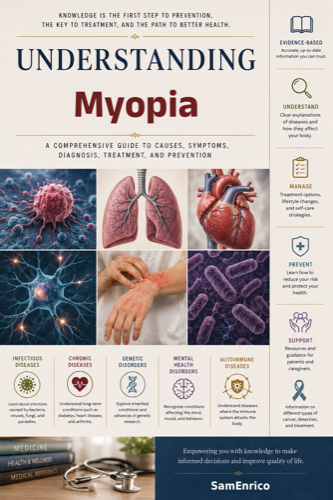
Non-FictionInformativeEducational
Understanding Myopia eBook
This disease publication, published by SamEnrico,
This disease publication, published by SamEnrico, covers Understanding Myopia
Formats
Free sample
Chapter 1: The Silent Epidemic--–- Every weekday morning at precisely 7:45 AM, seven-year-old Mia sat in the third row of her first-grade classroom, squinting at the whiteboard. Her teacher, Mrs. Chen, had written the day’s math problems in crisp black marker, but to Mia, the numbers looked like soft, gray smudges floating on a sea of white. She didn’t complain. She didn’t know she needed to.
Like most children her age, Mia assumed the entire world saw the way she did—that blurry trees, fuzzy faces, and illegible street signs were simply how things looked. When she finally received her first pair of glasses at age nine, she gasped on the car ride home. “Mom, I can see the leaves,” she whispered, pointing at individual oak leaves on a passing tree. “I didn’t know leaves had separate parts.”This story, recounted by Mia’s mother in a parenting forum, is not unusual. It is, in fact, tragically ordinary.
And it is happening millions of times over, across every continent, in every socioeconomic stratum. What Mia experienced was the onset of myopia—nearsightedness—a condition so common that most people dismiss it as a minor inconvenience, a rite of passage requiring nothing more than a trip to the optometrist and a pair of stylish frames. But that dismissal is a dangerous misconception. Myopia, particularly when it begins early in childhood, is not a benign quirk of biology. It is a progressive, often irreversible disease of the eye that now affects nearly 30 percent of the global population—and is on track to afflict half of all humans by 2050.Welcome to the silent epidemic.
You are likely reading this book because you or someone you love has myopia. Perhaps you have already been told that it is “just genetics” or that “everyone needs glasses eventually.” Perhaps you have been reassured that contact lenses or laser surgery will solve everything. These statements are not merely incomplete—they are dangerously misleading. This chapter will transform your understanding of myopia from a passive acceptance of “bad eyes” into an active recognition of a preventable, manageable chronic disease. By the time you finish these pages, you will understand why the world is in the midst of a myopia boom, why standard glasses are not enough, and why the choices you make today will determine not just the thickness of your child’s lenses but the very integrity of their retina decades from now.The Shocking Numbers: From Rare Nuisance to Global Crisis Let us begin with the mathematics of blindness.
In 1971, the National Health and Nutrition Examination Survey in the United States found that approximately 25 percent of Americans aged 12 to 54 were myopic. By 2004, that number had risen to 42 percent. In East Asia, the numbers are even more staggering. In Seoul, South Korea, a staggering 96.5 percent of 19-year-old males were myopic in a 2017 study. In Singapore, known as the “myopia capital of the world,” 80 percent of young adults have the condition.
China, home to nearly 1.4 billion people, has seen myopia rates among university students exceed 90 percent.But these are not just academic statistics. They represent real human eyes—and real human futures. The World Health Organization has identified unaddressed myopia as a leading cause of vision impairment worldwide. More concerning still, high myopia—defined as a prescription exceeding -6.00 diopters or an axial length greater than 26 millimeters—is now endemic in many urban populations. High myopia is not simply “worse” nearsightedness.
It is a qualitatively different condition, one in which the structural integrity of the eye is compromised. People with high myopia face dramatically elevated risks of retinal detachment, myopic macular degeneration, glaucoma, and cataracts—all of which can lead to irreversible blindness.Consider this: a person with low myopia (less than -3.00 diopters) has a fourfold increased risk of retinal detachment compared to a non-myopic person. A person with high myopia (greater than -6.00 diopters) has a twentyfold increased risk. Myopic macular degeneration has become the leading cause of blindness in people under 50 in many East Asian countries. This is not a minor health problem.
It is a public health crisis on par with diabetes and obesity—and like those conditions, it is largely preventable with early intervention.The Critical Distinction: Simple Myopia vs. Pathological Myopia To understand why these numbers matter, you must first grasp a distinction that most eye care professionals fail to communicate clearly to patients. There are, in fact, two entirely different conditions that share the same name.Simple myopia is the familiar form. It typically begins in school-aged children, progresses slowly through adolescence, and stabilizes in the early twenties. The final prescription is usually between -1.00 and -3.00 diopters.
The axial length of the eye—the distance from the cornea to the retina—is modestly longer than average, but the retina and other ocular tissues remain structurally normal. People with simple myopia require corrective lenses for distance vision, but they are at only slightly elevated risk for serious complications. This is the myopia of “I need glasses for driving and movies.”Pathological myopia is a different beast entirely. It often begins earlier—sometimes as young as three or four years old. It progresses relentlessly, sometimes well into the thirties or forties.
The final prescription often exceeds -6.00 diopters, and axial length can stretch to 28, 30, or even 35 millimeters (normal is approximately 23.5 millimeters). At these extremes, the sclera—the white outer coat of the eye—thins and weakens. The retina, stretched over this elongated globe, develops cracks, hemorrhages, and areas of atrophy. The choroid, the vascular layer that nourishes the retina, wastes away. The optic nerve is subjected to abnormal mechanical stress, raising glaucoma risk.This is the myopia of “I have to hold my phone two inches from my nose,” of “I’ve had three retinal detachment surgeries,” of “the doctor says I have macular degeneration at age forty.” And it is exploding in prevalence precisely because most people—including most eye care providers—still treat myopia as a simple refractive error rather than a progressive disease that requires active management.Why Your Grandparents Had Better Vision Than Your Children If you are over forty, you may remember a time when myopia was relatively uncommon—perhaps one or two kids in each classroom wore glasses.
Today, in many urban schools, more than half of the students are myopic by the end of elementary school. What changed?The simple answer is lifestyle, and it is a stunning illustration of how the modern environment shapes human biology. For 99 percent of human evolutionary history, our ancestors spent nearly all of their waking hours outdoors. They hunted, gathered, traveled, and socialized under open skies, exposed to sunlight intensities of 10,000 to 100,000 lux. Then, in the span of a few generations—a blink of an evolutionary eye—we moved indoors.
A typical modern child spends six to seven hours per day in classrooms lit at 300 to 500 lux, followed by several more hours of screen time in dimly lit homes. Add to this the dramatic reduction in physical outdoor play, the rise of structured indoor activities, and the increasing academic pressures that begin in preschool, and you have a perfect storm for eye growth gone…
This is the end of the free sample. Get the eBook to keep going. Buy now
About this book
Details
- Author
- Zaragoza Harlan
- Publisher
- SamEnrico
- Language
- English
- Genre
- Non-Fiction, Informative, Educational
- Released
- 2026-06-02
- Pages (approx.)
- 156
- Available as
- eBook, Audiobook

Read better in the ZLOADR app
Your eBooks on your phone or tablet. Sign in with your SamEnrico account and start reading.
More by Zaragoza Harlan
 Imposter Syndrome In InterviewsZaragoza Harlan$11.99
 Critical Parent Internal Voice WorkbookZaragoza Harlan$11.99
 Hamstring Flexibility Stretch GuideZaragoza Harlan$11.99
 Assertive Email CommunicationZaragoza Harlan$11.99
 Instagram vs Reality Comparison GuideZaragoza Harlan$11.99
 The Spy of the Labyrinth: Daedalus and Icarus’ Secret MissionZaragoza Harlan$11.99
 How to Start a Overhead Transparency Projectors Business (Beginners Guide)Zaragoza Harlan$11.99
 Roku SWOT Library GuideZaragoza Harlan$12.99
 Citation Rule Memory HackZaragoza Harlan$12.99
 Coach Technique En Architecture LogicielleZaragoza Harlan$11.99
You may also like
 Hong Kong Handover 1997Dunn Johnnie$11.99
 Zumba For Postnatal Recovery CourseNeal Christian$11.99
 Zumba for BeginnersLadner Nikia$11.99
 YouTube Comment Mining GuideHumes Pandora$12.99
 Worry Box MeditationCarlin Rudy$11.99
 Workplace Stress MeditationNguyen Lynn$11.99
 Workplace Stress and Sleep RepairHawley Ivory$11.99
 Workplace Perfectionism CureDelaney Jeffry$11.99
 Workplace Injustice Anger GuideWallen Isabelle$11.99
 Work Addiction and Burnout LinkGreenwood Ester$11.99
 Women in Yoga and WellnessBeattie Galina$11.99
 Women in Stand Up ComedyChun Evangeline$11.99