
Non-FictionInformativeEducational
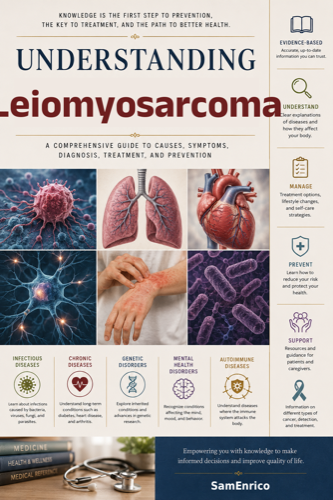
Understanding Leiomyosarcoma eBook
This disease publication, published by SamEnrico,
by Chan Chasity
This disease publication, published by SamEnrico, covers Understanding Leiomyosarcoma
Formats
Free sample
Chapter 1: The Silent Invader...--It begins without warning. No fever. No pain that stops you in your tracks. No dramatic moment when you know, deep in your gut, that something has gone terribly wrong. Instead, leiomyosarcoma (LMS) announces itself in the most insidious way possible: as nothing at all.
Or as something so ordinary, so easily dismissed, that weeks and months slip by while the tumor grows, cell by relentless cell, in the smooth muscle walls of a blood vessel, the deep tissue of your thigh, the hidden spaces behind your organs.This is the first and most dangerous truth about LMS: it is a master of disguise. By the time most patients hear the word "sarcoma" – let alone the tongue-twisting "leiomyosarcoma" – their tumor has been growing for years. A 2021 study in the Journal of Clinical Oncology found that the average time from first symptom to definitive diagnosis for retroperitoneal sarcomas, including LMS, was 12.8 months. For uterine LMS, misdiagnosis as benign fibroids occurs in nearly 60% of cases before surgery. For limb LMS, patients wait an average of 8 months from noticing a lump to receiving a biopsy.This chapter is not merely a biology lesson.
It is a map of the enemy. You cannot fight what you do not understand, and you cannot understand LMS without first grasping where it comes from, what it wants, and why it behaves so differently from the cancers you have heard about your entire life. By the end of this chapter, you will know the language of smooth muscle, the geography of LMS subtypes, and why this rare disease demands a completely different playbook than breast cancer, lung cancer, or colon cancer.What Is Leiomyosarcoma, Exactly?Let us begin with the name itself, because in medicine, names are not arbitrary labels. They are coded histories. "Leiomyosarcoma" breaks down into three Greek and Latin roots: leio (smooth), myo (muscle), and sarcoma (cancer of connective tissue).
Put them together, and you have a cancer of smooth muscle tissue.But what is smooth muscle? You have three types of muscle in your body. Skeletal muscle is the one you can control – your biceps, your quadriceps, the muscles that let you wave hello or walk up stairs. Cardiac muscle is unique to your heart, pumping rhythmically from birth to death without any conscious effort. Smooth muscle is the quiet worker.
You cannot consciously control it. It lines the walls of your blood vessels, your uterus, your gastrointestinal tract, your bladder, your airways, and the arrector pili muscles that make your hair stand on end when you are cold or frightened. Smooth muscle contracts and relaxes to move food through your intestines, push blood through your arteries, empty your bladder, and, in women, expel a baby during childbirth.LMS arises when the DNA inside a smooth muscle cell is damaged in a specific way that unlocks two catastrophic abilities. First, the cell begins to divide uncontrollably, ignoring the normal signals that tell cells when to stop. Second, it acquires the ability to invade through tissue planes and, most dangerously, to travel through the bloodstream to distant organs.
This second ability – metastasis – is what makes LMS life-threatening.Critical distinction: LMS is a sarcoma, not a carcinoma. This is not a minor academic point. Carcinomas (breast, lung, colon, prostate) arise from epithelial cells – the cells that line organs and glands. They spread through both the bloodstream and the lymphatic system, which is why lymph node removal is standard in carcinoma surgery. Sarcomas, including LMS, arise from connective tissue (muscle, fat, bone, cartilage, nerve) and spread almost exclusively through the bloodstream.
This means three things for you as a patient:Lymph node involvement is rare in LMS (less than 5% of cases), so routine lymph node dissection is usually unnecessary.The lungs are the most common site of metastasis because they are the first filter for venous blood.The surveillance strategy for LMS focuses on CT scans of the chest, not physical exams of lymph node basins.The Cell of Origin: Where LMS Hides To understand LMS, you must understand where smooth muscle lives. Each location carries different risks, different symptoms, and different treatment challenges.Blood Vessel Walls: Smooth muscle forms the middle layer (tunica media) of arteries and veins. LMS arising from blood vessel walls is called intravascular LMS, and it can grow either inside the vessel (intraluminal) or outward into surrounding tissue (extraluminal). This subtype is particularly dangerous because the tumor starts with direct access to the bloodstream. The most common sites are the inferior vena cava (the large vein that returns blood from the lower body to the heart), the femoral vein (in the thigh), and the saphenous vein (in the leg).The Uterus: The uterus is a smooth muscle organ.
Its muscular wall, the myometrium, is composed of densely packed smooth muscle cells. This is why uterine LMS is the most common subtype – not because the uterus is uniquely susceptible to cancer, but because it contains more smooth muscle than any other organ except the gastrointestinal tract. A critical warning: uterine LMS is often misdiagnosed as uterine fibroids (leiomyomas), which are benign smooth muscle tumors. Fibroids affect up to 70% of women by age 50. LMS is rare (approximately 0.5 per 100,000 women).
But when a presumed fibroid grows rapidly, causes pain, or appears after menopause, LMS must be considered.The Gastrointestinal Tract: The walls of the esophagus, stomach, small intestine, and colon contain smooth muscle that propels food forward through peristalsis. LMS of the GI tract is relatively rare compared to gastrointestinal stromal tumors (GIST), which arise from a different cell type (interstitial cells of Cajal). However, when LMS does occur in the GI tract, it is most common in the small intestine and colon.The Retroperitoneum: This is the space behind the abdominal cavity, between the peritoneum (the lining of the abdomen) and the back muscles. It contains the kidneys, the aorta, the inferior vena cava, the pancreas, and large lymph nodes. Retroperitoneal LMS is particularly dangerous for two reasons.
First, it grows silently because the retroperitoneum is expandable – a tumor can reach 20 or 30 centimeters before causing symptoms. Second, it wraps around vital structures (the aorta, the ureters, the spine), making complete surgical removal difficult. Retroperitoneal LMS accounts for approximately 15-20% of all LMS cases but has the worst prognosis due to late diagnosis and surgical challenges.The Limbs (Extremities): Deep soft tissue LMS of the thigh, calf, or upper arm is the most common non-uterine location. These tumors present as a painless, deep-seated mass that grows slowly over months. Because they are deep (below the muscle fascia), they are often not visible as a lump until they are quite large.
A patient might notice that their thigh feels "full" or that their pants fit tighter on one leg. The critical error is assuming a soft tissue mass is a lipoma (benign fat tumor), which is common, superficial, and soft. LMS is deep, firm, and fixed to underlying tissue.Cutaneous (Skin) LMS: The least common but least aggressive subtype. Cutaneous LMS arises from the arrector pili muscles – the tiny smooth muscles attached to hair follicles. These tumors appear as small (1-2 cm), firm, red or purple nodules on the skin, most commonly…
This is the end of the free sample. Get the eBook to keep going. Buy now
About this book
Details
- Author
- Chan Chasity
- Publisher
- SamEnrico
- Language
- English
- Genre
- Non-Fiction, Informative, Educational
- Released
- 2026-05-18
- Pages (approx.)
- 159
- Available as
- eBook, Audiobook

Read better in the ZLOADR app
Your eBooks on your phone or tablet. Sign in with your SamEnrico account and start reading.
More by Chan Chasity
 Remote Work Talent Migration PatternsChan Chasity$11.99
 Social Anxiety for LGBTQChan Chasity$11.99
 Bean A Day Longevity HabitChan Chasity$11.99
 The Workaholism and Substance Abuse LinkChan Chasity$11.99
 The Lemurian Fellowship EscapeChan Chasity$11.99
 Quetzalcoatl’s Serpent Storm: The Feathered God’s Last StandChan Chasity$11.99
 Collecting EnamelsChan Chasity$11.99
 B2B One Page Marketing ManualChan Chasity$12.99
 Senior Housing Real Estate GuideChan Chasity$12.99
 How to Start a Burettes Made of Glass Business (Beginners Guide)Chan Chasity$11.99
You may also like
 Hong Kong Handover 1997Dunn Johnnie$11.99
 Zumba For Postnatal Recovery CourseNeal Christian$11.99
 Zumba for BeginnersLadner Nikia$11.99
 YouTube Comment Mining GuideHumes Pandora$12.99
 Worry Box MeditationCarlin Rudy$11.99
 Workplace Stress MeditationNguyen Lynn$11.99
 Workplace Stress and Sleep RepairHawley Ivory$11.99
 Workplace Perfectionism CureDelaney Jeffry$11.99
 Workplace Injustice Anger GuideWallen Isabelle$11.99
 Work Addiction and Burnout LinkGreenwood Ester$11.99
 Women in Yoga and WellnessBeattie Galina$11.99
 Women in Stand Up ComedyChun Evangeline$11.99