
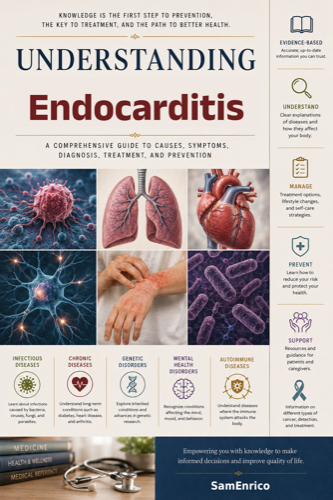
Non-FictionInformativeEducational
Understanding Endocarditis eBook
This disease publication, published by SamEnrico,
This disease publication, published by SamEnrico, covers Understanding Endocarditis
Formats
Free sample
Chapter 1: The Great Masquerader--–- The fever had been lingering for three weeks. Jenna, a 34-year-old yoga instructor and marathon runner with no prior medical problems, had done everything right. She rested. She hydrated. She took over-the-counter fever reducers.
She even went to the emergency department twice. The first time, they said “viral syndrome” and sent her home with a prescription for ibuprofen. The second time, a different physician noted a “barely audible heart murmur” but attributed it to her fever-induced tachycardia and discharged her with the same diagnosis: “likely viral illness, return if worsens.” On her third visit—this time unable to walk from her car to the ER entrance without stopping to catch her breath—a astute nurse noticed something the previous physicians had missed. Jenna’s fingernails contained small, splinter-like hemorrhages. Her eyes showed tiny petechial hemorrhages on her conjunctiva.
And her fever had never once dropped below 101.5°F despite two weeks of antipyretics. That nurse ordered blood cultures. Forty-eight hours later, the lab reported gram-positive cocci in clusters. Staphylococcus aureus. Jenna had endocarditis.
By the time she was diagnosed, a vegetation had already destroyed 60% of her mitral valve, and she would require emergency valve replacement surgery followed by six weeks of intravenous antibiotics. She survived. But she would never run a marathon again. Jenna’s story is not rare. It is, tragically, the rule.This chapter introduces the single most important concept in endocarditis: the disease does not announce itself with a distinctive rash, a positive rapid test, or a textbook presentation.
Instead, it wears masks. It mimics the flu, autoimmune disease, cancer, long COVID, and even anxiety. Understanding why endocarditis is called “The Great Masquerader” is the first step toward defeating it.The Pre-Antibiotic Era: A Death Sentence Before the discovery of penicillin in 1928 and its widespread availability in the 1940s, a diagnosis of endocarditis was effectively a death warrant. Historical medical texts from the 19th century describe the disease with a sense of helplessness that modern readers can scarcely comprehend. Sir William Osler, often called the father of modern medicine, famously wrote in his 1892 textbook The Principles and Practice of Medicine: “Infective endocarditis is one of the most hopeless of all diseases.
Recovery is practically unknown.”Osler was not exaggerating. In the pre-antibiotic era, the only “treatments” available were bed rest, bloodletting, and the administration of heavy metals like mercury or arsenic—none of which had any effect on the bacteria destroying the heart valves. Patients typically died within four to six weeks of diagnosis if they had acute endocarditis, or within six to twelve months if they had the subacute form. They died not from the infection itself but from its complications: heart failure from destroyed valves, massive embolic strokes when vegetations broke off and traveled to the brain, or septic shock when bacteria overwhelmed the bloodstream.The rare patients who “survived” endocarditis in the pre-antibiotic era did so only because their immune systems managed to wall off the infection—a phenomenon called “healed endocarditis”—but they were left with permanently scarred and deformed valves that would eventually cause heart failure years later. Autopsy studies from the 1930s showed that endocarditis was found in approximately 1-2% of all autopsies, meaning it was a common cause of death, yet it remained poorly understood by most physicians.What changed?
The introduction of penicillin during World War II transformed endocarditis from a uniformly fatal disease into a potentially curable one. By the 1950s, the combination of penicillin and streptomycin cured approximately 70% of patients with streptococcal endocarditis. But even today, despite decades of medical advances, endocarditis kills 20-30% of patients with Staphylococcus aureus infection—a sobering reminder that this disease remains dangerous, aggressive, and unforgiving of diagnostic delays.Defining Endocarditis: What Is It Exactly?At its simplest level, endocarditis is an infection of the endocardium—the thin, smooth membrane that lines the inside of the heart’s four chambers and covers the heart valves. But that definition, while anatomically accurate, fails to capture the disease’s destructive potential.Think of the endocardium as the heart’s inner skin. Under normal circumstances, it is remarkably resistant to infection.
Bacteria circulating in the bloodstream—a condition called bacteremia—rarely attach to healthy, intact endocardium. The bloodstream constantly carries small numbers of bacteria from everyday activities like brushing your teeth, flossing, eating, or even just chewing. In a healthy person with normal heart valves and intact endocardium, these bacteria are quickly cleared by the immune system without ever causing a problem.The trouble begins when the endocardium is damaged. That damage can come from many sources: turbulent blood flow across an abnormal valve, a history of rheumatic fever, the sewing ring of a prosthetic valve, or the trauma of a pacemaker lead rubbing against the endocardial surface. Once the endocardium is roughened or denuded, platelets and fibrin—the body’s natural clotting system—adhere to the damaged area, forming a sterile platelet-fibrin clot.
This clot is called a non-bacterial thrombotic endocarditis lesion, and it is the soil in which infective endocarditis grows.When bacteria enter the bloodstream and encounter this sterile clot, they find a perfect hiding place. The fibrin mesh protects them from phagocytes (white blood cells that normally engulf and destroy bacteria). The platelets release growth factors that actually help bacteria multiply. And the clot itself provides a physical barrier that antibiotics struggle to penetrate. Over days to weeks, the bacteria, fibrin, and platelets accumulate into a vegetation—a friable, cauliflower-like mass attached to the valve or endocardium.This vegetation is the hallmark of endocarditis.
It is simultaneously the cause of the disease’s most dangerous complications and the target of all treatment efforts. The vegetation destroys the valve underneath it, causing regurgitation (leaking). It showers septic emboli into the bloodstream. It extends into the surrounding heart muscle, causing abscesses. And it persists for weeks or months unless treated with prolonged, high-dose intravenous antibiotics or surgically excised.The Two Faces of Endocarditis: Acute Versus Subacute Not all endocarditis is the same.
Clinicians have long recognized two distinct presentations, which differ not only in their speed and severity but also in their microbiology, complications, and outcomes.Acute Endocarditis is the more dangerous form. It develops rapidly, over days to less than two weeks. Patients often appear toxic: high fevers (103°F or higher), rigors (violent shaking chills), and signs of sepsis. The causative organism is almost always an aggressive bacterium, most commonly Staphylococcus aureus (responsible for approximately 30-40% of all acute cases). Other acute pathogens include Streptococcus pyogenes (group A strep), Streptococcus pneumoniae (pneumococcus), and Neisseria meningitidis (meningococcus).Acute endocarditis destroys valves in days, not weeks.
A patient with a previously normal mitral valve can develop severe, life-threatening regurgitation within 48 to 72 hours of symptom onset. Vegetations in acute endocarditis are often large (>15 mm), highly friable, and prone to embolize. Complications are the rule, not the exception: embolic stroke (20-40% of patients), heart failure (30-50%), perivalvular abscess (20-30%), and death (20-40% even with modern treatment).Subacute Endocarditis is slower, more insidious, and easier to miss. Symptoms develop over weeks to months. Patients often do not look sick.
They complain of fatigue, low-grade fevers (especially in the evenings), night sweats, weight loss, and a general sense of “not…
This is the end of the free sample. Get the eBook to keep going. Buy now
About this book
Details
- Author
- Batts Raymundo
- Publisher
- SamEnrico
- Language
- English
- Genre
- Non-Fiction, Informative, Educational
- Released
- 2026-05-18
- Pages (approx.)
- 160
- Available as
- eBook, Audiobook

Read better in the ZLOADR app
Your eBooks on your phone or tablet. Sign in with your SamEnrico account and start reading.
More by Batts Raymundo
 Self Hypnosis Eye Closure Challenge ManualBatts Raymundo$11.99
 Chunking for Speed ReadingBatts Raymundo$11.99
 Psychoeducation for Angry PartnersBatts Raymundo$11.99
 Beginner's Mindset ShiftBatts Raymundo$11.99
 Architecture Student Sleep DeprivationBatts Raymundo$11.99
 Whispers of the Lost Library of AlexandriaBatts Raymundo$11.99
 The Jade Seekers: Uncovering the Olmec Lost City of the PacificBatts Raymundo$11.99
 AI Art Product MockupsBatts Raymundo$12.99
 Lean Kanban for ToyotaBatts Raymundo$12.99
 Frisbee Golf ? FrolfBatts Raymundo$11.99
 How to Start a Prefabricated Buildings and Components Made of Concrete Business (Beginners Guide)Batts Raymundo$11.99
You may also like
 Hong Kong Handover 1997Dunn Johnnie$11.99
 Zumba For Postnatal Recovery CourseNeal Christian$11.99
 Zumba for BeginnersLadner Nikia$11.99
 YouTube Comment Mining GuideHumes Pandora$12.99
 Worry Box MeditationCarlin Rudy$11.99
 Workplace Stress MeditationNguyen Lynn$11.99
 Workplace Stress and Sleep RepairHawley Ivory$11.99
 Workplace Perfectionism CureDelaney Jeffry$11.99
 Workplace Injustice Anger GuideWallen Isabelle$11.99
 Work Addiction and Burnout LinkGreenwood Ester$11.99
 Women in Yoga and WellnessBeattie Galina$11.99
 Women in Stand Up ComedyChun Evangeline$11.99