
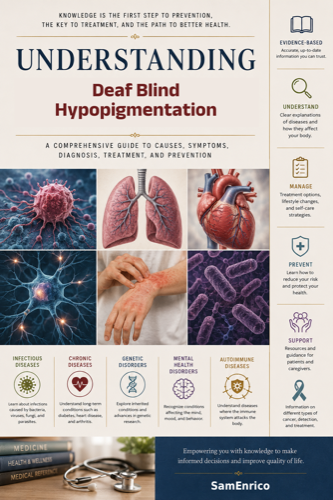
Non-FictionInformativeEducational
Understanding Deaf Blind Hypopigmentation eBook
This disease publication, published by SamEnrico,
This disease publication, published by SamEnrico, covers Understanding Deaf Blind Hypopigmentation
Formats
Free sample
Chapter 1: The Silent Palette...--–- The morning Miriam gave birth to her third child, the delivery room fell quiet. Not the peaceful quiet of a sleeping newborn, but the tense quiet of nurses exchanging glances. Little Daniel had a shock of white hair above his right temple, like a brushstroke of snow on a dark canvas. One eye was deep brown, the other a striking, translucent blue. He passed his newborn hearing screen—a chirp in each ear that made him startle—and the medical team relaxed.
"Probably nothing," the pediatrician said. "Sometimes these things happen. A beautiful, unique boy."Miriam took a photograph that day. In it, Daniel looks like any other hours-old infant: scrunched face, tiny fingers curled into fists, hospital blanket swaddled tight. But the white forelock is unmistakable.
Three years later, that photograph became the first piece of evidence when Daniel was diagnosed with Waardenburg syndrome. By then, he had moderate hearing loss in his left ear, profound loss in his right, and his father had admitted, upon careful questioning, that he too had been born with a white patch of hair—his mother had dyed it for years to hide it.This book begins with Daniel’s story because it contains all the essential elements of auditory-pigmentary syndromes: a striking physical sign present at birth, a hidden genetic thread connecting generations, a sensory loss that unfolds over time, and a family struggling to understand what they are seeing. The white forelock, the heterochromia, the progressive recognition of hearing loss—these are not random coincidences. They are the visible fingerprints of a developmental process that went slightly, profoundly awry in the first weeks of gestation.The title of this book is Understanding Deaf Blind Hypopigmentation. If you have picked it up because you or someone you love has white in their hair, unusual eyes, hearing loss, or some combination of these, you have already begun the journey.
This first chapter is not a clinical introduction—there will be time for genes and syndromes and treatment protocols later. Instead, this chapter is an invitation to see the human body not as a collection of separate systems (skin, ears, eyes) but as a single, integrated masterpiece of embryonic engineering. And like any masterpiece, it can bear the marks of its creation in unexpected places.Before we dive into neural crest cells and PAX3 mutations, let us consider three questions that every parent, every patient, every clinician asks when they first encounter these conditions:Why does this happen to the skin, the hearing, and the eyes all at once?Is this condition getting worse?What does the future hold?The answers lie in a journey that begins approximately three weeks after conception, when you were nothing more than a flat disc of cells no larger than the period at the end of this sentence.The Embryological Clue: Where Three Systems Meet To understand why deafness, blindness, and pigment changes travel together, we must go back to the very beginning of human development. Approximately eighteen days after fertilization, a structure called the neural tube forms along the back of the embryo. This tube will eventually become the brain and spinal cord.
But along the edges of this closing tube, something remarkable happens: a population of cells breaks free and begins to migrate throughout the body.These are the neural crest cells. They are, in the words of one embryologist, the "nomads of the embryo." They travel along defined pathways to become an astonishing variety of tissues: the bones of the face, the nerves of the gut, the muscles of the heart’s outflow tract, the pigment cells of the skin, and—most relevant to this book—critical structures within the inner ear and the eye.The neural crest cells destined for the ear migrate toward the developing cochlea, where they will form the stria vascularis. This tiny strip of tissue, no larger than a grain of rice in an adult, is the battery of the inner ear. It generates an electrical potential that allows hair cells to convert sound vibrations into nerve signals. Without a functioning stria vascularis, the cochlea is like a flashlight without a battery—all the parts are present, but nothing works.Meanwhile, other neural crest cells migrate toward the developing eye.
They penetrate the uveal tract—the iris, the ciliary body, and the choroid—and become melanocytes. In the iris, these pigment cells determine eye color. In the choroid, they absorb scattered light to sharpen vision. In the ciliary body, they contribute to the structure that produces aqueous humor.And a third population of neural crest cells migrates to the skin, where they settle into the basal layer and become the melanocytes responsible for skin and hair color. They lie in wait, ready to transfer pigment to keratinocytes as the skin grows and turns over.Three systems.
One origin. The neural crest.When a genetic mutation disrupts neural crest development—whether by interfering with cell migration, proliferation, survival, or differentiation—all three systems can be affected simultaneously. But here is the crucial nuance that will echo through every chapter of this book: not all neural crest derivatives are equally vulnerable to a given mutation. Some mutations hit the cochlea hardest. Others spare the eye entirely.
Still others produce striking pigment changes with minimal hearing loss.This variability is why your neighbor with the white forelock may hear perfectly, while your child with the same condition is profoundly deaf. This is why one sibling with Waardenburg syndrome has beautiful blue eyes and normal vision, while another has colobomas and legal blindness. The same genetic instruction, executed in the chaotic, beautiful theater of embryonic development, produces an infinite spectrum of outcomes.The Three Questions, Answered Early Let us return to those three questions, because they deserve answers before we go any further.Why do these three systems fail together? Because they share a common origin in the neural crest. Any genetic or environmental insult that disrupts neural crest cells can affect the cochlea, the eye, and the skin simultaneously.
However—and this is critical—most auditory-pigmentary syndromes do NOT cause true blindness in the majority of patients. The book’s title includes "blind" because some conditions in this family (Yemenite type, Hermansky-Pudlak syndrome, coloboma-associated Waardenburg) do cause significant visual impairment. But in classic Waardenburg syndrome types I and II, vision is typically normal or near-normal. The triad is a possibility, not a guarantee.Is this condition getting worse? For the vast majority of patients, no.
Sensorineural hearing loss in Waardenburg syndrome is almost always congenital and non-progressive. The pigment changes do not spread or darken over time—what you see at birth is largely what you will see as an adult. Colobomas are structural defects that do not enlarge. There are exceptions, which later chapters will address: Hermansky-Pudlak syndrome can cause progressive pulmonary fibrosis, and some rare variants of Waardenburg may involve progressive neurologic decline. But for most families reading this book, the answer is a genuine relief: the condition you diagnose today is the condition your child will live with tomorrow.
It does not steal ground over time.What does the future hold? A future of hearing aids or cochlear implants, perhaps.…
This is the end of the free sample. Get the eBook to keep going. Buy now
About this book
Details
- Author
- Kaiser Nereida
- Publisher
- SamEnrico
- Language
- English
- Genre
- Non-Fiction, Informative, Educational
- Released
- 2026-05-09
- Pages (approx.)
- 160
- Available as
- eBook, Audiobook

Read better in the ZLOADR app
Your eBooks on your phone or tablet. Sign in with your SamEnrico account and start reading.
More by Kaiser Nereida
 Recovery Lifestyle ManualKaiser Nereida$11.99
 Parental Anger Visualization GuideKaiser Nereida$11.99
 Bullet Journal Priority SetupKaiser Nereida$11.99
 Cronometer Advanced GuideKaiser Nereida$11.99
 Presidential Libraries GuideKaiser Nereida$11.99
 Silk Road: The Dark Web’s Billion-Dollar ExperimentKaiser Nereida$11.99
 Einstein’s Shadow: The Antarctic Relativity Expedition That Defied DeathKaiser Nereida$11.99
 Ultimate Handbook Guide to Stepanakert : (Nagorno-Karabakh Republic) Travel GuideKaiser Nereida$11.99
 Expectation-Maximization Algorithm OperatorKaiser Nereida$11.99
 Schedule L Transactions GuideKaiser Nereida$12.99
 Discord Server StructureKaiser Nereida$12.99
You may also like
 Hong Kong Handover 1997Dunn Johnnie$11.99
 Zumba For Postnatal Recovery CourseNeal Christian$11.99
 Zumba for BeginnersLadner Nikia$11.99
 YouTube Comment Mining GuideHumes Pandora$12.99
 Worry Box MeditationCarlin Rudy$11.99
 Workplace Stress MeditationNguyen Lynn$11.99
 Workplace Stress and Sleep RepairHawley Ivory$11.99
 Workplace Perfectionism CureDelaney Jeffry$11.99
 Workplace Injustice Anger GuideWallen Isabelle$11.99
 Work Addiction and Burnout LinkGreenwood Ester$11.99
 Women in Yoga and WellnessBeattie Galina$11.99
 Women in Stand Up ComedyChun Evangeline$11.99