
Non-FictionInformativeEducational
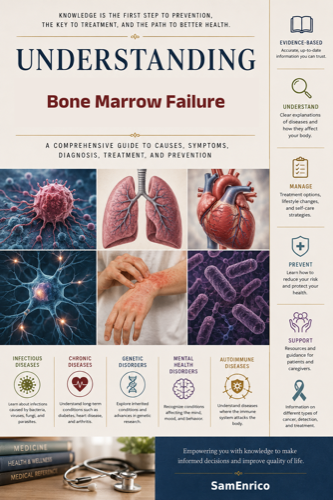
Understanding Bone Marrow Failure eBook
This disease publication, published by SamEnrico,
This disease publication, published by SamEnrico, covers Understanding Bone Marrow Failure
Formats
Free sample
Chapter 1: The Hidden Factory--–- Every day, without a single conscious thought from you, a factory inside your bones produces more than 200 billion new blood cells. That is roughly 2.3 million cells every second. By the time you finish reading this sentence, your bone marrow has already manufactured millions of red blood cells to carry oxygen, white blood cells to fight infection, and platelets to clot your blood. This relentless, silent production line is the foundation of life itself. And when it falters—when the factory begins to slow, to malfunction, or to shut down entirely—the consequences are profound, complex, and often devastating.Yet most people, including many healthcare professionals outside of hematology, have never stopped to consider this inner universe.
We take our blood for granted. We cut ourselves, we bleed, we clot, and we heal. We breathe, and oxygen reaches our tissues. We encounter germs, and our immune system responds. But behind every one of these everyday miracles stands the hematopoietic system—a marvel of biological engineering that balances self-renewal, differentiation, and regulation with astonishing precision.Understanding bone marrow failure begins here, not with disease, but with health.
You cannot truly grasp what it means for the marrow to fail until you appreciate how exquisitely it functions when everything goes right. This chapter, therefore, builds the foundation upon which the rest of this book rests. We will explore the anatomy of the marrow, the hierarchy of blood-forming cells, the nurturing microenvironment known as the niche, the chemical messengers that direct traffic, and the molecular switches that determine cell fate. By the end, you will see your own blood in a new light—not as a simple red fluid, but as a dynamic, living tissue born from a hidden factory that works tirelessly to keep you alive.The Geography of Marrow: Red Versus Yellow Bone marrow is not a uniform substance. It exists in two distinct varieties, and their distribution across the human body changes dramatically from infancy to adulthood.
In a newborn baby, nearly all bones contain red marrow—the active, blood-producing tissue. This makes sense for a rapidly growing organism that must expand its blood volume and immune capacity. As we age, much of this red marrow gradually converts to yellow marrow, which consists largely of fat cells and serves as an energy reserve.By adulthood, red marrow is confined to specific locations: the flat bones (sternum, skull, ribs, pelvis, shoulder blades) and the ends of the long bones (femurs and humeri). The shafts of the long bones become filled with yellow marrow. This geographical shift is not arbitrary.
Red marrow requires a rich blood supply and a supportive three-dimensional structure; flat bones provide both. Moreover, the concentration of red marrow in the axial skeleton places blood production close to the central circulation, allowing rapid deployment of new cells.Clinically, this distribution matters enormously. When a hematologist performs a bone marrow biopsy, they typically target the posterior iliac crest (the back of the hip bone) because it retains red marrow even in old age. In certain diseases, such as myelofibrosis or severe aplastic anemia, the body may attempt to reactivate yellow marrow or even produce blood in the liver and spleen—a phenomenon called extramedullary hematopoiesis. But these compensatory efforts are rarely sufficient to sustain normal blood counts, and they often cause organ enlargement and dysfunction.The conversion from red to yellow marrow is also a diagnostic clue.
In conditions of chronic hemolytic anemia (like sickle cell disease or thalassemia), the marrow expands outward, eroding bone and creating characteristic radiographic changes. Conversely, in bone marrow failure, the marrow may appear pale, fatty, and empty on imaging—a finding that often precedes formal diagnosis by months or even years.The Hematopoietic Stem Cell: The Master Seed At the apex of the blood production hierarchy sits a cell so rare and so precious that researchers spent decades trying to isolate it. The hematopoietic stem cell (HSC) is the ultimate ancestor of every red blood cell, white blood cell, and platelet in your body. It possesses two defining properties that no other blood cell shares: self-renewal (the ability to make copies of itself) and multipotency (the ability to differentiate into all blood lineages).Self-renewal is what separates a stem cell from a progenitor cell. A true HSC can divide asymmetrically: one daughter cell remains a stem cell, preserving the pool for future needs, while the other daughter commits to becoming a mature blood cell.
This balance is exquisitely regulated. Too much self-renewal leads to leukemia (where stem cells proliferate uncontrollably). Too little self-renewal leads to marrow failure (where the stem cell pool depletes over time).Multipotency means that a single HSC can generate the entire blood system. This was famously demonstrated in the 1960s by James Till and Ernest Mc Culloch, who showed that a single transplanted cell could reconstitute all blood lineages in a lethally irradiated mouse. In humans, the same principle underlies bone marrow transplantation: a relatively small number of HSCs, infused into a patient whose own marrow has been destroyed, can rebuild an entirely new blood and immune system.How many HSCs does a healthy adult have?
Estimates vary, but most researchers agree that the human body contains roughly 10,000 to 20,000 true long-term HSCs. These cells are scattered throughout the red marrow, interspersed with billions of more committed progenitors. They are mostly quiescent—resting in a dormant state called G0—but they can be awakened by signals of stress, such as bleeding, infection, or chemotherapy. This quiescence is protective: it prevents exhaustion of the stem cell pool and reduces the risk of acquiring DNA mutations during cell division. But it also makes HSCs resistant to many chemotherapy drugs that target rapidly dividing cells, which is why stem cells can survive treatments that kill most other blood cells.When an HSC does divide, it gives rise to two broad categories of progeny: the myeloid lineage and the lymphoid lineage.
The myeloid lineage produces red blood cells (erythrocytes), platelets (from megakaryocytes), and the innate immune cells (neutrophils, eosinophils, basophils, monocytes, macrophages, and dendritic cells). The lymphoid lineage produces the adaptive immune cells: B lymphocytes (which make antibodies), T lymphocytes (which kill infected cells and orchestrate immune responses), and natural killer (NK) cells (which bridge innate and adaptive immunity).The Niche: Where Stem Cells Live An HSC does not float freely in the marrow. It resides in a specialized microenvironment called the niche—a three-dimensional architecture of supporting cells, extracellular matrix, and signaling molecules that together maintain stem cell function. Without the niche, HSCs rapidly differentiate or die. With the niche, they remain quiescent, self-renew, and respond appropriately to demand.The concept of the stem cell niche was first proposed by Ray Schofield in 1978, but only in the last two decades have researchers identified the actual cells that constitute it.
Two main niche compartments have been described in the bone marrow: the osteoblastic (endosteal) niche and the vascular (perivascular) niche.The osteoblastic niche is located adjacent to the inner surface of the bone, where osteoblasts (bone-forming cells) line the endosteum. These osteoblasts secrete factors such as osteopontin, angiopoietin-1, and thrombopoietin that promote HSC quiescence and self-renewal. HSCs that reside near the bone…
This is the end of the free sample. Get the eBook to keep going. Buy now
About this book
Details
- Author
- Moniz Brittney
- Publisher
- SamEnrico
- Language
- English
- Genre
- Non-Fiction, Informative, Educational
- Released
- 2026-06-02
- Pages (approx.)
- 153
- Available as
- eBook, Audiobook

Read better in the ZLOADR app
Your eBooks on your phone or tablet. Sign in with your SamEnrico account and start reading.
More by Moniz Brittney
 Murdoch Sunday Times AcquisitionMoniz Brittney$11.99
 Humming to Calm Nerves ProtocolMoniz Brittney$11.99
 Prioritization for Political CampaignsMoniz Brittney$11.99
 Emotion Function Awareness WorkbookMoniz Brittney$11.99
 Mindfulness for the Angry ParentMoniz Brittney$11.99
 The Pink Panther Caper: The Heist That Shocked the Art WorldMoniz Brittney$11.99
 The Lost Caravan: A Castaway’s Odyssey in the Karakum DesertMoniz Brittney$11.99
 Zoo Animal Party PerformerMoniz Brittney$11.99
 Kenyan Remote Customer Support GuideMoniz Brittney$12.99
 Amazon Vine Reviewer ProgramMoniz Brittney$12.99
 10 Ways to Use Crabs (Recipe Book)Moniz Brittney$11.99
You may also like
 Hong Kong Handover 1997Dunn Johnnie$11.99
 Zumba For Postnatal Recovery CourseNeal Christian$11.99
 Zumba for BeginnersLadner Nikia$11.99
 YouTube Comment Mining GuideHumes Pandora$12.99
 Worry Box MeditationCarlin Rudy$11.99
 Workplace Stress MeditationNguyen Lynn$11.99
 Workplace Stress and Sleep RepairHawley Ivory$11.99
 Workplace Perfectionism CureDelaney Jeffry$11.99
 Workplace Injustice Anger GuideWallen Isabelle$11.99
 Work Addiction and Burnout LinkGreenwood Ester$11.99
 Women in Yoga and WellnessBeattie Galina$11.99
 Women in Stand Up ComedyChun Evangeline$11.99