
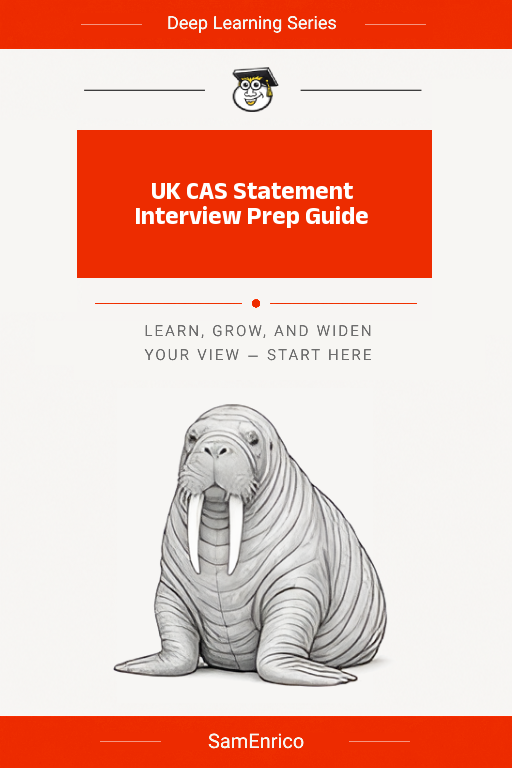
UK CAS Statement Interview Prep Guide eBook
Align your answers with Confirmation of Acceptance
Align your answers with Confirmation of Acceptance for Studies details to show genuine student status.
Formats
Free sample
Chapter 1: The Hidden Truth...--Every year, approximately 30,000 genuinely qualified international students receive a Confirmation of Acceptance for Studies from a UK university, book their flights, pay their deposits, and then—days or weeks later—open an email that begins with the word “Refused.” They are not refused because their grades were insufficient. Their English scores were not too low. Their bank accounts were not empty. They are refused because a UKVI Entry Clearance Officer, sitting in a visa processing centre thousands of miles away, listened to their interview recording or read their credibility assessment and concluded one devastating sentence: “I am not satisfied that you are a genuine student.”This chapter exists because that sentence is often wrong—and because you are going to learn why it happens, how to prevent it, and why every other guide you have read has failed to prepare you for the single most important moment of your visa application.The Refusal That Makes No Sense Let me tell you about Priya. (Her name has been changed, but her case file is real.)Priya graduated with a first-class degree in Economics from a respected university in India.
She scored 7.5 on IELTS—well above the requirement for her CAS course. She had £35,000 in her father’s bank account, properly documented with a gift deed. She was accepted into a top-30 UK university for an MSc in International Business. Her agent assured her that her profile was “strong” and that the visa interview would be a formality.The interview lasted eleven minutes.The ECO asked: “What will you study?”Priya answered: “International Business.”The ECO asked: “Can you tell me three specific modules from your course?”Priya paused. She knew the course was about business.
She knew she wanted a career in management. But she had never looked at the module list. Her agent had submitted the application. Her university had issued the CAS. She assumed that was enough.She guessed: “Marketing, finance, and… human resources?”The ECO asked: “Are those the exact module names as listed on your CAS course specification?”Priya said: “Probably similar.”The refusal letter arrived seventy-two hours later.
The key paragraph read: “You were unable to name a single module from your proposed course of study without hesitation and guessing. When asked to confirm whether your answers matched the CAS course specification, you responded with ‘probably similar,’ which demonstrates a lack of genuine understanding of your own academic programme. I am not satisfied that you are a genuine student. Refused under paragraph 9.8.1 of the Immigration Rules.”Priya’s grades did not save her. Her IELTS score did not save her.
Her bank balance did not save her. She was refused not because she was unqualified, but because her answers did not align with her CAS data.She is not alone.The Gap That No One Talks About Here is the problem that every international student guide ignores: there is a fundamental difference between being a genuine student and proving that you are a genuine student to a UKVI Entry Clearance Officer.Your university already determined that you are academically genuine when they issued your CAS. They checked your qualifications. They verified your English score. They assessed your application.
The CAS itself is proof that a UK-regulated institution has accepted you.But the UKVI officer is not your university. They do not care about your potential. They do not care about your dreams. They care about one thing: risk assessment. Specifically, they are trained to assess four risks:Overstay risk: Will you leave the UK when your visa expires?Illegal work risk: Will you work more hours than permitted or in prohibited jobs?Course non-completion risk: Will you enroll but then drop out to work or settle?Misrepresentation risk: Have you lied or omitted material facts?Notice something important: none of these risks are about your academic ability.
You can be a brilliant student and still be a high-risk applicant in the eyes of UKVI. In fact, brilliant students are sometimes higher risk because they may have more opportunities to overstay into skilled work.The ECO does not know you. They have never met you. They have a photograph, a CAS printout, and your interview recording. That is all.
Their decision—a decision that determines whether you spend £10,000 to £50,000 on a UK education—rests almost entirely on whether your spoken answers match the data on your CAS.This is the gap. And this book exists to close it.The Five Pillars of the Genuine Student Requirement To close the gap, you must first understand what the ECO is actually evaluating. The Genuine Student Requirement is not a single test but a framework of five distinct pillars. Each pillar represents a category of risk. Your interview answers will be assessed against all five, whether you realise it or not.Pillar One: Academic Ability The ECO will verify that your previous qualifications logically support your ability to complete the CAS course.
This does not mean you need perfect grades. It means your academic history must show progression.What the ECO looks for:Your previous degree or diploma is at an appropriate level (e.g., a bachelor’s degree for a master’s CAS)Your grades meet or exceed the CAS requirements Your subject background has reasonable connection to the CAS course What triggers suspicion:A significant drop in qualification level (e.g., a Ph D applicant with no prior degree)Repeated failures or withdrawals without explanation A “jump” between unrelated fields with no bridging narrative How this pillar appears in interviews:“Your CAS shows your previous qualification is in Civil Engineering. Why are you now applying for Fashion Management?”Pillar Two: English Proficiency The ECO will confirm that your English language test score meets the CAS requirement. This is usually a simple checkbox—unless your spoken English during the interview is significantly worse than your test score suggests.What the ECO looks for:Your SELT score matches or exceeds the CAS requirement Your spoken English during the interview is consistent with that score You understand the questions without repeated clarification What triggers suspicion:A high test score but very poor spoken English (suggests cheating or test substitution)Inability to understand basic questions Heavy reliance on memorised phrases that break down under follow-up questions How this pillar appears in interviews:“Your IELTS score is 7.0, but you are struggling to understand my questions. Can you explain this discrepancy?”Pillar Three: Financial Sustainability The ECO will verify that you (or your sponsor) have sufficient funds to cover tuition fees and living costs for the entire course duration.
This pillar is largely documentary, but it appears in interviews when your verbal explanations contradict your bank statements.What the ECO looks for:Tuition fees (as listed on CAS)Living costs (£1,334/month London; £1,023/month outside London) for up to 9 months Evidence that funds have been held for at least 28 consecutive days A credible explanation for large or unusual deposits What triggers suspicion:Saying “I will work to pay my tuition” (implies you cannot afford the course)Inability to name your sponsor or explain the source of funds Contradictions between your verbal answers and your bank statements How this pillar appears in interviews:“Your CAS shows…
This is the end of the free sample. Get the eBook to keep going. Buy now
About this book
Details
- Author
- Bisson Latricia
- Publisher
- SamEnrico
- Language
- English
- Genre
- Non-Fiction, Student's Shortcut
- Released
- 2026-05-29
- Pages (approx.)
- 139
- Available as
- eBook, Audiobook

Read better in the ZLOADR app
Your eBooks on your phone or tablet. Sign in with your SamEnrico account and start reading.
More by Bisson Latricia
 The Interruption Scripting WorkbookBisson Latricia$11.99
 IBS Pelvic Floor Therapy GuideBisson Latricia$11.99
 Fear Appeal PersuasionBisson Latricia$11.99
 Discussing Open Relationship BoundariesBisson Latricia$11.99
 The 4 Hour Workday ScheduleBisson Latricia$11.99
 The Freelance Tax Shield GuideBisson Latricia$11.99
 Smoking Cessation ScriptsBisson Latricia$11.99
 Myofascial Release Techniques for Back PainBisson Latricia$11.99
 Dash Cam Review for LearningBisson Latricia$11.99
 The Light of Reason: Erasmus and the Birth of HumanismBisson Latricia$11.99
 The Enigma of the Dyatlov Pass: Voices from the SnowBisson Latricia$11.99
 Understanding Aniridia Type 2Bisson Latricia$17.99
You may also like
 LSE Online Program LengthAgee Letisha$11.99
 Harvard Extension School for Working AdultsRoush Yer$11.99
 LSE Online Reading ListAshford Ludivina$11.99
 LSE Online Language RequirementsWhitten Daphine$11.99
 LSE Online Class SizeHughey Garret$11.99
 LSE Online Alumni MentorshipWild Lyla$11.99
 London School of Economics Alumni NetworkDutton Chantal$11.99
 Harvard Extension School Student SupportCantrell Christene$11.99
 Harvard Extension School Library AccessSantana Adah$11.99
 Harvard Extension School Degree CompletionBray Wyatt$11.99
 Harvard Extension School Course AuditingAbbott Craig$11.99
 Harvard Extension School Extension DiplomaNew Joane$11.99