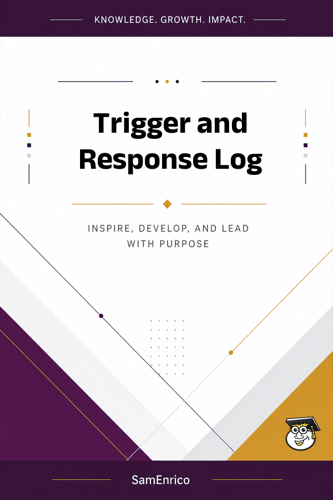
Trigger and Response Log
Document cause, reaction, and helpful coping for e
by Moses Katia
Document cause, reaction, and helpful coping for each episode.
Formats
About this book
Free sample
Chapter 1: The 30-Second Rule--The sigh came from across the kitchen table.It was not a loud sigh. It was not a dramatic sigh. It was the kind of sigh that could mean anything—exhaustion, a long day, a mild annoyance with the dog. But in the three seconds that followed that sigh, you felt something shift. A tightness in your chest.
A thought that arrived without invitation: They're sick of me. Then a word, spoken before you could stop it. Something sharp. Something you regretted immediately.The sigh was not the problem. The three seconds after the sigh were not the problem either.
The problem was everything that happened in the thirty seconds before the sigh—and that you never saw it coming.This is the most important thing you will learn in this entire book: Your trigger is not what you think it is. Most people, when asked what set them off, will point to the obvious event. The sigh. The critical email. The partner who left dishes in the sink.
The teenager who rolled their eyes. But the obvious event is almost never the real trigger. The real trigger is hiding in the thirty seconds before the obvious event—a window so narrow and so crowded with微小 signals that you have learned to look right through it.This chapter will teach you to see that window. And once you see it, you will never be able to unsee it.The Geography of a Trigger Let us begin with a definition so precise that it will change how you listen to your own life. A trigger is any stimulus—internal or external—that activates a stored emotional memory (a schema) and initiates a cascade of physiological, cognitive, and behavioral responses.
That definition contains three parts, each of which we will unpack.First, a trigger is a stimulus. Something happens. Someone speaks. A memory surfaces. Your stomach growls.
These are events in the world or in your body. Second, that stimulus activates a stored emotional memory. Your brain does not respond to the present moment as it actually is. It…
This is the end of the free sample. Get the eBook to keep going. Buy now
Contents
- Chapter 1
- Chapter 2
- Chapter 3
- Chapter 4
- Chapter 5
- Chapter 6
- Chapter 7
- Chapter 8
- Chapter 9
- Chapter 10
- Chapter 11
- Chapter 12
Details
- Author
- Moses Katia
- Publisher
- SamEnrico
- Language
- English
- Genre
- Non-Fiction, Self-Help, Symptom Tracking
- Released
- 2026-06-08
- Pages (approx.)
- 138
- Available as
- eBook, Audiobook

Read better in the ZLOADR app
Your eBooks on your phone or tablet. Sign in with your SamEnrico account and start reading.
More by Moses Katia
 Divorce and Estate PlanningMoses Katia$11.99
 Team Creativity for DevelopersMoses Katia$11.99
 Road Rage Smartphone DistractionMoses Katia$11.99
 Nonprofit Layoff GuideMoses Katia$11.99
 Attic Dust Motes MeditationMoses Katia$11.99
 Breast Health For Blind WomenMoses Katia$11.99
 Persuasion for Data ScientistsMoses Katia$11.99
 The Blood of Marathon: Athens' Last Stand Against the Persian HordeMoses Katia$11.99
 The Great Louvre Heist: Napoleon's Lost MasterpiecesMoses Katia$11.99
 How to Produce a Cooling SystemMoses Katia$11.99
 How to Produce Paintball EquipmentMoses Katia$11.99
 Fair Trade Export Certification GuideMoses Katia$12.99