
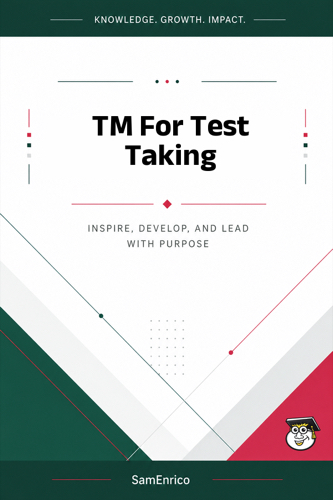
TM For Test Taking eBook
Improve test performance and reduce exam anxiety u
by Bruns Toney
Improve test performance and reduce exam anxiety using TM.
Formats
Free sample
Chapter 1: The 47 That Changed Everything--–- Sarah had done everything right. For six weeks, she had sacrificed sleep, social life, and sanity. She had rewritten her organic chemistry notes three times. She had completed every practice problem in the textbook and then found more online. She had explained reaction mechanisms to her study group until her voice went hoarse.
The night before the final, she had reviewed her flashcards until her eyes blurred, then set her alarm for 5:00 AM to review them again.When she walked into the examination hall at 8:00 AM, she felt something she had not felt in months: prepared.The proctor handed out the test booklets face-down. Sarah placed her pencil at the top of the answer sheet. She closed her eyes, took a deep breath, and reminded herself of what her test-prep tutor had told her: "You know this material. Trust yourself."The proctor said, "You may begin."Sarah flipped the booklet over. She read the first question.
It was about nucleophilic acyl substitution—a mechanism she had taught to three different classmates. She knew this. She knew it cold.Nothing happened.The answer did not come. The steps did not arrange themselves in her mind. Instead, a familiar sensation began to spread through her chest: a tightness, then a racing, then a heat rising up her neck.
Her palms became slick against the wooden desk. The clock on the wall seemed to grow louder with each tick.She read the question again. The words still made sense individually, but they would not assemble into meaning. She could feel the knowledge somewhere inside her—it was there, she knew it was there—but it was like trying to find a specific book in a library after someone had turned off all the lights."Move on," she whispered to herself. "Skip it.
Come back."She turned to question two. Same thing. Question three. Question four.By the time she reached question ten, her hand was shaking so badly that her pencil marks looked like earthquake readings. She looked around the room.
Other students were writing steadily, their heads down, their pages filling with answers. She was the only one frozen.When the proctor called "Pencils down," Sarah's answer sheet was more than half empty. She walked out of the exam hall in a daze. She checked her phone. Her study group chat was exploding with messages: "That was brutal but fair." "I think I did okay." "What did you get for the stereochemistry question?"Sarah did not respond.Three weeks later, her grade appeared online.
She stared at the number, refreshing the page three times to make sure it was not a glitch.She had studied forty hours and scored a forty-seven.This is not a story about a student who did not know the material. This is not a story about laziness, poor preparation, or a lack of intelligence. This is a story about the single most destructive force in academic performance—a force that test-prep courses never mention, that tutors rarely understand, and that students blame on themselves when they should blame it on their nervous systems.This is a story about the silent score-saboteur.The Anatomy of a Freeze Every year, millions of students walk into examination rooms carrying knowledge they have legitimately mastered. They have done the reading. They have completed the homework.
They have passed the practice tests. And then, under the pressure of the real exam, their brains simply... stop.Psychologists call this phenomenon "choking." But that word is too casual for what actually happens inside the body. Choking suggests a momentary lapse, a brief failure of concentration. What actually occurs is a full-scale physiological hijacking—a cascade of stress hormones that literally shuts down the brain's ability to access stored information.To understand why this happens, you need to understand a fundamental distinction that most test-taking advice ignores: the difference between having knowledge and accessing knowledge.Declarative Knowledge vs.
Performance Access Declarative knowledge is what you have when you can explain a concept to a friend, solve a practice problem, or write a correct answer on a flashcard. It is the information stored in your long-term memory. By every measurable standard, Sarah had declarative knowledge of organic chemistry. She had demonstrated it repeatedly during her six weeks of studying.Performance access is something else entirely. It is your brain's ability to retrieve that stored information under specific conditions—specifically, under conditions of time pressure, perceived consequences, and social evaluation.
An exam is not a practice session. An exam is a performance. And performance access is governed by a different set of neural rules than declarative memory.Think of it this way: declarative knowledge is like having a library full of books. Performance access is like having a working librarian who can find any book you ask for in under ten seconds. You can have a magnificent library—complete, organized, comprehensive—and still be unable to find anything if your librarian has gone home for the day.When you are relaxed, your brain's librarian is fully staffed.
When you are stressed, that librarian starts packing their desk.The Physiology of the Hijack Let us look under the hood. When you perceive a situation as threatening—and for many students, an exam feels exactly like a threat—a small, almond-shaped structure deep in your brain called the amygdala sounds the alarm. This alarm triggers your sympathetic nervous system, often called the "fight or flight" response.Within seconds, your adrenal glands release two hormones: adrenaline and cortisol.Adrenaline increases your heart rate, raises your blood pressure, and redirects blood flow to your large muscles. This is excellent if you need to run from a predator. It is terrible if you need to solve a quadratic equation or recall the causes of World War I.
Your body is preparing for physical action, not cognitive processing.Cortisol is more insidious. It does not act in seconds; it acts in minutes and hours. Cortisol suppresses functions that are non-essential for immediate survival. And here is the problem: your prefrontal cortex—the part of your brain responsible for working memory, rational thought, impulse control, and information retrieval—is apparently considered "non-essential" by your ancient survival wiring.When cortisol floods your system, your prefrontal cortex begins to down-regulate. Neural firing slows.
Connections between memory storage regions and retrieval regions weaken. The result is exactly what Sarah experienced: you know the information, but you cannot reach it.The research on this is striking. A meta-analysis published in the journal Emotion reviewed forty-one studies on test anxiety and cognitive performance. The findings were consistent across age groups and subject matters: moderate anxiety improved performance on simple tasks but impaired performance on tasks requiring working memory. High anxiety—the kind Sarah experienced—reduced working memory capacity by an average of thirty percent.Thirty percent.
That is the difference between an A and a C. That is the difference between medical school and a gap year. That is the difference between knowing and failing.The Silent Score-Saboteur Here is what makes test anxiety so cruel: it is often invisible until it is too late. Students like Sarah do not walk around feeling anxious…
This is the end of the free sample. Get the eBook to keep going. Buy now
About this book
Details
- Author
- Bruns Toney
- Publisher
- SamEnrico
- Language
- English
- Genre
- Non-Fiction, Self-Help, Test Prep
- Released
- 2026-06-09
- Pages (approx.)
- 153
- Available as
- eBook, Audiobook

Read better in the ZLOADR app
Your eBooks on your phone or tablet. Sign in with your SamEnrico account and start reading.
More by Bruns Toney
 Angel Investor Pitch GuideBruns Toney$12.99
 Jenkins CI/CD Outage ProtocolBruns Toney$11.99
 Stop Binge Eating WorkbookBruns Toney$11.99
 Sexual Intimacy Stress GuideBruns Toney$11.99
 The Couple Grief After Child LossBruns Toney$11.99
 The Last Voyage of the Mary Celeste: Ghost Ship or Human Mystery?Bruns Toney$11.99
 ScoutBruns Toney$11.99
 Understanding Wandering SpleenBruns Toney$17.99
 How to Start a Bath Preparations Business (Beginners Guide)Bruns Toney$11.99
 ARIPO Examination GuideBruns Toney$12.99Angel Investor Pitch GuideBruns Toney$12.99
You may also like
 Hong Kong Handover 1997Dunn Johnnie$11.99
 Zumba For Postnatal Recovery CourseNeal Christian$11.99
 Zumba for BeginnersLadner Nikia$11.99
 YouTube Comment Mining GuideHumes Pandora$12.99
 Worry Box MeditationCarlin Rudy$11.99
 Workplace Stress MeditationNguyen Lynn$11.99
 Workplace Stress and Sleep RepairHawley Ivory$11.99
 Workplace Perfectionism CureDelaney Jeffry$11.99
 Workplace Injustice Anger GuideWallen Isabelle$11.99
 Work Addiction and Burnout LinkGreenwood Ester$11.99
 Women in Yoga and WellnessBeattie Galina$11.99
 Women in Stand Up ComedyChun Evangeline$11.99