
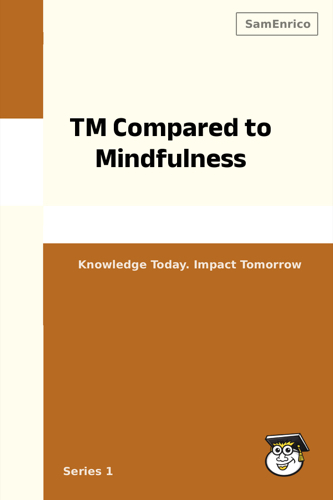
Non-FictionSelf-HelpMeditation Comparison
TM Compared to Mindfulness Audiobook
Distinguish effortless transcendence from focused
Distinguish effortless transcendence from focused attention practices.
Formats
Free sample
Chapter 1: The Crowded Mind...–- You have tried meditation before. Or you have never tried it, but you are certain you would fail. You imagine sitting cross-legged on a cushion, eyes closed, breathing softly—and then you imagine the avalanche. Thoughts about work, about money, about that conversation you had three years ago that still makes you cringe. A to-do list scrolls behind your eyelids like a stock ticker.
Your phone buzzes. You wonder if the chicken is still defrosting. You open your eyes and think: I am not the kind of person who can meditate.This is not a confession of personal weakness. It is the single most common experience reported by people who attempt meditation in the modern world. And it is almost always misinterpreted.
The interpretation goes like this: “My mind is too noisy. I cannot stop thinking. Therefore, I am bad at meditation.” From this, two conclusions follow. The first is quitting. The second is trying harder—bearing down, clamping attention onto the breath like a vise, battling each thought as if it were an invader.
Both conclusions are wrong. Both are based on a fundamental misunderstanding of what meditation actually is, or more accurately, what different kinds of meditation actually are.The truth is that you have been handed a map for a terrain that does not exist. The popular image of meditation—a blank mind, a silent brain, an absence of thought—is not a realistic goal for most practices. And when you inevitably fail to achieve that blankness, you blame yourself. This chapter exists to remove that blame permanently.
You are not broken. Your mind is not unusually noisy. You have simply not yet found the technology that fits your nervous system.This book is called Effortless vs. Effort for a reason. It argues that there are two fundamentally different families of meditation, and they ask two fundamentally different things of you.
One family asks you to pay attention. The other asks you to let go. One uses effort like a muscle. The other uses effortlessness like a release valve. They are not better or worse than each other.
They are different. And confusing them—which almost everyone does—leads directly to the experience of failure described above.Consider two people sitting in a room.The first person is told to focus on their breath. Notice the cool air entering the nostrils, the warm air leaving. When…
This is the end of the free sample. Get the Audiobook to keep going. Buy now
About this book
Details
- Author
- Kemper Grisel
- Publisher
- SamEnrico
- Language
- English
- Genre
- Non-Fiction, Self-Help, Meditation Comparison
- Released
- 2026-06-07
- Pages (approx.)
- 133
- Available as
- eBook, Audiobook

Listen in the VoxFlicks app
Audiobooks and audio dramas wherever you go. Sign in with your SamEnrico account and press play.
More by Kemper Grisel
 NVC Jackal Language ConversionKemper Grisel$11.99
 Harvard Extension School Academic IntegrityKemper Grisel$11.99
 Visa Section StoriesKemper Grisel$11.99
 The Tokyo Trial: Japan's Fight for Women's Football Equality (2015)Kemper Grisel$11.99
 How to Produce Bicycle PedalsKemper Grisel$11.99
 Science TeacherKemper Grisel$11.99
 Multidisciplinary Proposal GuideKemper Grisel$12.99
 How to Start a Botanical Products for Pharmaceutical Use Business (Beginners Guide)Kemper Grisel$11.99
You may also like
 Hong Kong Handover 1997Dunn Johnnie$11.99
 Zumba For Postnatal Recovery CourseNeal Christian$11.99
 Zumba for BeginnersLadner Nikia$11.99
 YouTube Comment Mining GuideHumes Pandora$12.99
 Worry Box MeditationCarlin Rudy$11.99
 Workplace Stress MeditationNguyen Lynn$11.99
 Workplace Stress and Sleep RepairHawley Ivory$11.99
 Workplace Perfectionism CureDelaney Jeffry$11.99
 Workplace Injustice Anger GuideWallen Isabelle$11.99
 Work Addiction and Burnout LinkGreenwood Ester$11.99
 Women in Yoga and WellnessBeattie Galina$11.99
 Women in Stand Up ComedyChun Evangeline$11.99