
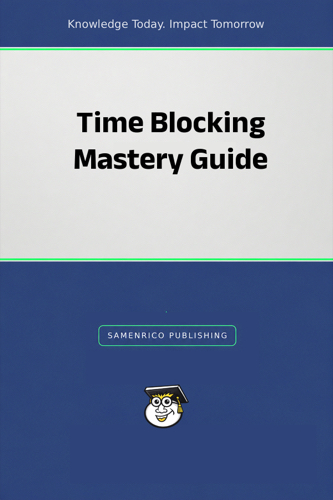
Time Blocking Mastery Guide eBook
Learn to schedule every hour of your workday with
by Zapata Abbie
Learn to schedule every hour of your workday with intentional color-coded blocks.
Formats
Free sample
Chapter 1: The Color Prison--–- Every morning, millions of professionals open their calendars and see the same thing: a gray grid of empty boxes waiting to be filled. They sigh, check email, attend meetings, and by 5pm, they cannot remember what they actually accomplished. The problem is not laziness. It is not a lack of ambition. The problem is that most people are using a system designed to track events, not to drive meaningful work.
This book exists because you deserve better than a gray prison.Let me ask you a question. Think back to yesterday. Can you name, with certainty, the three most important things you completed? If you are like 87 percent of knowledge workers surveyed by Harvard Business Review, you cannot. You remember being busy.
You remember answering emails, attending calls, and fighting fires. But the important work—the work that moves your career forward, the work that makes you feel proud—somehow slipped through the cracks. You are not alone. Research from the Dominican University of California found that 41 percent of to-do list items never get done. Forty-one percent.
Nearly half of everything you write down never happens.Why? Because a to-do list is a wish. It says “I should do this someday.” Your calendar, on the other hand, is a commitment. It says “I will do this at this specific time.” The gap between “should” and “will” is the intention-action gap, and it is the single biggest thief of productivity in the modern workplace. Closing that gap is what this book is about.
But closing it requires more than just putting tasks on a calendar. It requires a visual system that speaks directly to how your brain actually works. It requires color.This chapter introduces the foundational problem that most time management systems ignore, the science of why color changes everything, and the P.A.I.N.T. System—a five-step framework that will guide you through every chapter of this book. By the time you finish this chapter, you will understand why your current system is failing and why a color-coded calendar is the most underrated tool in productivity.The Illusion of the To-Do List Let me tell you a story.
Sarah is a marketing director at a mid-sized tech company. Every Monday morning, she writes a to-do list with twenty-two items. She feels organized. She feels in control. By Wednesday, she has crossed off four items, added seventeen new ones, and moved twelve from Monday to Tuesday to Wednesday to Thursday.
On Friday, she looks at the list, sighs, and throws it away. Monday morning, she starts a new list. The cycle repeats.Sarah is not lazy. She works fifty-five hours a week. But she is confusing activity with progress.
Her to-do list gives her the dopamine hit of planning without the accountability of execution. This is the illusion of productivity: the feeling that writing something down is the same as doing it. It is not.Research from the Journal of Personality and Social Psychology shows that the act of writing a to-do list can actually reduce anxiety in the short term because your brain feels like it has outsourced the memory task. But that same study found that without a time anchor, those tasks drift indefinitely. Your brain says “I wrote it down, so I don’t need to remember it” but then never schedules it.
The task enters a limbo state—not forgotten, not done, just floating.The to-do list also suffers from what productivity expert David Allen calls “open loops.” Every incomplete task occupies working memory, creating cognitive drag. The more items on your list, the more mental energy you waste cycling through them. By the time you have twenty items, you are spending more energy managing the list than doing the work. Allen’s solution in Getting Things Done is to capture everything in an external system. But capture is not enough.
You also need allocation. You need to tell each task not just “I see you” but “You go here at this time.”Time blocking is the antidote. When you assign a task to a specific hour on your calendar, you transform it from an abstract intention into a concrete appointment. You would not skip a meeting with your boss. Why do you skip meetings with your own priorities?
Time blocking forces you to treat your most important work with the same respect you give to external obligations. But there is a problem with most time blocking systems, and it is the reason you have probably tried time blocking before and given up. The problem is that a calendar full of identical-looking blocks tells you nothing about what kind of work you are supposed to be doing.The Problem with Monochrome Calendars Imagine opening your calendar and seeing eight gray blocks labeled “Work on project,” “Email,” “Meeting,” “Work on project,” “Lunch,” “Meeting,” “Work on project,” “Email.” You have blocked your time. Congratulations. But when you look at that calendar, do you feel motivated?
Do you feel clear? Probably not. You feel like you are looking at a wall of cement.Monochrome calendars fail for three reasons. First, they do not differentiate between types of work. A ninety-minute block of deep focus looks exactly like a thirty-minute block of email.
Your brain cannot distinguish between high-cognitive effort and low-cognitive effort, so you arrive at each block with the same level of energy and intention. That is a mistake. Deep work requires preparation, zero distractions, and peak energy. Email requires none of those things. Treating them the same on your calendar guarantees you will underprepare for deep work and overprepare for shallow work.Second, monochrome calendars do not communicate boundaries to other people.
If you work in an open office or on a shared calendar, your colleagues see gray blocks. They have no idea whether you are writing a quarterly report (do not interrupt) or cleaning out your inbox (interruptions are fine). So they interrupt you for everything. A study from the University of California, Irvine found that after an interruption, it takes an average of twenty-three minutes to return to the original task. If you are interrupted four times a day, you lose nearly two hours of focused work.
Not because your colleagues are malicious, but because your calendar did not tell them when to stay away.Third, monochrome calendars do not trigger the right emotional response. Color psychology research from the University of Winnipeg found that red increases attention to detail and physiological arousal. Blue enhances creative thinking and calm. Green reduces stress and signals safety. When you see gray, you feel nothing.
Neutrality is the enemy of action. You want your calendar to evoke a emotional response—urgency for red blocks, calm for blue blocks, relief for green blocks. Gray gives you none of that.This is why every successful time blocker eventually discovers color coding. It is not about making your calendar look pretty. It is about making your calendar work with your brain instead of against it.The Science of Visual Cognition Let me explain how your brain actually processes visual information.
The human visual system can identify a colored object in as little as one hundred milliseconds. That is one-tenth of…
This is the end of the free sample. Get the eBook to keep going. Buy now
About this book
Details
- Author
- Zapata Abbie
- Publisher
- SamEnrico
- Language
- English
- Genre
- Non-Fiction, Self-Help, Productivity
- Released
- 2026-06-06
- Pages (approx.)
- 148
- Available as
- eBook, Audiobook

Read better in the ZLOADR app
Your eBooks on your phone or tablet. Sign in with your SamEnrico account and start reading.
More by Zapata Abbie
 AgTech Investment GuideZapata Abbie$11.99
 Senior Strength Training GuideZapata Abbie$11.99
 Post Hospital Sarcopenia PlanZapata Abbie$11.99
 Pesticide Drift Home ProtectionZapata Abbie$11.99
 Enmeshment Trauma TriggersZapata Abbie$11.99
 Parental Anger ManagementZapata Abbie$11.99
 Lactose IBS ManagementZapata Abbie$11.99
 Alcohol Recovery for Older AdultsZapata Abbie$11.99
 Silk & Sabotage: The Rise and Fall of the House of WorthZapata Abbie$11.99
 The Tide of Titans: How the Dutch Built a Maritime EmpireZapata Abbie$11.99
 The Last Scribe of Alexandria: Unraveling the Lost Library’s Final GuardianZapata Abbie$11.99
 How to Start a Pork Pie Business (Beginners Guide)Zapata Abbie$11.99
You may also like
 Productivity Habit SystemWinter Cameron$11.99
 Five AM Club Morning RoutineLarue Alva$11.99
 Workload Prioritization Stress HandbookToney Dolly$11.99
 The Prevention PlanPepper Veta$11.99
 SMART Goals Action Planning GuideSouza Charlyn$11.99
 Memory Palace for Daily TasksBlair Ida$11.99
 Deep Work Interruption Shield GuideKasper Myriam$11.99
 Chunking Grocery ShoppingSmalls Carolyne$11.99
 Time Management Pattern GuideRollins Sherell$11.99
 The Remote Work Time TrackerAbney Vonda$11.99
 The Distraction Proof Morning RoutineGray Marsha$11.99
 The Deep Work Interruption Shield ManualParks Ian$11.99