
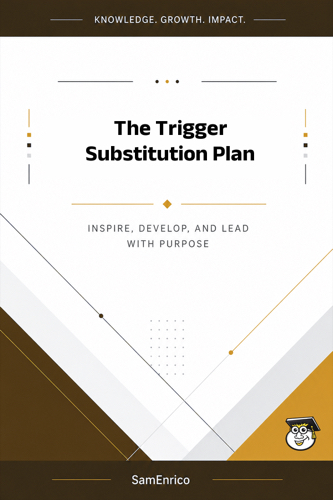
Non-FictionSelf-HelpSubstitution
The Trigger Substitution Plan eBook
Replaces unavoidable triggers with alternative res
by Bui Carry
Replaces unavoidable triggers with alternative responses.
Formats
Free sample
Chapter 1: The Willpower Trap--–- If willpower worked, you wouldn’t be holding this book.Let that land for a moment. You didn’t pick up The Trigger Substitution Plan because you’re winning the war against your automatic reactions. You picked it up because you’re exhausted from fighting yourself. Because you promised—again—that you wouldn’t snap at your child, wouldn’t reach for your phone in a moment of boredom, wouldn’t eat the thing you said you wouldn’t eat, wouldn’t procrastinate on the thing you swore you’d start today.And yet, here you are. Again.Not because you’re weak.
Not because you lack discipline. Not because you don’t care enough. But because you’ve been sold a lie—a seductive, intuitive, and completely false story about how human behavior actually works.The lie is this: If you want it badly enough, you can just stop.Stop eating sugar. Stop yelling. Stop scrolling.
Stop procrastinating. Stop reacting. Just. Stop.This is the Willpower Trap. It’s the belief that conscious intention is stronger than automatic reaction.
It’s the assumption that your rational brain—the part that knows what’s good for you—should be able to overrule your impulsive brain in any moment of conflict. And when it doesn’t, when you fail, the only possible explanation is a character defect. You didn’t want it badly enough. You’re lazy. You’re undisciplined.
You’re broken.This chapter is going to dismantle that lie completely. Not with motivational slogans, but with behavioral science, clinical evidence, and a truth that will change how you see every single one of your “failures” from this moment forward.The Knowing-Doing Gap In his groundbreaking book Triggers, executive coach Marshall Goldsmith identified a phenomenon he calls the Knowing-Doing Gap. It’s the chasm between what you know you should do and what you actually do in the moment of decision.Consider the evidence. A study of hospital handwashing—one of the simplest, most life-saving behaviors imaginable—found that doctors and nurses reported knowing they should wash their hands before entering a patient’s room approximately 95% of the time. Their actual handwashing rate?
Less than 40%. These weren’t lazy or malicious people. They were exhausted, overwhelmed, habit-driven humans operating in a trigger-rich environment. They knew better. They failed anyway.This is not a knowledge problem.
You already know that yelling doesn’t help. You already know that scrolling before bed ruins your sleep. You already know that procrastination creates more stress than the task itself. Knowing has never been the bottleneck.The bottleneck is the trigger.A trigger is any stimulus—internal or external—that activates a learned behavioral sequence faster than your conscious brain can intervene. The sound of a notification.
The sight of a cookie. The tone of your partner’s voice. The 3 PM lull in energy. The feeling of boredom. The first hint of criticism.
Each of these cues bypasses your rational brain and feeds directly into your habit circuitry.And here’s the crucial point: triggers are not optional. You do not get to vote on whether they arrive. The annoying boss will hold the weekly meeting. The child will whine. The phone will ping.
The 3 PM crash will come whether you ate a salad or a sandwich. You can’t delete the trigger. You can only change how you respond to it.That’s the central insight of this entire book, and it’s worth stating clearly because most habit-change books get this exactly backward.Why "Just Stop" Never Works Most self-help advice falls into one of two categories, both of which are variations on the Willpower Trap.Category One: Motivation. Try harder. Want it more.
Visualize your success. Read this inspirational quote every morning. The implicit message is that your failure is a failure of desire—that if you just cared enough, you would succeed. This is cruel, because it blames people for a neurological reality they cannot control. Motivation is a feeling.
Feelings fluctuate. Building a behavior change plan on a fluctuating feeling is like building a house on a frozen lake.Category Two: Avoidance. Just delete the app. Just don’t buy junk food. Just leave the room.
This advice works for avoidable triggers—and we’ll talk about those in Chapter 2. But it’s useless for the triggers that follow you into every room of your life. You can’t delete your boss. You can’t avoid your child. You can’t leave the room during every difficult conversation.
For the triggers that matter most—the ones that shape your relationships, your career, and your self-worth—avoidance is not an option.What both categories miss is the fundamental architecture of how habits actually work. A habit is not a choice you make repeatedly. It is a neural pathway that has been fired so many times that it has become the default route for a given trigger. It’s the fastest path from cue to response, carved deep by repetition.Imagine a field covered in snow. The first time you walk across it, you make a faint trail.
The second time, you follow roughly the same path, deepening it slightly. By the hundredth time, you’ve created a trench so deep that walking anywhere else requires active effort. That’s your habit. That’s why “just stop” feels like wading through waist-deep snow while everyone else glides along the trench. It’s not weakness.
It’s physics.The Willpower Trap asks you to fight the trench with sheer force of intention. It asks you to climb out of the deep groove every single time, using only your conscious mind, while the trigger arrives again and again and again.This is a losing battle. Not because you’re not strong enough, but because you’re fighting the wrong enemy.The 1.5-Second Window So if you can’t avoid the trigger, and you can’t simply stop the response, what can you do?The answer lies in a small but critical gap in the brain’s processing sequence—a gap that most people don’t even know exists.Here’s what happens when a trigger arrives. First, your brain registers the stimulus. This happens at the speed of perception: approximately 0.2 seconds.
That’s faster than a blink. It’s faster than you can say the word “trigger.” By the time you consciously notice that something has happened, your brain has already classified it as threatening, rewarding, or neutral.But—and this is the crucial part—the physical response takes longer. The muscle movements, the words leaving your mouth, the hand reaching for the cookie, the tension flooding your shoulders—these take an additional 1.5 seconds to lock into place.That’s 1.5 seconds of lag between “I notice the trigger” and “my body executes the old response.”This is not a theory. It’s established neuroscience, first identified by Benjamin Libet in the 1980s and confirmed by dozens of subsequent studies. Your brain begins preparing a response before you consciously decide to act.
But the conscious awareness of the trigger arrives just before the response becomes irreversible. That sliver of time—the gap between…
This is the end of the free sample. Get the eBook to keep going. Buy now
About this book
Details
- Author
- Bui Carry
- Publisher
- SamEnrico
- Language
- English
- Genre
- Non-Fiction, Self-Help, Substitution
- Released
- 2026-06-09
- Pages (approx.)
- 143
- Available as
- eBook, Audiobook

Read better in the ZLOADR app
Your eBooks on your phone or tablet. Sign in with your SamEnrico account and start reading.
More by Bui Carry
 Binge Eating Triggers GuideBui Carry$11.99
 Women In Science STEM Education Impact WorkbookBui Carry$11.99
 SAS Recce Patrol LeaderBui Carry$11.99
 Competitor Analysis Creative GuideBui Carry$11.99
 The Shirabyoshi’s Last Dance: Ghostly Performances of the Floating WorldBui Carry$11.99
 The Great Reset: How a Single Cabinet Shake-Up Redefined Modern PoliticsBui Carry$11.99
 Understanding Galactose-1-phosphate Uridylyltransferase DeficiencyBui Carry$17.99
 How to Start a Axminster Carpet Business (Beginners Guide)Bui Carry$11.99
 CNC Milling MachinistBui Carry$11.99
 Chinese Time Zone SuccessBui Carry$12.99
 Acquisition Term Sheet WorkbookBui Carry$12.99
You may also like
 Hong Kong Handover 1997Dunn Johnnie$11.99
 Zumba For Postnatal Recovery CourseNeal Christian$11.99
 Zumba for BeginnersLadner Nikia$11.99
 YouTube Comment Mining GuideHumes Pandora$12.99
 Worry Box MeditationCarlin Rudy$11.99
 Workplace Stress MeditationNguyen Lynn$11.99
 Workplace Stress and Sleep RepairHawley Ivory$11.99
 Workplace Perfectionism CureDelaney Jeffry$11.99
 Workplace Injustice Anger GuideWallen Isabelle$11.99
 Work Addiction and Burnout LinkGreenwood Ester$11.99
 Women in Yoga and WellnessBeattie Galina$11.99
 Women in Stand Up ComedyChun Evangeline$11.99