
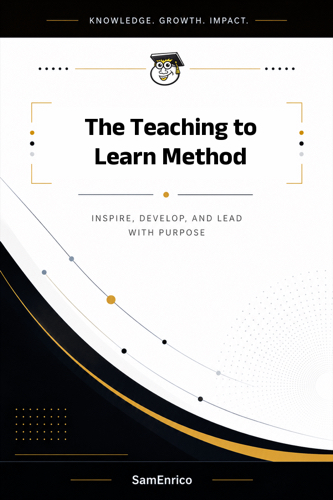
The Teaching to Learn Method eBook
Explain material to others to solidify your own un
by Owens Nettie
Explain material to others to solidify your own understanding.
Formats
Free sample
Chapter 1: The Protege Paradox--There is a strange and wonderful thing that happens every day in basements, coffee shops, and suburban living rooms across the world. A fourteen-year-old girl sits across from her eleven-year-old neighbor, trying to explain fractions. She is not a teacher. She has no lesson plan, no certification, no textbook publisher backing her up. She is simply a student who happened to score a B+ on last week's math test, and now she is trying to help a child who scored a D-.Two hours later, something remarkable occurs.
The eleven-year-old finally understands fractions. But something else has happened, something that would seem impossible if you did not know where to look. The fourteen-year-old now understands fractions better than she did when she walked in. She understands them better than the classmates who scored A's and spent the afternoon reviewing their notes in silent solitude. She did not study.
She did not reread the chapter. She did not highlight a single sentence. She taught. And in teaching, she learned.This is not a feel-good story about the kindness of tutors. It is a neurological fact.
The act of explaining to another person changes the architecture of your own memory. It forces your brain to abandon the lazy pathways of recognition and build the demanding highways of recall. The student who expects to teach remembers differently than the student who expects to be tested. And that difference is the difference between shallow learning that vanishes by Monday and deep understanding that stays for life.The problem is that almost nobody knows this. Or rather, almost everyone has experienced it without naming it.
You have probably had the experience yourself. You struggled with a concept for hours. You reread the same paragraph six times. Nothing. Then a friend asked you to explain it, and halfway through your stumbling, mangled attempt at an explanation, something clicked.
You figured it out while you were teaching it. That was not luck. That was the Protege Paradox: the person who learns the most in any classroom is the teacher.We have been taught to believe that learning is a one-way street. Information flows from expert to novice, from textbook to student, from teacher to learner. The teacher gives; the student receives.
This model is so deeply embedded in our culture that it feels like common sense. But common sense is wrong. The real flow of learning runs in the opposite direction of what we expect. The more you teach, the more you learn. The more you explain, the more you understand.
The more you give away, the more you keep.This book is about that reversal. It is about why teaching is the fastest path to mastery, how to harness that power even when you have no students, and what happens when you stop thinking of yourself as a learner and start thinking of yourself as an explainer. But before we get to the how, we need to understand the why. And the why begins with a high school math tutor who never knew she was running an experiment on herself.The Tutor Who Outperformed the Valedictorian Consider two students in the same calculus class. The first is the valedictorian-in-waiting.
She studies alone, at a clean desk, with color-coded notes and a highlighter that has never touched a page it did not improve. She rereads each chapter twice. She reviews her highlights before the exam. She scores an A.The second student is a B-average tutor. She spends two afternoons a week helping a junior varsity athlete pass pre-calculus.
She does not have time to reread her own chapters. She barely reviews her notes. She shows up to the exam tired and a little resentful. She also scores an A. In fact, she scores higher than the valedictorian on the cumulative final.This is not a hypothetical.
Educational psychologists have studied this effect for decades under various names: the protégé effect, learning by teaching, the tutor effect. The finding is remarkably consistent across age groups, subject areas, and formats. Students who prepare to teach another person learn more than students who prepare to be tested. They retain information longer. They apply it more flexibly.
They make fewer errors of inference. And they do all of this without spending more time studying.What explains this paradox? The answer lies in what happens inside the brain before any teaching actually occurs. The valedictorian, studying for a test, asks herself a silent question: "Will I recognize this on the exam?" Her brain, following that cue, optimizes for recognition. It looks for patterns, for distinct features, for ways to match incoming information to stored memories.
This is efficient. It is also shallow. Recognition is the lowest form of memory. It is the difference between picking your car out of a parking lot and drawing your car from memory. One requires a vague sense of familiarity.
The other requires a complete mental model.The tutor, by contrast, asks herself a different question before she ever opens the textbook: "How will I explain this to someone who knows nothing?" That question changes everything. Her brain, following that cue, optimizes for generative construction. It looks for structure, for causal links, for the logical skeleton beneath the facts. It asks not "Does this match something I have seen?" but "How does this work, and why, and what comes next, and what breaks if I remove this piece?"This is the difference between surface storage and relational mapping. Surface storage is a filing cabinet.
You put facts in folders. You pull them out when needed. Relational mapping is a subway map. You see how stations connect, which lines transfer, where the express train skips stops, and what happens when a tunnel closes. The valedictorian builds a filing cabinet.
The tutor builds a subway map. Both can get you to the right answer on a multiple-choice question. Only one can help you navigate a question you have never seen before.The Science of Anticipatory Encoding The most surprising finding in this research is that you do not actually have to teach to get the benefit. You only have to prepare to teach. In a landmark study, researchers divided students into two groups.
Both groups were given the same material to study. One group was told they would be tested on the material. The other group was told they would have to teach the material to another student. In reality, neither group was ever tested or asked to teach. The only difference was the instruction they received before studying.The results were striking.
The group that prepared to teach scored significantly higher on comprehension tests than the group that prepared to be tested. They organized their notes differently. They asked better questions during the study period. They made more connections between concepts. And they did all of this without ever standing in front of a classroom.
The anticipation of teaching was enough to rewire their encoding strategy.This is what I call anticipatory encoding. Your brain does not wait until you are actually explaining to shift into teaching mode. It shifts the moment you form the intention to explain. That intention acts as a cognitive…
This is the end of the free sample. Get the eBook to keep going. Buy now
About this book
Details
- Author
- Owens Nettie
- Publisher
- SamEnrico
- Language
- English
- Genre
- Non-Fiction, Self-Help, Teaching
- Released
- 2026-06-07
- Pages (approx.)
- 137
- Available as
- eBook, Audiobook

Read better in the ZLOADR app
Your eBooks on your phone or tablet. Sign in with your SamEnrico account and start reading.
More by Owens Nettie
 Mistake Log for Exam ImprovementOwens Nettie$11.99
 Richard Eberling Suspect GuideOwens Nettie$11.99
 Dream Arts IntegrationOwens Nettie$11.99
 Suicide Prevention TalkOwens Nettie$11.99
 Intuitive Master GuideOwens Nettie$11.99
 Pet Loss and EatingOwens Nettie$11.99
 Accountability Partner GuideOwens Nettie$11.99
 The Merger That Shook the World: How a Corporate Marriage Saved a NationOwens Nettie$11.99
 The Healers of the Jade Serpent: Olmec Medical PioneersOwens Nettie$11.99
 Service Providers Guide to Water CoolersOwens Nettie$11.99
 How to Start a Copper Rolling - Drawing - and Extruding BusinessOwens Nettie$11.99
 Create a Membership Site in 14 DaysOwens Nettie$12.99
You may also like
 Hong Kong Handover 1997Dunn Johnnie$11.99
 Zumba For Postnatal Recovery CourseNeal Christian$11.99
 Zumba for BeginnersLadner Nikia$11.99
 YouTube Comment Mining GuideHumes Pandora$12.99
 Worry Box MeditationCarlin Rudy$11.99
 Workplace Stress MeditationNguyen Lynn$11.99
 Workplace Stress and Sleep RepairHawley Ivory$11.99
 Workplace Perfectionism CureDelaney Jeffry$11.99
 Workplace Injustice Anger GuideWallen Isabelle$11.99
 Work Addiction and Burnout LinkGreenwood Ester$11.99
 Women in Yoga and WellnessBeattie Galina$11.99
 Women in Stand Up ComedyChun Evangeline$11.99