
Non-FictionSelf-HelpProductivity
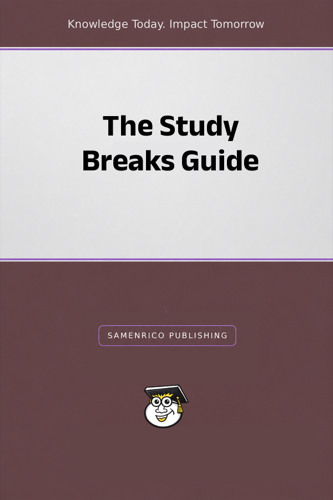
The Study Breaks Guide eBook
Schedule effective rest periods to prevent mental
Schedule effective rest periods to prevent mental fatigue.
Formats
Free sample
Chapter 1: The Exhaustion Lie--You have been told a lie. Not a small, harmless fib, but a corrosive, career-limiting falsehood that has been repeated so often by well-meaning parents, competitive classmates, and inspirational social media posts that you have absorbed it as biological fact. The lie is this: more hours of studying produce more success. Work longer, stay later, grind harder—and the grades will follow. This lie is seductive because it contains a shard of truth.
Effort matters. Discipline matters. Showing up matters. But somewhere between the truth and the lie, nuance was murdered, and a monster was born: the myth of linear work.Linear work is the belief that if you study for two hours, you get twice the result of one hour. If you study for four, you get four times the result.
Your brain, the lie suggests, is like a conveyor belt. Put in time, get out learning. This is not merely wrong. It is dangerously, expensively, and provably wrong. And it is the primary reason you feel exhausted, guilty, and perpetually behind—even when you are doing more than enough.Welcome to The Study Breaks Guide.
This book is not about doing less. It is about doing more by resting on purpose. But before we can build your personalized rest system, we must first demolish the foundation of guilt and misinformation upon which your current study habits are likely built. This chapter is an intervention. It will name the lie, trace its origins, explain why your brain physically cannot sustain linear output, and replace the myth of exhaustion with the science of strategic rest.
By the end, you will not only have permission to rest. You will have a responsibility to do so.The Conveyor Belt Fallacy Imagine a factory assembly line. It starts at 8:00 AM. For the first hour, every worker is fresh. Parts move quickly.
Quality is high. By 10:00 AM, subtle fatigue sets in. Workers are still productive, but minor errors appear—a screw not fully tightened, a label slightly crooked. By noon, the line is still moving, but now one in every twenty items needs rework. By 2:00 PM, the line is running at full speed, but errors have tripled.
By 4:00 PM, the line is producing more defective products than good ones. And yet, the factory manager refuses to stop the line. "Keep going," he yells. "More hours mean more products."You would call that manager an idiot. You would be correct.Now look at your own study habits.
You sit down at 10:00 AM. For the first 90 minutes, you are sharp. Concepts click. Notes are clean. By 11:30 AM, your eyes drift.
You re-read the same sentence twice. By 1:00 PM, you have switched to highlighting (passive, low-learning activity) because active recall feels too hard. By 3:00 PM, you are "studying" while also checking your phone, listening to music, and thinking about dinner. By 5:00 PM, you have spent seven hours at your desk, but you could not pass a quiz on any of the material from the final three hours. You feel exhausted, frustrated, and proud of your suffering.
"At least I put in the time," you tell yourself.The conveyor belt fallacy is the belief that time spent equals learning achieved. It is the single greatest source of student burnout and the primary reason high-achieving students crash hard in their third year of college or second semester of graduate school. You have been trained to worship hours. This book will train you to worship results. And results require rest.The Law of Diminishing Cognitive Returns Economists have a concept called the law of diminishing returns.
It states that after a certain point, adding more of one input (labor, time, fertilizer) produces smaller and smaller increases in output. Your brain operates under a stricter version of this law: after a certain point, adding more study time actually produces negative returns. You do not just learn less per hour. You forget what you already learned.Here is what happens inside your skull during an extended study session without strategic breaks. For the first 45 to 60 minutes of focused work, your prefrontal cortex—the executive center responsible for reasoning, planning, and impulse control—operates at near-peak efficiency.
Neurons fire cleanly. Connections between related concepts form readily. This is your brain in flow. Around the 75-minute mark, a process called neural fatigue begins. Your brain has been consuming glucose and oxygen at an elevated rate.
Synaptic vesicles (the little sacs that release neurotransmitters) begin to deplete. Think of it as a runner’s muscles accumulating lactic acid—except the runner is your attention.By 90 to 120 minutes of continuous focus (and the exact number varies by individual, task difficulty, and prior sleep quality), your brain enters a state of diminishing returns. Error rates climb. Working memory shrinks—you can no longer hold four concepts in your head simultaneously. Most critically, your brain’s ability to transfer information from short-term to long-term memory degrades.
This is not an opinion. This is neurobiology. The hippocampus, which acts as a gatekeeper for memory consolidation, requires a chemical environment of moderate arousal and low stress to do its job. Extended study without rest elevates cortisol (stress hormone) and depletes the neurotransmitters needed for encoding. You are essentially studying with a broken recording device.The most damaging consequence of ignoring these biological limits is what researchers call the "fatigue error cascade." A student pushes through the 90-minute mark, makes a small mistake, does not notice it because they are tired, and then builds three more concepts on top of that mistake.
By hour four, their notes contain foundational errors that will require twice the effort to unlearn later. They have not just wasted time. They have actively damaged their own knowledge base.This is the hidden cost of the exhaustion lie. You are not being virtuous by grinding through fatigue. You are being inefficient.
You are being counterproductive. And you are training your brain to associate studying with misery, which makes it harder to start the next session.The Two Types of Resters: Reactive vs. Proactive After observing thousands of students across multiple universities, researchers have identified two distinct rest profiles. Your place on this spectrum largely predicts your academic outcomes, your stress levels, and your likelihood of burnout before graduation.Reactive resters are the majority. They study until they cannot study anymore.
Their breaks are not planned; they are collapses. A reactive rester sits down to study at 2:00 PM with good intentions. By 2:45 PM, they are still working. By 4:00 PM, their attention has fragmented. They check Instagram "just for a minute." That minute becomes fifteen.
They feel guilty, so they study another forty-five minutes of low-quality work. By 6:00 PM, they are mentally exhausted, order takeout, and scroll Tik Tok for two hours while vaguely feeling like they should be doing something productive. Their "break" was not a break. It was a crash. And it was followed by guilt, not restoration.Reactive resters share common traits: they feel constantly behind, they romanticize suffering ("I stayed up until 2 AM studying"), they confuse effort with effectiveness, and they experience high levels of rest guilt—the anxious voice that whispers "you should be working" even during legitimate downtime.
Their breaks are long (hours), unstructured, and often screen-based. They do not feel refreshed after resting. They feel numb.Proactive resters…
This is the end of the free sample. Get the eBook to keep going. Buy now
About this book
Details
- Author
- Woodall Alana
- Publisher
- SamEnrico
- Language
- English
- Genre
- Non-Fiction, Self-Help, Productivity
- Released
- 2026-06-09
- Pages (approx.)
- 143
- Available as
- eBook, Audiobook

Read better in the ZLOADR app
Your eBooks on your phone or tablet. Sign in with your SamEnrico account and start reading.
More by Woodall Alana
 Dream Trust Building LogWoodall Alana$11.99
 Walking Meditation for RamadanWoodall Alana$11.99
 Pet Loss and WorkWoodall Alana$11.99
 Nap and Melatonin GuideWoodall Alana$11.99
 Group Study That Actually WorksWoodall Alana$11.99
 Language Learning Goal PlannerWoodall Alana$11.99
 High Achiever Morning HabitsWoodall Alana$11.99
 The Silent War: Grant and Lee’s Shadow Game in the WildernessWoodall Alana$11.99
 The Timbuktu Tectonics: How African Scholars Mapped the Earth's FuryWoodall Alana$11.99
 How to Produce Kitchen TowelsWoodall Alana$11.99
 Service Providers Guide to Wedding PlanningWoodall Alana$11.99
 Data Backup Cross BorderWoodall Alana$12.99
You may also like
 Hong Kong Handover 1997Dunn Johnnie$11.99
 Zumba For Postnatal Recovery CourseNeal Christian$11.99
 Zumba for BeginnersLadner Nikia$11.99
 YouTube Comment Mining GuideHumes Pandora$12.99
 Worry Box MeditationCarlin Rudy$11.99
 Workplace Stress MeditationNguyen Lynn$11.99
 Workplace Stress and Sleep RepairHawley Ivory$11.99
 Workplace Perfectionism CureDelaney Jeffry$11.99
 Workplace Injustice Anger GuideWallen Isabelle$11.99
 Work Addiction and Burnout LinkGreenwood Ester$11.99
 Women in Yoga and WellnessBeattie Galina$11.99
 Women in Stand Up ComedyChun Evangeline$11.99