
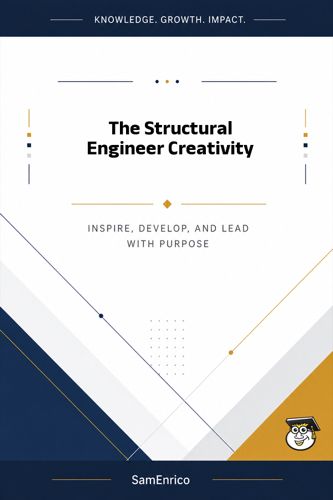
The Structural Engineer Creativity eBook
Innovates within building codes and material const
Innovates within building codes and material constraints.
Formats
Free sample
Chapter 1: The Freedom Trap--–- The young architect swept his hand across the rendering with the flourish of a magician revealing a trick. The building on the screen was beautiful—a twisting tower of glass and steel that seemed to defy gravity itself. Curving balconies spiraled upward like vines. The lobby soared three stories high with no visible columns. Every surface was unique.
Every angle was unexpected."I've given you complete freedom," he said to the structural engineer sitting across the table. "No budget constraints. No material limitations. No ugly columns to block my sightlines. Just build exactly what I've drawn."The engineer, a woman with twenty years of experience and the tired eyes of someone who had seen this performance before, said nothing for a long moment.
She zoomed in on the rendering. She rotated the model. She pulled up a quick wind-load calculation on her tablet. Then she looked up."You've given me nothing," she said quietly.The room went cold."Complete freedom," she continued, "is a nightmare. You've handed me a shape that wants to twist itself apart in the wind.
You've removed every vertical support in a twenty-story building. You've specified a glass thickness that doesn't exist in any supplier's catalog. You haven't given me freedom. You've given me a puzzle with no rules—and that's not a puzzle. That's a headache."The architect opened his mouth to object, but the engineer held up her hand."I can build something beautiful," she said.
"But you have to tell me what you're actually willing to work with. Give me a budget. Give me a maximum column size. Give me a material I can actually buy. Give me constraints.
That's how I do my best work."This chapter is about why she was right—and why the most creative structural engineers in the world do not fear constraints. They hunt for them.The Artist's Fallacy There is a myth that circulates through architecture schools, design studios, and every creative field from advertising to software development. The myth says that creativity requires absolute freedom. That rules are the enemy of art. That the best work emerges when the artist is unshackled from budgets, codes, materials, and the petty tyranny of physics.Call this the Artist's Fallacy.It is seductive.
It feels noble. It is also catastrophically wrong.Look at the evidence. The most famous flops in architectural history are almost always the result of too much freedom, not too little. The Walkie Talkie skyscraper in London—a building with no meaningful structural innovation but with a curved facade that melted cars on the street below because someone forgot to account for focused reflected sunlight. The Walt Disney Concert Hall in Los Angeles, before its exterior panels were sandblasted to reduce glare, cooked nearby sidewalks to 140 degrees.
The John Hancock Tower in Boston, whose entirely unconstrained glass facade rained 500-pound windows onto the streets of Copley Square.None of these buildings failed because of overly strict codes. They failed because the design team was given too much freedom to ignore the actual constraints of physics, materials, and human biology.Now consider the opposite: the buildings celebrated as structural art. The Sydney Opera House—built only after engineer Ove Arup spent years translating Jørn Utzon's impossible shells into a ribbed concrete structure that could actually stand. The Centre Pompidou in Paris—where architects Renzo Piano and Richard Rogers embraced the constraint of flexible interior space by moving all structural and mechanical systems to the outside, creating a building that looks like a giant Erector set. The Menil Collection museum in Houston—where engineer Peter Rice and architect Renzo Piano turned the constraint of fragile art (paintings that degrade in UV light) into the "leaf" roof, a cunning system of curved concrete leaves that admit only indirect daylight.What do these successes have in common?
They did not ignore constraints. They fell in love with them.The engineer's creative process is fundamentally different from the romantic ideal of the artist. Where the artist asks "What can I imagine?", the structural engineer asks "What can I persuade gravity, geometry, and the local building department to allow?" The engineer's medium is not paint or words or code. It is force, material, and law. And those media come with non-negotiable rules.So here is the paradox that gives this book its title, and that this chapter will establish as the foundation for everything that follows: Constraints are not the opposite of creativity.
They are the source of it.The Problem Definition Matrix Every structural engineering project begins not with a blank page but with four walls. Call this the Problem Definition Matrix. Before a single beam is sized or a single column located, the engineer must understand four categories of constraint:One: Budget. This is the most obvious constraint and the one most architects hate to discuss. But a building that costs twice what the client can afford is not a building.
It is a drawing. Budget constraints force trade-offs: thicker slab or fewer columns? Premium steel or standard grade? The engineer who pretends budget doesn't matter is not creative. She is unemployed.Two: Local Law.
Building codes are not suggestions. They are the accumulated wisdom of a century of collapses, fires, earthquakes, and human tragedy. The International Building Code (IBC) alone runs more than 700 pages. Add local amendments, zoning laws, fire codes, accessibility requirements, and environmental regulations, and the stack of constraints is taller than the building itself.But—and this is crucial, and we will spend all of Chapter 3 on it—codes are not monolithic walls. They have doors.
The "Alternative Means and Methods" clause in every code is a formal invitation to innovate, provided you can prove your solution works. Some parts of the code are prescriptive (follow exactly). Some are performance-based (state the outcome, prove the solution). Some are silent (no guidance exists—you're on your own). The creative engineer learns to read the code not as a straitjacket but as a menu.Three: Material Properties.
Steel wants to carry tension. Concrete wants to carry compression. Timber wants to carry loads along the grain, not across it. These are not opinions. They are the results of millions of years of physics and chemistry.
The engineer who pretends steel can be as formable as concrete or that timber can match steel's tensile strength is not creative. She is dangerous.But—again, a crucial nuance—material constraints are not all the same. Some are absolute: steel will buckle if you make it too slender. Some are negotiable: you can reduce concrete's carbon footprint by changing the mix design. Some are arbitrary: a supplier's plate thickness limit might be negotiable with a different supplier or a different fabrication method.
The creative engineer learns to ask: which material constraint am I looking at?Four: Site Geometry. The land itself is a constraint. A triangular lot. A buried stream. A required setback.
A height limit from an adjacent airport. An earthquake fault line running through the property. These are not obstacles to be overcome. They are the raw material of uniqueness. Two identical buildings on two different sites are impossible.
The site forces difference. The creative engineer celebrates that.These four walls—budget, law, material, site—define the room within which the engineer…
This is the end of the free sample. Get the eBook to keep going. Buy now
About this book
Details
- Author
- Riddick Latasha
- Publisher
- SamEnrico
- Language
- English
- Genre
- Non-Fiction, Self-Help, Structural Engineering
- Released
- 2026-06-05
- Pages (approx.)
- 151
- Available as
- eBook, Audiobook

Read better in the ZLOADR app
Your eBooks on your phone or tablet. Sign in with your SamEnrico account and start reading.
More by Riddick Latasha
 The Complicated Grief and HealthRiddick Latasha$11.99
 Watchman Nee TestimonyRiddick Latasha$11.99
 Pet Loss For Foster ChildrenRiddick Latasha$11.99
 Mindful Vacuuming CourseRiddick Latasha$11.99
 The Iron Kings of Caledonia: Rome’s Celtic Foes and the Birth of British ResistanceRiddick Latasha$11.99
 How to Start a Camel Hair Spinning on The Woollen System Business (Beginners Guide)Riddick Latasha$11.99
 Organic Vegetable Export GuideRiddick Latasha$12.99Organic Vegetable Export GuideRiddick Latasha$12.99Organic Vegetable Export GuideRiddick Latasha$12.99Organic Vegetable Export GuideRiddick Latasha$12.99Organic Vegetable Export GuideRiddick Latasha$12.99Organic Vegetable Export GuideRiddick Latasha$12.99