
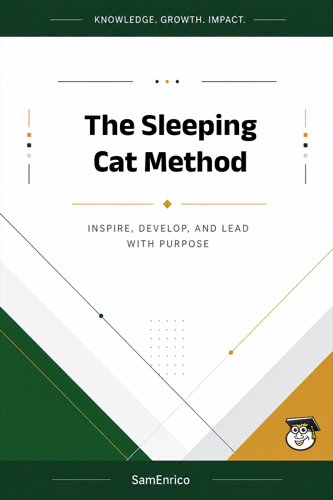
The Sleeping Cat Method eBook
Visualizes a resting cat for mimicking complete re
Visualizes a resting cat for mimicking complete relaxation.
Formats
Free sample
Chapter 1: Why Tension Became Virtue--–It was 2:17 AM, and I was lying on my bathroom floor.Not because I had fallen. Not because I was sick. Not because anything dramatic had happened. I had simply run out of places to hide. My children were asleep.
My partner had given up on me hours ago. And I had spent the previous four hours “relaxing” on the couch—scrolling, watching, snacking, scrolling some more—only to find my heart still racing, my jaw still clenched, and my mind still trapped in a loop of everything I hadn’t done, everything I had done wrong, and everything that was about to go wrong tomorrow.My Apple Watch, that smug little judge on my wrist, showed a resting heart rate of 98 beats per minute.Ninety-eight. While I was lying down.That was the moment I looked across the hallway into the bedroom and saw Miso, my tabby cat, curled into a perfect spiral on the cool tile floor. She had been there for six hours. Her breathing was so slow I had to watch for ten seconds to see her sides move.
When I finally crawled over and pressed my palm against her ribcage, I counted her heart rate: barely sixty beats per minute. While awake and hunting, a cat’s heart can hit 140. But at rest? At rest, her body knew something mine had forgotten.My cat was more than twice as relaxed as me, and she had never read a self-help book. She had never downloaded a meditation app.
She had never attended a yoga retreat, journaled her feelings, or tried a breathing technique she found on Instagram. She simply… stopped. And her body did the rest.That night, I made a decision that would change everything. Not to try harder. Not to find the perfect relaxation technique.
But to stop trying altogether. To learn, instead, from a creature who had mastered the art of doing nothing at all.This book is the result of that decision.The Great Lie of Modern Relaxation Let me tell you something that will sound counterintuitive, maybe even offensive: you do not have a relaxation problem. You have a trying-to-relax problem.Everywhere we look, we are told that relaxation is a skill to be acquired, a goal to be achieved, a box to be checked. We buy weighted blankets. We schedule “self-care Sundays.” We set reminders to meditate.
We spend actual money on apps that promise to teach us how to breathe. And then, when we lie down and still feel tense, we conclude that we are broken. That we are “bad at relaxing.” That something is fundamentally wrong with us.But here is the truth the multi-billion-dollar wellness industry will never tell you: relaxation is not a task you accomplish. It is a state you allow.You cannot “achieve” calm any more than you can achieve a sunset. You can drive to the beach.
You can face west. You can sit in a chair and watch the sky. Those are actions. But the sunset itself? The actual event of the sun dropping below the horizon?
That happens on its own, according to laws you did not write and cannot control. Your job is simply to create the conditions and then get out of the way.This is what cats understand instinctively. A cat does not “do” relaxation. A cat is relaxed. The distinction is everything.I have spent years studying the research on stress, relaxation, and the nervous system.
I have read Herbert Benson’s foundational work on the relaxation response. I have followed the research on heart rate variability, vagus nerve stimulation, and neuroplasticity. And the single most consistent finding across all of this research is this: the effort to relax is the enemy of relaxation.When you try to relax, your brain interprets the effort as a task. Tasks require focus. Focus requires activation.
Activation requires the sympathetic nervous system—the very system you are trying to quiet. You are literally fighting yourself. No wonder it never works.Resting vs. Relaxing: A Crucial Distinction Before we go any further, I need to clear up a confusion that trips up almost everyone who picks up a book like this. Most people believe that resting and relaxing are the same thing.
They are not. And confusing the two is why you can spend all weekend on the couch and still feel exhausted on Monday.Resting is what you do when you stop moving. You lie down. You sit in a chair. You watch television.
You scroll your phone. Your body is still, but your nervous system? Your nervous system may still be running at full speed. Studies using heart rate variability monitoring have shown that watching a suspenseful show or scrolling through social media keeps the brain in low-level Beta activity—the same frequency associated with active thinking and mild anxiety. You are not recovering.
You are just lying down while your brain continues to spin.Relaxing, by contrast, is a measurable physiological shift. Your parasympathetic nervous system—the “rest and digest” branch—takes over from the sympathetic “fight or flight” branch. Your heart rate slows. Your blood pressure drops. Your digestion activates.
Your muscles release their chronic, low-grade grip. This is not a feeling. It is a biological event. And it cannot be forced.Think of it this way: resting is the absence of movement. Relaxing is the presence of a specific neurological state.
One is passive. The other is an active surrender.Miso, my cat, understood this perfectly. When she slept, she did not simply stop moving. Her whole body changed. Her jaw went slack.
Her limbs became heavy and limp. Her breathing slowed to a rhythm that would worry a human doctor. She did not achieve this state through effort. She allowed it to overtake her.Most humans do the opposite. We lie down with the intention of relaxing, but we bring our tension with us.
We clench our jaws without noticing. We hold our shoulders up toward our ears. We keep one foot ready to spring back into action. We are not surrendering. We are waiting.The Monkey Mind and the Sleeping Cat There is a concept in Buddhist psychology called the “Monkey Mind.” It is the constant, chattering internal voice that swings from branch to branch—from worry to planning to regret to judgment to fear and back again.
It is the voice that narrates your anxiety, rehearses conversations that will never happen, and reminds you of that embarrassing thing you said seven years ago.The Monkey Mind is not your enemy. It is a survival mechanism, evolved to keep you alert to threats. In ancestral environments, the Monkey Mind kept you alive. That rustle in the bushes? Could be a predator.
The Monkey Mind made you notice. That person who looked at you funny? Could be a rival. The Monkey Mind made you prepare.But in the modern world, where there are no predators hiding in the bushes and your rivals are mostly people you haven’t thought about in years, the Monkey Mind has become a tyrant. It generates threats where none exist.
It mistakes a mildly critical email for a life-or-death danger. It keeps your nervous system in a state of low-grade…
This is the end of the free sample. Get the eBook to keep going. Buy now
About this book
Details
- Author
- Ervin Phillis
- Publisher
- SamEnrico
- Language
- English
- Genre
- Non-Fiction, Self-Help, Animal
- Released
- 2026-06-09
- Pages (approx.)
- 136
- Available as
- eBook, Audiobook

Read better in the ZLOADR app
Your eBooks on your phone or tablet. Sign in with your SamEnrico account and start reading.
More by Ervin Phillis
 Bring Along ProvisionErvin Phillis$11.99
 Micronutrients For Gut Health GuideErvin Phillis$11.99
 Metaphor Library for ScriptsErvin Phillis$11.99
 Pet Loss For ExpatriatesErvin Phillis$11.99
 The Bomb Squad Technician StressErvin Phillis$11.99
 Pelvic Pain Release ExercisesErvin Phillis$11.99
 Time Blocking For Holiday PrepErvin Phillis$11.99
 BossypantsErvin Phillis$11.99
 The Lioness of Dahomey: A Warrior Queen's Unyielding ReignErvin Phillis$11.99
 The Last Unknown River: Mapping the Amazon’s Hidden HeartErvin Phillis$11.99
 Shadow Votes: The 2000 Florida Ballot ScandalErvin Phillis$11.99
 Growing WikstroemiaErvin Phillis$11.99
You may also like
 Hong Kong Handover 1997Dunn Johnnie$11.99
 Zumba For Postnatal Recovery CourseNeal Christian$11.99
 Zumba for BeginnersLadner Nikia$11.99
 YouTube Comment Mining GuideHumes Pandora$12.99
 Worry Box MeditationCarlin Rudy$11.99
 Workplace Stress MeditationNguyen Lynn$11.99
 Workplace Stress and Sleep RepairHawley Ivory$11.99
 Workplace Perfectionism CureDelaney Jeffry$11.99
 Workplace Injustice Anger GuideWallen Isabelle$11.99
 Work Addiction and Burnout LinkGreenwood Ester$11.99
 Women in Yoga and WellnessBeattie Galina$11.99
 Women in Stand Up ComedyChun Evangeline$11.99